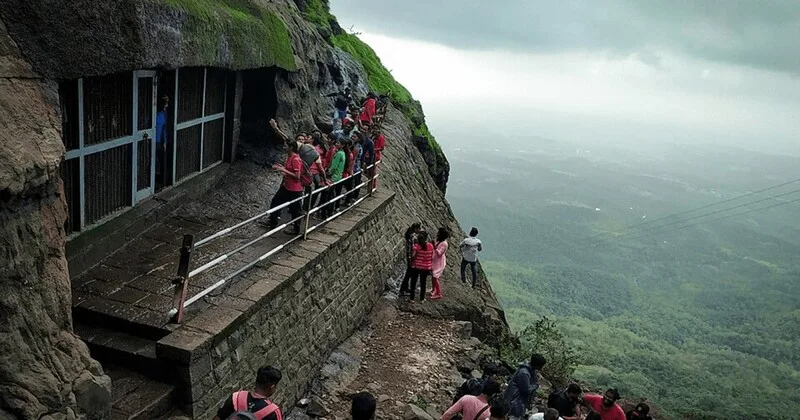
Junnar: Over the past year, at least eight instances of illegal construction, including hotels, eateries and residential houses, have been reported within the protected zones surrounding the sensitive archaeological sites of Naneghat rock-cut caves and Shivneri Fort in Junnar taluka of Pune district. Officials of the Archaeological Survey of India (ASI) have registered criminal cases in these matters and initiated proceedings for the demolition of the unauthorised structures.
Junnar taluka is home to several historically significant monuments spanning different eras. Among them, the Naneghat rock-cut caves, Shivneri Fort, and Lenyadri Caves fall under the protection of the ASI.
The Naneghat caves, which date back to the 1st century BCE, are renowned for their early Brahmi inscriptions that shed light on the Satavahana dynasty and ancient trade routes. Archaeologists consider them vital for understanding the region’s role as a key corridor linking the Deccan plateau with the western coast. Shivneri Fort is equally significant for its ancient fortifications, water management systems and structural remains, reflecting multiple phases of occupation from early historic to medieval times. Excavations and architectural studies at the site offer valuable insights into Deccan military architecture and settlement patterns. The fort also holds immense historical importance as the birthplace of Chhatrapati Shivaji, founder of the Maratha Empire.
The Lenyadri caves form part of a larger Buddhist rock-cut complex and are noted for their chaityas and viharas carved into the hillside.
Protected zones and legal framework
According to officials, each of these monuments has a clearly demarcated protected zone where construction activity is strictly prohibited. A 100-metre radius from the protected limits is designated as a prohibited area, where no new construction is allowed under any circumstances. Only structures that existed prior to 1992 may undertake repairs, and that too with prior approval from the competent ASI authority. Beyond this lies a 200-metre regulated zone, where construction is permitted only after securing due clearance. Proposals in this area must be submitted to the National Monuments Authority, and any building activity can commence only after formal approval is granted.
Kiran Awachar, in charge of Junnar Police Station, said that multiple FIRs have been registered over the past year based on complaints filed by ASI officials. “Investigation into these cases is underway,” he said.
A review of cases at the police station shows that three FIRs pertain to illegal constructions near the Naneghat rock-cut caves, while five others relate to unauthorised structures within the prohibited zone of Shivneri Fort. All the cases have been registered under the Ancient Monuments and Archaeological Sites and Remains Act.
Structural risks and irreversible damage concerns
An ASI officer said the constructions were carried out either within prohibited areas or in regulated zones without mandatory approvals. “Two of the structures are houses built as tin sheds. Some were erected to run illegal eateries, while two are linked to unauthorised hotel constructions. Such activities not only obstruct the visual integrity of these protected monuments but also pose serious structural risks. Since these sites are located on hills, construction on slopes can trigger landslides and cause significant damage,” the officer said.
The officer further warned that unauthorised construction can severely disturb archaeological layers in and around the monuments, leading to irreversible harm. “Once the integrity of a protected site is compromised, restoration becomes nearly impossible. We are committed to taking strict action to safeguard these nationally protected monuments for future generations. Our process begins with issuing notices to violators, followed by the registration of criminal cases and prosecution. After communication from the ASI headquarters, the district collector is empowered to carry out demolition of the illegal structures,” the officer added.