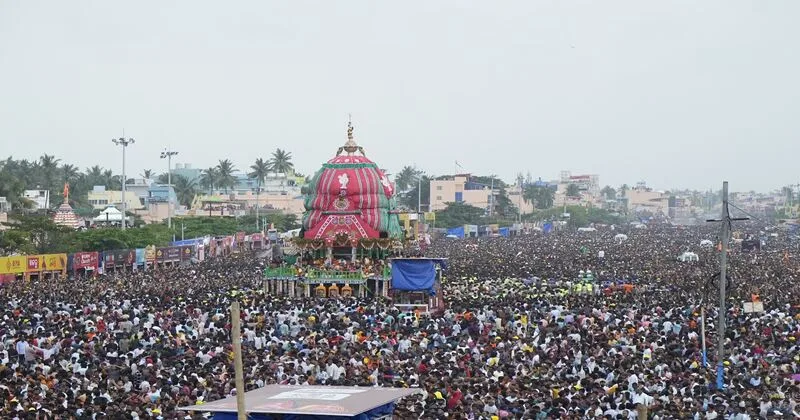
With prayers and faith, the world’s biggest religious gathering witnessed the divine journey of the Chaturdha Murti to the Shree Gundicha Temple and their return to the Shree Mandir. Along the way, millions of devotees from across the world had the opportunity to receive their sacred darshan. As this grand spiritual journey comes to an end, it leaves every devotee with cherished memories, deep faith, and the blessings of Mahaprabhu Jagannath.
The towering chariots now stand still. The chants of “Jai Jagannath” have faded into the sea breeze. The Grand Road (Bada Danda), once overflowing with millions of devotees is slowly returning to the normal pace of visitors and locals.
For millions, Rath Yatra is not merely a festival; it is an emotion, a spiritual calling, and a once-in-a-lifetime experience. Every devotee who walks the Bada Danda comes seeking something beyond rituals a moment of divine peace amidst unimaginable chaos.
They come. They pray. They cry. They pull the chariots. They return home carrying memories that remain etched in their hearts forever.
But when the devotees leave, another story quietly remains behind.
It is the story of those who never got the opportunity to look up at the magnificent chariots for long because they were busy ensuring that everyone else could.
Rath Yatra 2026 was unlike any other.
Heavy rainfall lashed Puri before and during major rituals, with the devotees increasing at a larger speed.
Rainwater submerged parking areas, waterlogging appeared across the city, and every passing hour posed a fresh challenge. Yet, the festival continued without losing its rhythm because of the unwavering hands relentlessly working behind the scenes.
At the centre of this massive operation was the Puri district administration under the leadership of Collector Dibyajyoti Parida. Guided by the vision of Chief Minister Mohan Charan Majhi and closely monitored at the highest administrative level by Chief Secretary, what unfolded was not merely administrative efficiency but an extraordinary display of coordination, commitment, and collective responsibility.
More than twenty-five departments functioned as one unified team. Preparations had begun months in advance through multiple review meetings, action plans, and continuous monitoring. A Core Team was constituted, senior officers were deployed, and for the first time, 23 Officers on Special Duty, 162 Executive Magistrates, an Integrated Command and Control Centre, wireless communication systems, and inter-departmental digital coordination ensured that every challenge received an immediate response.
While devotees witnessed devotion, thousands witnessed duty.
When rain flooded streets, sanitation workers stepped into ankle-deep water wearing raincoats, clearing drains and removing garbage through the night. Nearly 1,600 sanitation workers worked in shifts, removing around 2,500 tonnes of waste while restoring nearly 160 kilometres of roads. Even after the heavy rainfall, major roads were cleared within minutes through continuous dewatering operations using dozens of pumps and emergency equipment.
When devotees felt thirsty, they quenched their thirst drinking water instead of searching. More than 68 million litres of safe drinking water were supplied through hundreds of water kiosks, water ATMs, tankers, and continuous sprinkling systems spread across the city.
When fatigue, dehydration, or illness struck, medical teams stood ready long before the emergency occurred. Eighty-two medical camps, fifteen temporary hospitals, eighty-two ambulances, and hundreds of doctors, nurses, paramedics, and volunteers remained on constant tv alert. More than 63,000 patients received treatment, while emergency response teams reached people within an average of just one and a half to two minutes. The compassion extended beyond healthcare.
Over 150 voluntary organisations and nearly 5,000 food volunteers ensured that no pilgrim went hungry, while hundreds of volunteers distributed drinking water across the festival route.
Despite the enormous challenge of managing waste generated by free food distribution among massive crowds, sanitation teams continued their work without pause.
Even nature seemed determined to test the administration. Puri experienced rainfall on 19 days during the festival period against the normal 11.8 rainy days, with the town itself recording nearly 650 mm of rainfall. Yet the spirit of the festival remained unbroken because preparedness and blessings of Mahaprabhu to overcome adversity.
Perhaps that is the true spirit of Rath Yatra.
Not only the devotion of millions who come to seek blessings, but also the silent dedication of thousands who serve without expecting recognition highlights the Rath Yatra 2026.
As the Bada Danda slowly returns to its everyday rhythm, the echoes that remain are not just of sankirtan and devotional chants. They are also the echoes of countless footsteps taken by sanitation workers before sunrise, doctors who skipped sleep, police personnel who stood for endless hours, disaster response team battling flooded roads, volunteers distributing food, and officials staying alert 24×7 hours, taking decisions every minute so that millions could experience a safe and unforgettable spiritual experience.
Every successful Rath Yatra is remembered for the divine darshan.
But behind every successful Rath Yatra lies an unseen journey of sacrifice, service, resilience, and teamwork.
Long after the devotees have gone home, that silent story continues to live in the hearts of those who made the impossible look effortless.