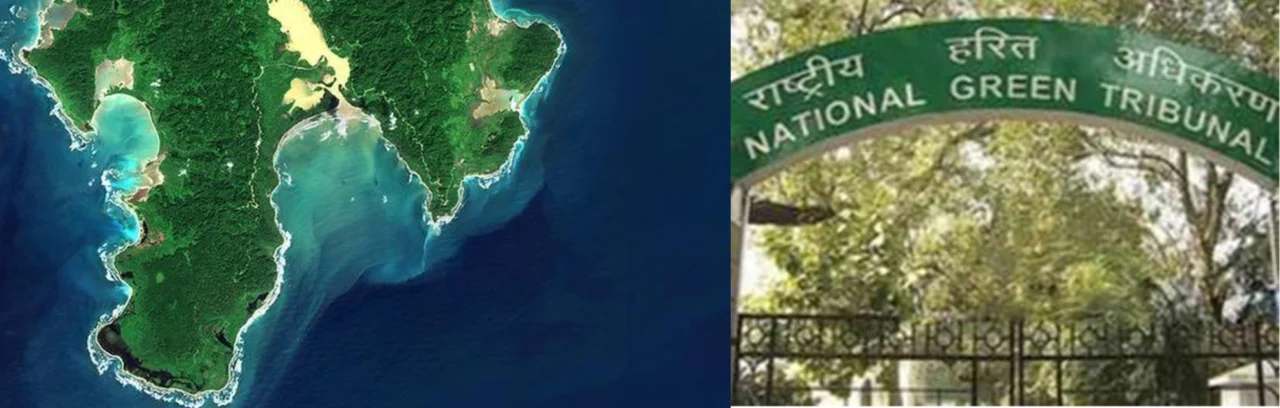
A six-member National Green Tribunal (NGT) special bench ruled on February 16 that it did not find “any good ground” to interfere in the environmental clearance accorded to the Rs 81,000-crore Great Nicobar mega infrastructure project as there were “adequate safeguards” in the project’s environmental clearance. The bench, headed by NGT chairperson Justice Prakash Shrivastava, also noted the “strategic importance of the project” and the issues that were dealt with by a high-powered committee (HPC) tasked with revisiting the project’s environmental clearance, as per a 2023 order of the NGT.
The recent decision of the National Green Tribunal (NGT) to uphold the environmental clearance granted to the Great Nicobar Mega Infrastructure Project is not merely a judicial order; it is a reaffirmation of India’s strategic intent. After detailed scrutiny of environmental impact assessments, forest clearances, and regulatory safeguards, the Tribunal found no substantive grounds to interfere. Yet, despite institutional validation, the project continues to face organised political resistance, particularly from the Indian National Congress and its ideological allies.
The controversy surrounding Great Nicobar is not simply about ecology. It is about whether India will assert its maritime destiny or allow political obstructionism to stall strategic infrastructure under the rhetoric of environmental absolutism.
The Great Nicobar Mega Infrastructure Project, with an estimated investment of approximately ₹81,000 crore, envisions a deep-draft International Container Transhipment Terminal (ICTT), a dual-use international airport, a power plant, and an integrated township. Its location near the Malacca Strait gives it extraordinary strategic relevance. A substantial portion of global trade passes through this narrow sea corridor. For India, positioned at the crossroads of the Indian Ocean, this geography is not incidental; it is foundational.
Currently, a significant share of India’s cargo is transshipped through foreign ports such as Singapore and Colombo. This dependence leads to revenue leakage and logistical vulnerability.
Establishing a domestic transhipment hub in Great Nicobar would not only strengthen economic sovereignty but also reduce strategic dependence. For a nation aspiring to be a leading maritime and manufacturing power, control over logistics infrastructure is a matter of national interest.
In the larger Indo-Pacific context, where maritime competition is intensifying, infrastructure equals influence. Ports and airstrips are not merely economic installations; they are strategic assets. Strengthening Great Nicobar enhances India’s surveillance capacity, defence readiness, and regional presence. It strengthens the Andaman and Nicobar Command and secures India’s eastern maritime frontier.
Critics have raised concerns about ecological fragility, biodiversity, and tribal rights. These concerns, in principle, merit consideration. Great Nicobar hosts rainforests, mangroves, coral ecosystems, and endemic species.
However, what is often omitted in political rhetoric is that the project underwent regulatory scrutiny under established environmental frameworks.
The National Green Tribunal examined the environmental clearance, expert committee reports, and compliance with Island Coastal Regulation Zone norms before upholding the approval. Conditions relating to shoreline protection, wildlife management, and monitoring mechanisms were incorporated.
The Tribunal did not dismiss environmental concerns; it evaluated them and concluded that adequate safeguards were in place within the legal framework.
This judicial endorsement is significant. It demonstrates that the project was not arbitrarily cleared but subjected to statutory oversight.
Despite this, sections of the Indian National Congress, led by figures such as Jairam Ramesh, have sharply criticised the project. The Congress narrative frames the initiative as environmentally reckless and procedurally flawed.
However, a pattern emerges when one examines the party’s historical posture on major infrastructure projects. Whether it is large dams, industrial corridors, mining projects, or defence installations, development initiatives frequently encounter resistance from the same political and activist networks. Environmentalism, in these instances, often becomes a convenient instrument for halting projects rather than improving them.
There is a difference between environmental vigilance and environmental veto. Vigilance seeks stronger safeguards; veto seeks stoppage. The rhetoric surrounding Great Nicobar, particularly from Congress and its aligned groups, appears closer to the latter. By amplifying worst-case scenarios and disregarding institutional clearance, the opposition risks creating a climate where no strategic infrastructure can move forward without endless litigation and agitation.
Such obstructionism has long-term consequences. Strategic delays weaken India’s maritime positioning. Economic opportunities shift elsewhere. Infrastructure gaps widen. In a competitive Indo-Pacific environment, hesitation carries costs.
India’s environmental jurisprudence is among the most evolved in the developing world. The country has statutory impact assessments, judicial review mechanisms, and public participation frameworks. The answer to environmental risk cannot be developmental paralysis. Globally, advanced nations have demonstrated that ecological protection and infrastructure expansion can coexist through technology, adaptive management, and stringent monitoring. To argue that strategic development in Great Nicobar must be abandoned altogether is to suggest that frontier regions should remain perpetually underdeveloped, regardless of national interest.
The Andaman and Nicobar Islands are not remote outposts disconnected from India’s future. They are strategic sentinels. Integrating them through infrastructure strengthens disaster response, economic opportunity, and national cohesion. It ensures that remote territories are not strategically neglected.
The Indo-Pacific is witnessing intensified maritime competition. Sea lanes are lifelines of global commerce. Nations are investing heavily in ports, logistics corridors, and naval infrastructure. In this environment, India’s hesitation would not preserve equilibrium; it would concede ground.
The Great Nicobar project must therefore be understood as part of a long-term maritime doctrine, one that recognises the Indian Ocean as central to India’s security and prosperity. It is not a short-term political announcement but a generational investment.
The debate over Great Nicobar ultimately tests India’s resolve. Can the nation pursue strategic infrastructure while maintaining ecological safeguards? Or will political opposition, couched in environmental rhetoric, stall critical projects indefinitely?
The National Green Tribunal has spoken within the bounds of law. Safeguards have been mandated. Oversight mechanisms exist. Constructive engagement should focus on strengthening compliance rather than blocking progress.
If India is to emerge as a decisive maritime power, it must move beyond reflexive obstructionism. Environmental responsibility is essential but so is strategic foresight. The Great Nicobar Mega Infrastructure Project represents the convergence of both.
In the final analysis, the question is not whether development should occur, but whether India has the confidence to execute it responsibly despite political resistance. Great Nicobar is not merely an island project. It is a measure of India’s strategic maturity.