Why does Sri Krishna speak of “Sarva dharmān parityajya mām ekaṁ śaraṇaṁ vraja” only in the 18th chapter?
The confusion arises because Dharma is often mistaken for religion. In the Bhagavad Gita, Dharma means duty. A father’s duty toward his son is his dharma, and vice versa. Sri Krishna uses the word ‘parityajya,’ not ‘tyaga’. Parityajya means setting aside after completion, not abandonment. A duty is relinquished only once it is fulfilled—just as one does not reappear for an examination after passing it. If one fails, it must be repeated. Life is similar. One must fulfil all duties. Only after completing them does surrender become meaningful. Action lies within our control; accepting its result as prasad is the secret of a joyful life. That is why this verse appears only in the final chapter. Had such a stage been reached earlier, there would have been no need for the Bhagavad Gita.
Since Sri Krishna asked Arjuna to fight, does that mean violence is also a form of Dharma?
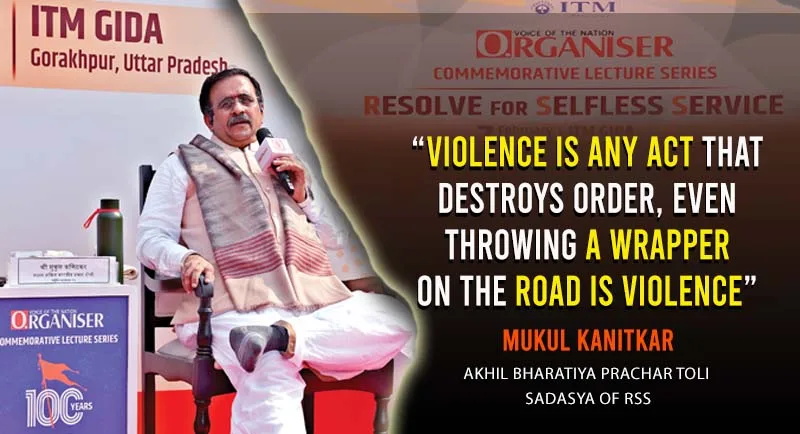
The Gita addresses this from the second chapter itself through the concept of dharmya-yuddha—war for establishing Dharma. When war is forced upon you, avoidance is not an option. Initiating aggression is violence, but fleeing when attacked is also violence. Violence is any act that destroys order. Even throwing a wrapper on the road is violence, while placing it in a dustbin is non-violent.
Duryodhana disrupted the order. The Pandavas made every possible effort to avoid war; Sri Krishna himself asked for just five villages. When all attempts failed and war became inevitable, withdrawal would not have been renunciation but cowardice. Bharat follows this principle even today—never initiating aggression, but responding firmly when provoked. Restraining those who threaten order is also non-violence.
Dharma means giving and politeness. War seems aggressive. Why does Krishna inspire to fight?
There is no contradiction. War is not aggression; aggression is aakraman (attack). Yuddha comes from yodhana, linked to organisation and restoration of order. War corrects disorder. Just as water flows and fire burns, every entity has its Dharma. Polluting a river is aggression; cleaning it is not.
Similarly, the struggle to remove corruption and distortion in society is restoration, not violence. Bharat regards the Earth as mother. When creation is polluted—materially or morally—a struggle is necessary. Even reading one verse of the Gita daily is part of this struggle. War, therefore, is defence, not aggression.
Sri Krishna is often accused of using chhal (deception). Does this justify deception in life?
Such views arise from careless reading and popular myths. Sri Krishna never deceived anyone. Chhal implies exploiting the innocent, which Krishna never did. Bhishma himself declared he would not fight if Shikhandi stood before him; there was no deceit.
The story of Krishna creating artificial darkness to kill Jayadratha does not exist in the authentic Mahabharat; it was a real solar eclipse calculated in advance. Krishna used situational awareness. When Karna’s chariot wheel sank, Krishna reminded him of his own actions against Abhimanyu and Draupadi. Punishing wrongdoing is not deception. Krishna never acted for personal gain. He even accepted the label Ran-chhod-das to protect the people of Mathura from Jarasandha. His approach was practical wisdom: do not exploit the innocent, do not be naïve, and choose the duty that serves the greater good.
If I understand body, mind, and intellect as objects, why can’t I apply this knowledge in life?
How does one swim? Swimming is based on physics. You may explain buoyancy perfectly, but that does not guarantee you can swim. Swimming requires practice. Sri Krishna says the same: abhyāsena tu kaunteya vairāgyena cha gṛhyate. Knowledge becomes conduct only through practice. Practice matters more than principles. The one principle you practise will save you in life. That is why Shakha is important—it is practice. Principles are implemented only through practice.
Does Karma Yoga contradict modern management, which focuses on results?
The contradiction arises from mistranslation. The word adhikāra does not mean “right” but qualification or competence. Sri Krishna says you are competent to act, but the result is influenced by many factors beyond you.
This is exactly what modern management teaches today: focus on the process, and results will follow. Total Quality Management reflects this principle precisely. The Gita is not opposed to efficiency; it is ahead of modern management thought. When practised, efficiency naturally increases.
What is the stand of the RSS on secularism and socialism in the Constitution?
The Constitution is panth-nirpeksha, not dharma-nirpeksha. Panth means path; dharma means duty. A Constitution cannot be neutral towards duty—that is why it emphasises fundamental duties.
This idea comes from the Gita. People approach the Divine through different paths, but the truth is one. Accepting multiple paths is secularism; denying others’ paths is not. The Constitution echoes the ancient idea: Ekam sat, viprah bahudhā vadanti.
As for socialism, Bharat rejects extreme individualism. Our ideal is Sarve bhavantu sukhinah—the welfare of all. Dr B R Ambedkar clarified that fraternity in the Constitution arises from the compassion taught by Bhagwan Buddha. When Bharat is truly regarded as mother, fraternity and harmony follow naturally. RSS considers that this is the spirit of both the Bhagavad Gita and the Indian Constitution.