
“Twenty-five years ago, the government of Atal Bihari Vajpayee handed over the Chhattisgarh of your dreams to you, along with a resolve that the state would reach new heights of development. …The seed that was sown twenty-five years ago has now grown into a flourishing tree of development. Chhattisgarh is rapidly advancing on the path of progress” –PM Narendra Modi, while participating in the Silver Jubilee celebrations of Chhattisgarh on November 1, 2025
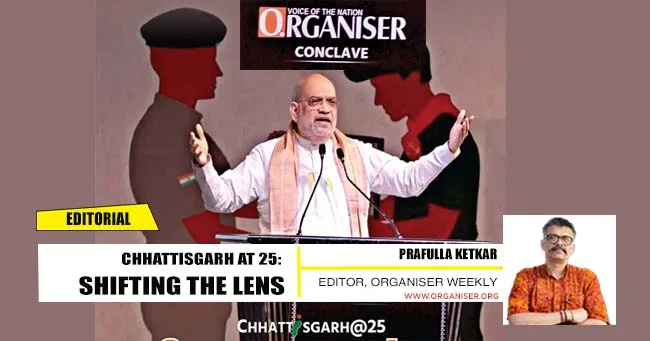
As Chhattisgarh completes 25 years of its formation, the State stands at a defining moment – emerging from decades of Maoist violence to a phase of confidence, development, and expanding opportunities. To mark this historic milestone, Organiser Weekly decided to host a high-level national conclave in Raipur titled Chhattisgarh@25: Shifting The Lens, which was graced by Union Home Minister Amit Shah and Chhattisgarh Chief Minister Vishnu Deo Sai, along with other expert panellists. The journey of Chhattisgarh changing the trajectory from victimhood to victory hood is truly commendable – hence shifting the lens. One needs to know how did this lens shift in a State that was created with ‘backwardness’ narrative and known to be the hub of Red Terror.
Chhattisgarh, a resource-rich State, always had the potential, with high forest cover and mineral resources to make valuable contribution in the development of Bharat. Though efforts were underway, a large area of Dandakaranya, especially the Bastar-Dantewada region, was under the control of the Maoists. The Union Government under the Congress-led UPA regime viewed the problem mainly through the prism of development deficit. Even when the security forces had the upper hand, the Government used to buckle down under the pressure for dialogue, giving an opportunity to the Maoists to regroup and rearm using the local Scheduled Tribe communities as cannon fodder to meet their political ends. However, of late there has been an impeccable Centre-State and inter-State coordination with a clear call to the Maoists – either surrender or perish. This is exactly where the fundamental lens of security has changed.
The development paradigm has also undergone a significant transformation in the last few years. The districts that were considered backwards became aspirational. They were incentivised to perform better. The inclusive approach, with women as the key drivers and the traditional skills of the Scheduled Tribes as a source of wealth creation, has a bottom-up approach to make development more vibrant and people-centric is another important dimension of this lens shift.
The societal role is critical in the transition process for a newly carved out state. The social participation, beyond the Maoist-funded or terrorised NGOs, has incredibly improved in delivering governance on the ground.The result of the shift in lens is clearly visible on the ground owing to the constructive role that is being played by the think tanks, policy analysts and educational institutions, social organisations and a paradigm shift in the policy. Now, the State is aspiring to be a technology hub, with the first AI-based Data Centre Park in Nava Raipur, and educational institutions documenting traditional healing and metallurgical practices to monetise them; another important dimension is to introduce a bifocal lens for participatory governance.
In 2023, an important book was written by an Australian scholar about the indigenous communities colonised by Europeans. The author Lorraine Muller, in her book Indigenous Research into Mainstream Australian Culture: Shifting the Lens, explores how indigenous values influence, and can improve, non-Indigenous Australian culture. The colonial laws and exploitation of resources have been the real concern for the Scheduled Tribes across the globe. In the Bharatiya context, they were the ones who never accepted the British rule. Deceitful conversion and forced exploitation were the tools used by the colonisers. Later, Maoists used these sentiments to occupy the strategic space in Dandakaranya.
As Chhattisgarh, along with many forest regions of Bharat, is getting free from the fake narratives of Naxalism, with a shift from contaminated lenses, we collectively have a greater responsibility to strengthen the process of integration. Learning from the true Bharatiya traditions, forest-dwelling communities that preserved our culture can help us decolonise our thought process. Despite the fact that we are heading towards meeting our goal of finishing red terrorism by March 31, 2026, the battle is not fully won since Maoism is being rooted out from the jungles or tribal areas. The real challenge is that now the Maoists are strategically shifting their base to the urban centres, this needs to be addressed at the earliest before it spreads its wings and penetrates our houses. While celebrating the remarkable twenty-five-year journey of Chhattisgarh and the eradication of the Maoist menace in the forests, the real ideological battle is still on, and we have to fight it out collectively at all fronts. That would be the real outcome of shifting the lenses.