Wedded to strategic autonomy: EAM on India's energy choices
June 23, 2026
  • Read Ecopy
  • Circulation
  • Advertise
  • Careers
  • About Us
  • Contact Us
Android AppiPhone AppArattai
Organiser
  • ‌
  • Bharat
    • Assam
    • Bihar
    • Chhattisgarh
    • Jharkhand
    • Maharashtra
    • View All States
  • World
    • Asia
    • Europe
    • North America
    • South America
    • Africa
    • Australia
  • Editorial
  • International
  • Opinion
  • RSS @ 100
  • More
    • Op Sindoor
    • Analysis
    • Sports
    • Defence
    • Politics
    • Business
    • Economy
    • Culture
    • Special Report
    • Sci & Tech
    • Entertainment
    • G20
    • Azadi Ka Amrit Mahotsav
    • Vocal4Local
    • Web Stories
    • Education
    • Employment
    • Books
    • Interviews
    • Travel
    • Law
    • Health
    • Obituary
  • Subscribe
    • Subscribe Print Edition
    • Subscribe Ecopy
    • Read Ecopy
  • ‌
  • Bharat
    • Assam
    • Bihar
    • Chhattisgarh
    • Jharkhand
    • Maharashtra
    • View All States
  • World
    • Asia
    • Europe
    • North America
    • South America
    • Africa
    • Australia
  • Editorial
  • International
  • Opinion
  • RSS @ 100
  • More
    • Op Sindoor
    • Analysis
    • Sports
    • Defence
    • Politics
    • Business
    • Economy
    • Culture
    • Special Report
    • Sci & Tech
    • Entertainment
    • G20
    • Azadi Ka Amrit Mahotsav
    • Vocal4Local
    • Web Stories
    • Education
    • Employment
    • Books
    • Interviews
    • Travel
    • Law
    • Health
    • Obituary
  • Subscribe
    • Subscribe Print Edition
    • Subscribe Ecopy
    • Read Ecopy
Organiser
  • Home
  • Bharat
  • World
  • Operation Sindoor
  • Editorial
  • Analysis
  • Opinion
  • Culture
  • Defence
  • International Edition
  • RSS @ 100
  • Magazine
  • Read Ecopy
Home International Edition India Foreign Policy

“We are very much wedded to strategic autonomy”: EAM Jaishankar on India’s energy choices

Speaking at the Munich Security Conference, External Affairs Minister Dr. S. Jaishankar reiterated that India's energy priorities are rooted in strategic autonomy. While speaking about the change in India's energy purchase calculations in the backdrop of a trade deal with the US, the Minister asserted that New Delhi purchases the oil based on global market dynamics and it is difficult to agree with all the partners on all the issues

WEBDESKWEBDESK
Feb 15, 2026, 10:30 pm IST
in Foreign Policy, Europe, USA, World, India
Follow on Google News
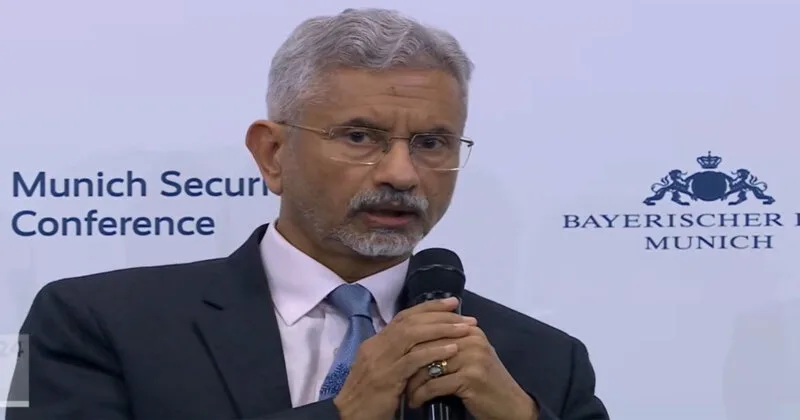
External Affairs Minister Dr. S. Jaishankar at Munich Security Conference

External Affairs Minister Dr. S. Jaishankar at Munich Security Conference

FacebookTwitterWhatsAppTelegramEmail

Munich: External Affairs Minister Dr. S. Jaishankar on February 14, Saturday asserted that India remains firmly committed to strategic autonomy, even as the global energy markets evolve and partnerships shift, amid a question over whether a recent trade agreement with the United States would affect New Delhi’s energy ties with Russia. Speaking at the Munich Security Conference, EAM Jaishankar was asked whether the new trade agreement with the US would compel India to reduce its reliance on Russian oil, potentially impacting its strategic autonomy.

“We are very much wedded to strategic autonomy because it’s very much a part of our history and our evolution. It’s something which is very deep and it’s something which cuts across the political spectrum as well”, he said. Addressing concerns over energy sourcing, the minister described the global oil market as complex and dynamic, stressing that commercial considerations guide procurement decisions. “As for energy issues, this is a complex market today. Oil companies in India, as in Europe, as probably in other parts of the world, look at availability, look at costs, look at risks and take the decisions that they feel are in their best interest”, he noted.

EAM Jaishankar said that in a rapidly changing global environment, countries continuously reassess their calculations and partnerships. “So many things are changing and so many of us are doing our calculations and recalculations”, he said, adding that while India may not agree with all partners on every issue, however, dialogue and a willingness are vital to find common ground remain important. “We would not necessarily agree on everything, but I do believe that by doing that, and if there is an inclination to find common ground and overlaps, that would happen”, he said.

Emphasising India’s independent decision-making, EAM Jaishankar concluded, “If the bottom line of your question is, would I remain independent-minded and make my decisions? And would I make choices which sometimes may not agree with your thinking or somebody else’s thinking, yes, it can happen”.

EAM Jaishankar asserted India’s support for UN80 agenda

External Affairs Minister S. Jaishankar on February 14 met with G7 Foreign Ministers and their global counterparts at the Munich Security Conference 2026, reiterating India’s support for the UN80 agenda and underscoring New Delhi’s role in safeguarding global security. He also emphasised India’s role in safeguarding the sea lines of communication, acting as a first responder in crises, strengthening port security and contributing to resilient submarine cable infrastructure.

Earlier, on February 9, Foreign Secretary Vikram Misri said that “national interest” would continue to guide India’s energy-related decisions, underlining that the key drivers of the country’s energy policy are “adequate availability, fair pricing and reliability of supply”, amid reports suggesting New Delhi is cutting its oil imports from Russia. Speaking during a Special Briefing by the Ministry of External Affairs (MEA) here, Misri stated that decisions in the energy sector, whether by the government or businesses, would be guided by national interests, while clarifying the issue of actual sourcing.

Misri clarified that oil companies make procurement decisions based on market conditions, including availability, risk assessment, costs and logistics, while adhering to internal accountability and fiduciary responsibilities. “As far as the actual sourcing of energy is concerned, this is undertaken by oil companies, which make decisions based on market conditions. They assess availability, evaluate risks, analyse costs and follow their internal accountability processes and fiduciary responsibilities. At any given time, there is a complex matrix of considerations, including financial and logistical aspects, that these companies must take into account,” he stated.

“What you will continue to see in this sector are business choices being made based on these considerations. Whether it is the government or businesses, national interest will continue to guide our choices”, he added. Misri noted India is a net importer in the oil and gas sector and as a developing economy, must remain conscious of its resource availability and the impact of import dependence on inflation. He added that safeguarding the interests of Indian consumers remains a top priority for the government.

Also Read: Pujaniya Shri Guruji Puraskar 2026 | Individual experiments must transform into societal change: Atul Limaye

Highlighting the volatility in global energy markets in recent years, the Foreign Secretary said that India, along with many other countries, shares a common interest in stable energy prices and a stable supply, noting India’s role as a stabilising factor in global energy markets. Misri emphasised that India does not depend on a single source for its crude oil imports and instead sources energy from dozens of countries.
He also noted that the mix of import sources naturally varies with market conditions.

“The key drivers of our energy policy are adequate availability, fair pricing and reliability of supply. If you look at the data, we import crude from dozens of countries. We do not depend on a single source, nor do we intend to. It is natural for the mix of sources to vary over time depending on market conditions. Our objective is to maintain multiple sources and diversify them to ensure stability. The more diversified we are in this area, the more secure we are”, the Foreign Secretary stated.

(With Inputs from ANI)
Topics: Munich Security ConferenceOil PurchaseRussiaIndiaUSAExternal Affairs Minister Dr S Jaishankar
ShareTweetSendShareSend
✮ Subscribe Organiser YouTube Channel. ✮
✮ Join Organiser's WhatsApp channel for Nationalist views beyond the news. ✮
Previous News

Defence Ministers of India and France to co-chair 6th Annual Defence Dialogue in Bengaluru

Next News

AI Impact Summit 2026 begins in New Delhi: India signals global leadership ambition in the age of AI 

Related News

UAE President Sheikh Mohamed bin Zayed Al Nahyan and Prime Minister Narendra Modi(File Photo)

UAE to buy BrahMos & Akashteer: Big win for India’s defence ecosystem to seal regional security amid West Asia crisis

United States Trade Representative Jamieson Greer and Union Commerce and Industry Minister Piyush Goyal

India-US Trade Agreement: Historic deal enters final stretch as USTR Jamieson Greer heads to New Delhi

Universities Adopt ‘Bharat’ on Degrees and Certificates

Madhya Pradesh: ‘Bharat’ replaces ‘India’ on degrees as academic institutions reclaim ancient identity

Representative Image

Europe’s Supremacy: A manufactured narrative imposed via colonial power is counterd by India’s civilizational memory

Yoga Day celebrations in Shanghai, China

International Yoga Day: Global celebrations echo the message of health, well-being and timeless ancient Indian wisdom

The Alchemy of Autarky: How India rewrote its economic destiny

Load More

Latest News

Bareilly Cantonment Emerges as Model for Sustainable Urban Development in India (Image Source X)

Uttar Pradesh: Bareilly Cantonment becomes India’s first carbon-negative cantonment

CM Yogi Adityanath making industry, investment and the connectivity revolution in Eastern Uttar Pradesh

The Purvanchal Growth Story: How industry, infrastructure, tourism & exports are fueling development in eastern UP

(Left) Fire at the coaching centre in Lucknow (Right) Members of ABVP extending all possible help

Lucknow Coaching Centre Fire tragedy is heartbreaking and deeply unfortunate: ABVP seeks action against culprits

Andhra Pradesh Minister and TDP National General Secretary Nara Lokesh

Nara Lokesh dismisses rumours of TDP sabotaging Modi government, reaffirms unconditional NDA support

With new military deployments, export opportunities and potential Russian production, BrahMos is entering a new era of strategic relevance

BrahMos enters high-volume production as military demand and global export orders surge

Dr Mahrang Baloch

Pakistan: Mahrang Baloch gets life sentence, Balochistan erupts in protest; BYC calls for shutdown

Prime Minister Narendra Modi

‘Maoism is breathing its last’: PM Modi highlights crackdown on red terror in last 12 years and growth in tribal areas

(Left) Dr Shyama Prasad Mookerjee (Right) West Bengal CM Suvendu Adhikari

Syama Prasad Mookerjee was instrumental in creation of West Bengal’: CM Suvendu Adhikari

Female recruitment in Jihadist networks emerges as major security concern

Khadija Terror Case: Female recruitment, online radicalisation in Jihadi networks poses major security concern

Outcry grows after Dalits in Theeyathur village carry deceased woman across paddy fields due to lack of burial access

Tamil Nadu: Dalits forced to carry deceased woman through paddy fields as Pudukkottai village lacks road access

Load More
  • Privacy
  • Terms
  • Cookie Policy
  • Refund and Cancellation
  • Delivery and Shipping

© Bharat Prakashan (Delhi) Limited.
Tech-enabled by Ananthapuri Technologies

  • Home
  • Search Organiser
  • Bharat
    • Assam
    • Bihar
    • Chhattisgarh
    • Jharkhand
    • Maharashtra
    • View All States
  • World
    • Asia
    • Africa
    • North America
    • South America
    • Europe
    • Australia
  • Editorial
  • Operation Sindoor
  • Opinion
  • Analysis
  • Defence
  • Culture
  • Sports
  • Business
  • RSS @ 100
  • Entertainment
  • More ..
    • Sci & Tech
    • Vocal4Local
    • Special Report
    • Education
    • Employment
    • Books
    • Interviews
    • Travel
    • Health
    • Politics
    • Law
    • Economy
    • Obituary
  • Subscribe Magazine
  • Read Ecopy
  • Advertise
  • Circulation
  • Careers
  • About Us
  • Contact Us
  • Policies & Terms
    • Privacy Policy
    • Cookie Policy
    • Refund and Cancellation
    • Terms of Use

© Bharat Prakashan (Delhi) Limited.
Tech-enabled by Ananthapuri Technologies