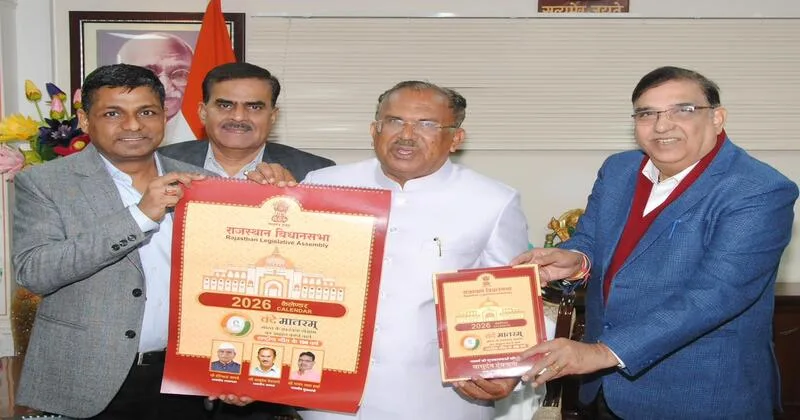
With the intention of spreading the glorious history and inspiring journey of the national anthem, Vande Mataram, to the masses, the Rajasthan Assembly has dedicated the 2026 calendar specifically to the 150th anniversary of Vande Mataram being celebrated across the country. This is another historic initiative by Rajasthan Assembly Speaker Vasudev Devnani on the 150th anniversary of Vande Mataram.
Through this innovative initiative by Rajasthan Assembly Speaker Vasudev Devnani, who is known for his innovations across the country, the Rajasthan Assembly’s annual calendar, 2026, has become a mirror of the history of the national anthem, Vande Mataram. This calendar is not merely a compilation of dates, but a visual and living document of India’s freedom struggle, cultural consciousness, and patriotic spirit. It vividly presents the story of Vande Mataram, from its creation to its becoming the national symbol.
According to Assembly Speaker Vasudev Devnani, the calendar’s purpose is to connect the new generation with history and strengthen patriotic values. The Rajasthan Assembly Calendar, 2026, is a confluence of history, art, and nationalism that, through Vande Mataram, refreshes the memories of the freedom struggle and inspires patriotism in future generations. The national anthem, Vande Mataram, is the immortal voice of India’s soul, awakening patriotism in its citizens during the freedom struggle.
Dedicated to India’s glorious heritage, each month of this calendar is linked to a significant episode in the history of Vande Mataram. It begins with the immortal song written by the creator of this timeless work, Bankim Chandra Chatterjee, in the 1870s, which later became an integral part of his novel Anandamath. The following pages depict how this song became a rallying cry for the struggle against British rule and a source of strength for revolutionaries in the freedom struggle, from the Partition of Bengal in 1905 to the 1930s. The calendar also explores, through rare photographs, historical quotes, and brief descriptions, how Vande Mataram gave voice to mass movements for independence across the country. All events, including the mention of national poet Rabindranath Tagore singing it at the 1896 Congress session, the incidents of its mass singing in jails and at gatherings by freedom fighters, and its recognition as the national anthem after independence, have been chronicled. This calendar makes the historic occasion of the 150th anniversary of Vande Mataram unforgettable and has emerged as an impressive document of patriotism, history, and cultural consciousness.
The calendar specifically highlights the literary contributions of Bankim Chandra Chatterjee, the author of the immortal song “Vande Mataram.” Born from his timeless novel, “Anandmath,” this song emerged from literature and became the voice of national consciousness. The calendar illustrates how the power of words shaped the freedom movement. As the calendar progresses, it highlights the influential role played by Vande Mataram in the freedom movement. During mass movements, meetings, and independence processions, this song became the national slogan of the struggle against British rule and continued to inspire courage in the hearts of freedom fighters. This calendar emotionally connects Vande Mataram’s 150-year journey with each month of the year. Its concept is that the spirit of the national anthem should not be limited to a single day but permeate citizens’ lives throughout the year. In the calendar’s opening pages, Vande Mataram is presented as a symbol of reverence, dedication, and self-respect for Mother India. It explains how this song emerged as a source of national sentiment and awakened Indians to the freedom movement.
The calendar links the 12 months of the year to 12 historical facts. Each month presents the history of Vande Mataram, its composition, its role in the freedom movement, its acceptance as the national song, and related historical events in a simple and effective manner. This allows everyone who views the calendar not only to see the dates but also to learn a new aspect of the national anthem each month. January features the first Hindi translation of Vande Mataram by Mahavir Prasad Dwivedi. This translation was published in the January 1906 issue of Saraswati magazine. The February page is dedicated to Gurudev Rabindranath Tagore’s rendition of Vande Mataram at the Congress session in February 1896.
The March page features a photograph of the room in Bankim Chandra Chattopadhyay’s ancestral home in Nehati, where he used to create his literature. It also highlights Bankim Chandra’s prophecy in March 1876, in which he said that the true significance of the song Vande Mataram would only be revealed with time. The April page includes a quote from the great freedom fighter and journalist Maharishi Aurobindo about the song in his magazine, Vande Mataram. In it, Maharishi Aurobindo wrote that through this song, the entire public had accepted patriotism as their religion. The Mother had appeared. The May page features an illustrated depiction of the Vande Mataram newspaper, started by the great revolutionary Bipin Chandra Pal, inspired by the song Vande Mataram, and Lala Lajpat Rai’s views on it. The June page highlights the spirit of national consciousness inherent in the Vraj flag designed by Sister Nivedita in June 1905 and the Vande Mataram inscribed on it.
The July page highlights the major newspapers published during the freedom movement, which mentioned Vande Mataram and published images of Bharat Mata, but were banned by the British government. The August page portrays Vande Mataram as the call of the brave, highlighting the final utterance of the great revolutionary Madanlal Dhingra, who was hanged on August 17, 1909. The pages from September to November present the journey of Vande Mataram being recognised as the national song and its constitutional recognition. This makes it clear that this song is the most powerful symbol of India’s unity in diversity. It mentions the advocacy by Seth Govind Das and Prof. Shibbanlal Saxena for making Vande Mataram the national anthem. Also included are excerpts from Dr Rajendra Prasad’s address as President of the Constituent Assembly on January 24, 1950, in which he stated that Vande Mataram should be respected on par with Jana Gana Mana. The December page features an incident involving Bankim Chandra Chatterjee, the author of this timeless national anthem, from Lalgola in Murshidabad, West Bengal.
This unique calendar of the Rajasthan Legislative Assembly conveys the message that Vande Mataram is not only a part of history but also an inspiration for nation-building for today’s young generation. It awakens a sense of duty and civic responsibility. This calendar is also complete in its daily utility, as it includes information on national festivals, important days, and the general calendar. Each page of the calendar features the thoughts of great freedom fighters like Bankim Chandra Chattopadhyay, Chandrashekhar Azad, Subhash Chandra Bose, Bhagat Singh, Swami Vivekananda, Ramprasad Bismil, Bal Gangadhar Tilak, immortal martyr Hemu Kalani, Madame Bhikaji Cama, Maharishi Dayanand Saraswati, Lala Lajpat Rai, and Pandit Madan Mohan Malaviya, constantly keeping alive the spirit of patriotism, duty, and sacrifice.
Assembly Speaker Vasudev Devnani is known for his constant innovations. Last year, in 2025, he dedicated the Assembly calendar to the Constitution. This time, he has taken a new initiative in support of Vande Mataram. This initiative establishes him not only as the head of a legislative body but also as a platform for national consciousness. It also demonstrates that he is striving not only to discharge the legislative responsibilities of a constitutional institution but also to play a vital role in preserving and promoting national values. This unique 2026 calendar of the Rajasthan Legislative Assembly, which marks the 150-year journey of the national anthem Vande Mataram, unites the glory of our past, the responsibility of our present, and the inspiration of our future. This initiative by Speaker Vasudev Devnani is undoubtedly an inspiring document. He has also created a Vande Bharat Gallery in the Assembly’s digital gallery, which is inspiring young students and the general public.
In addition to publishing the Assembly calendar with a theme of national importance on the English New Year, Speaker Vasudev Devnani has also initiated the publication of the Assembly diary on the Hindu New Year, Chaitra Shukla Pratipada, in keeping with Indian culture. By initiating this new tradition of publishing the diary, Speaker Devnani has given a new dimension to his innovations. He has also started the practice of publishing a coffee table book each year, compiling the innovations, notable achievements, and various activities undertaken in the Assembly, which has received widespread praise.
Rajasthan Assembly transformed from a Vasudev of innovations to a Devnani-like Assembly and an ideal temple of democracy
Over the past two years, Speaker Vasudev Devnani has undertaken a long list of innovations in the Assembly. First, he initiated the historic initiative of building a digital and political narrative museum in the Assembly, opening it for public viewing. Otherwise, for the general public, seeing the Assembly up close would have been a pipe dream. Devnani has created the Constitution Gallery in the Assembly, displaying illustrated displays of all 22 chapters of the original Constitution of India, which is highly educational and informative. The Constitution Gallery reveals to the public the true nature of the drawings and drafts included in the original Constitution manuscript, in keeping with the Constitution’s makers’ eternal culture, and dispels certain misconceptions among the general public. The Assembly’s digital gallery covers the history and progress of Rajasthan since its inception. The Political Narrative Museum also includes statues of the state’s first Chief Minister and Speakers of the Legislative Assembly, along with detailed information about them. A replica of the Legislative Assembly, a virtual tour, a studio for meeting the Speaker, and a lecture by Speaker Vasudev Devnani are all beautifully displayed. This Assembly Museum has seen nearly 50,000 visitors so far. Visiting the Legislative Assembly is a truly thrilling experience, especially for school children. Speaker Devnani has made this a reality by organising the Youth Parliament in the Assembly. Youth Parliament programs are regularly held in the Assembly to encourage youth.
Furthermore, on the initiative of Speaker Vasudev Devnani, a Kargil Shaurya Vatika has been created in the Assembly, and a vermillion tree has been planted there. Similarly, in line with Prime Minister Narendra Modi’s vision, a special program has been organised in the Assembly to honour the state’s brave women. Additionally, a healthy tradition of honouring women legislators on International Women’s Day has been initiated. The newly constructed Constitution Club of Rajasthan, adjacent to the Assembly building, is being developed as a hub for dialogue, consensus, good governance, and various activities.
All legislative work in the State Assembly has been digitised using the NeVA software developed by the Indian Parliament. This has made the Assembly paperless. Tablets have also been installed on the tables of all 200 MLAs. Furthermore, at the initiative of Assembly Speaker Vasudev Devnani, the Assembly House has been redecorated in pink, in keeping with Jaipur’s Pink City. A commendable effort has also been made to connect the public and the media directly to the Assembly by broadcasting Assembly proceedings on YouTube.
Assembly Speaker Devnani has many innovations in mind that remain to be implemented. These include the construction of a Central Hall in the Assembly, modeled after the old Parliament and Constitution Building, the installation of life-size oil paintings of prominent figures from the country and the state, the inauguration of a larger auditorium to utilize the unused large auditorium for the proposed Legislative Council on the upper floor of the Assembly, and the development of an inspirational space within the Assembly complex, where statues of eminent personalities, similar to those in the Parliament, are installed.
Assembly Speaker Vasudev Devnani has demonstrated a keen sense of urgency and zeal to ensure that questions posed by honourable MLAs in the Assembly receive prompt answers. To this end, Devnani periodically convenes meetings with the Chief Secretary and the Additional and Principal Secretaries of various departments, ensuring timely responses. As a result, administrative accountability has been established, and the number of pending questions has decreased to a record low, with 95 per cent of questions now being answered in each session. Speaker Devnani values discipline in the Assembly and is very strict about enforcing rules. The absence of officials in the officials’ gallery during Question Hour and Zero Hour in the Assembly.
In the past two years, the Rajasthan Assembly has evolved from a celestial abode of innovations to a model temple of democracy, a place of great national interest.