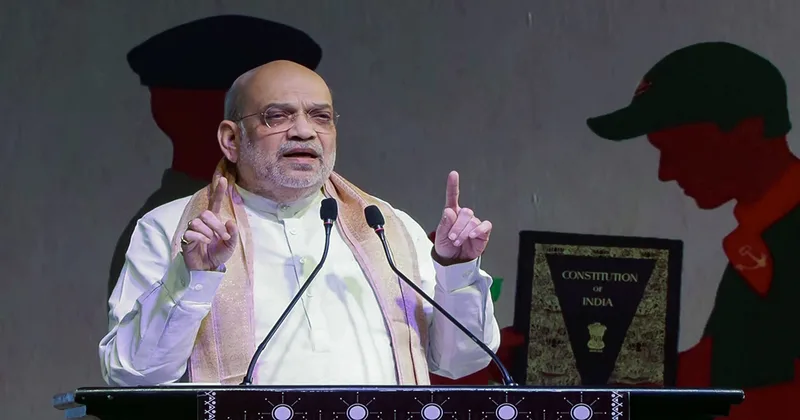
RAIPUR: Marking 25 years since Chhattisgarh’s formation, Union Home Minister Amit Shah on February 8 outlined what he described as a dramatic transformation of the state—from a region burdened by underdevelopment and Maoist violence to one poised to become a top-performing state in the coming decade.
Speaking at Oragniser Weekly’s conclave “Chhattisgarh @ 25: Shifting the Lens”, Shah framed the state’s journey through the themes of security, prosperity and stability, and asserted that these pillars now define Chhattisgarh’s new identity.
From ‘BIMARU’ to measurable growth
Recalling the term “BIMARU” once used for Bihar, Madhya Pradesh, Rajasthan and Uttar Pradesh, Shah said Chhattisgarh and other states carved out of them have now broken free from that label.
“If you want to assess 25 years of Chhattisgarh, you have to assess it through numbers,” Shah said, arguing that the scale of change is measurable and visible across sectors.
He claimed the state’s annual budget size has increased sharply between 2000 and 2025, reflecting what he described as a major expansion in fiscal capacity. According to Shah, growth in per-capita revenue and Gross State Domestic Product (GSDP) indicates that prosperity has expanded both in absolute terms and at the individual level.
Agriculture and irrigation push
Highlighting agriculture as a key driver of rural transformation, Shah said irrigation coverage in the state has doubled over the last 25 years. He claimed kharif crop production has tripled, while rabi production has seen an even sharper rise.
“Rabi output has increased nearly six times, which is significant because it depends on irrigation and not rainfall,” he said, linking the growth to sustained investments in water management and infrastructure.
Health, nutrition and social infrastructure
Shah pointed to a major expansion in health infrastructure, saying the number of district hospitals has risen from seven at the time of the state’s formation to 30 today. Medical colleges, he said, have increased from just one to 16 over the same period.
On child welfare and nutrition, the Union minister cited the expansion of anganwadi buildings and claimed that malnutrition-linked “hotspots” have declined. He also referred to improvements in mortality indicators, noting that many of these gains were achieved despite long periods when Maoist violence disrupted service delivery in large parts of the state.
Bastar projected as next growth frontier
One of the central themes of Shah’s address was Bastar, which he described as the state’s next major growth engine as Maoist influence recedes.
“Bastar has the resources to be among the most developed regions in the country, but insurgency destroyed institutions and blocked welfare delivery,” Shah said. With left-wing extremism “coming to an end,” he claimed the region’s growth curve would steepen rapidly.
He projected that Bastar could emerge as India’s most developed tribal district within a decade, provided security consolidation continues alongside development initiatives.
Education, connectivity and investment
Shah also highlighted improvements in education, pointing to the expansion of Eklavya residential schools. He said the state earlier had none, but now has 75 such institutions, along with a three-fold rise in hostels and student support systems.
On connectivity, he claimed that national highways have doubled and rural road construction has expanded at an unprecedented pace. Improved connectivity, he argued, has helped unlock investment potential and integrate remote regions with mainstream economic activity.
Shah also cited rising investment inflows and said Chhattisgarh has moved into a higher-growth phase that would have seemed “unimaginable” 25 years ago. He noted that the state now ranks among the leading producers of minerals such as coal, tin, iron ore, limestone and bauxite.
Political arc and governance narrative
Tracing the state’s political journey, Shah said Chhattisgarh began under “unique circumstances” after its formation on November 1, 2000, with administrative distance from Bhopal and a geography and culture requiring focused governance.
He credited the long BJP tenure under former chief minister Raman Singh for driving development while simultaneously confronting Maoist violence. Shah alleged that the subsequent Congress government presided over a period marked by “scams and corruption,” claiming development momentum and Maoist containment weakened during those years.
According to Shah, the BJP’s return to power under Chief Minister Vishnu Deo Sai has restored focus on both security and growth.
Linked to ‘Viksit Bharat’ vision
Positioning Chhattisgarh within Prime Minister Narendra Modi’s Viksit Bharat 2045 vision, Shah said the state’s 25-year trajectory suggests it can grow even faster in the coming years.
“Chhattisgarh will be freed from red terror and made one of the top states,” he said, framing the next phase as a combined story of security consolidation, economic expansion and long-term stability.
मोदी जी के 2047 के 'विकसित भारत' का 'विकसित छत्तीसगढ़' अग्रदूत बनेगा। हम छत्तीसगढ़ को लाल आतंक से पूरी तरह मुक्त करेंगे और जल्द इसे देश का नंबर-1 राज्य बनाएँगे। pic.twitter.com/O1JTR1Oj0j
— Amit Shah (@AmitShah) February 8, 2026
The address sought to present Chhattisgarh not just as a case study of regional transformation, but as an example of how sustained governance, security and development policies can alter the destiny of states once considered permanently lagging.