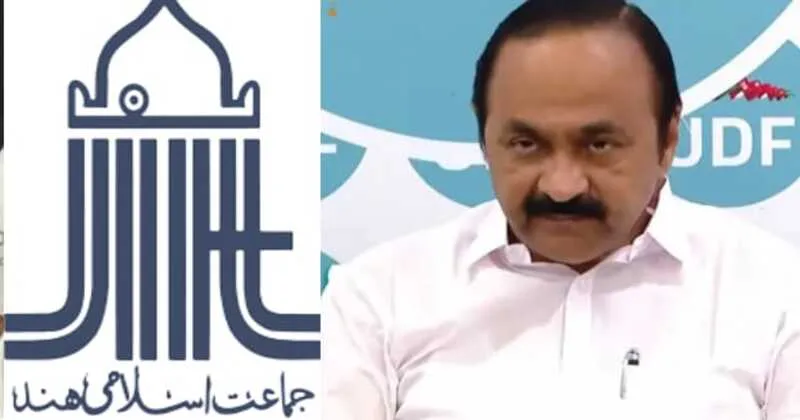
Kasaragod: The Indian National Congress is set to receive support from Jamaat-e-Islami, a move that has triggered sharp political exchanges in Kerala. Reacting to the development, Congress Leader of the Opposition V. D. Satheesan said Jamaat-e-Islami had clearly declared that religious fundamentalism was not its policy. He accused the Left of adopting double standards, stating that the Jamaat-e-Islami was considered secular when it supported the Left but was branded communal once it backed the Congress-led front.
Speaking to the media in Kasaragod district, Satheesan said the CPI(M) was referring to Jamaat-e-Islami as though the people of Kerala had forgotten its long political history. “Jamaat-e-Islami stood with the Communist Party of India (Marxist) for more than 40 years. CPI(M) seems to have forgotten that. When Jamaat-e-Islami announced support for the United Democratic Front, they suddenly launched a campaign saying the organisation was fundamentalist and dangerous,” Satheesan defended his decision. He added that the UDF had released records showing the Chief Minister Pinarayi Vijayan’s earlier statements acknowledging there was nothing wrong with Jamaat-e-Islami, including details of his conversation with the Jamaat-e-Islami Ameer. “After we made these public, the Chief Minister had to admit they were true. His propaganda was completely hypocritical,” Satheesan alleged.
Reiterating his position, Satheesan said Jamaat-e-Islami was secular when it supported the CPI(M) and communal when it supported the UDF. “None of this works in Kerala. Jamaat-e-Islami declared its support for us, and we accepted it,” he said.
He also maintained that Jamaat-e-Islami had abandoned religious fundamentalism. According to Satheesan, the Jamaat-e-Islami Ameer had clearly stated that religious fundamentalism would not be accepted in India’s pluralistic context. “There is no case against any leader or worker of Jamaat-e-Islami for communal speeches or creating communal conflict. They have declared that religious fundamentalism is not their policy. Then what is the problem?” he asked.
Contradicting Ameer, Jamaat general secretary defends Islamic Republic
Meanwhile, Jamaat-e-Islami State General Secretary Sheikh Muhammad Karakunnu last month took a contrasting stand, stating that “no true believer in Islam could reject the idea of an Islamic Republic”. His remarks were seen as contradicting the Jamaat-e-Islami Ameer’s earlier position, which had distanced the organisation from religious statehood.
Karakunnu shared a Facebook post asking, “Will the faithful reject the Islamic Republic?” In the post, he wrote that the Prophet founded the Islamic Republic with Medina as its headquarters and that it was established without shedding blood. He described it as an ideal, humane, and pluralistic state, claiming Muslims were a minority in its early years. Referring to the period of Umar al-Farooq, he said the Muslim population was less than four per cent. He urged critics to study its history, concluding that no believer who truly loves the Prophet could ever reject the Islamic Republic.
The episode has once again exposed how both the Indian National Congress and the Communist Party of India (Marxist) are willing to court Islamist groups for electoral gain, abandoning principle for vote-bank arithmetic. While they trade accusations against each other, both sides have normalised political engagement with organisations rooted in religious ideology. Such opportunistic alliances not only erode India’s secular foundations but also risk legitimising narratives that undermine social harmony and national security. By placing short-term political advantage above constitutional values, both parties stand accused of weakening the very secular and security fabric they publicly claim to defend.