

New Delhi: A powerful explosion rocked central Delhi on November 10, 2025, killing 15 people and injuring dozens more, authorities confirmed. The blast occurred around 9:17 am near Gate No. 1 of the Red Fort Metro Station, causing widespread panic and damage to nearby buildings.
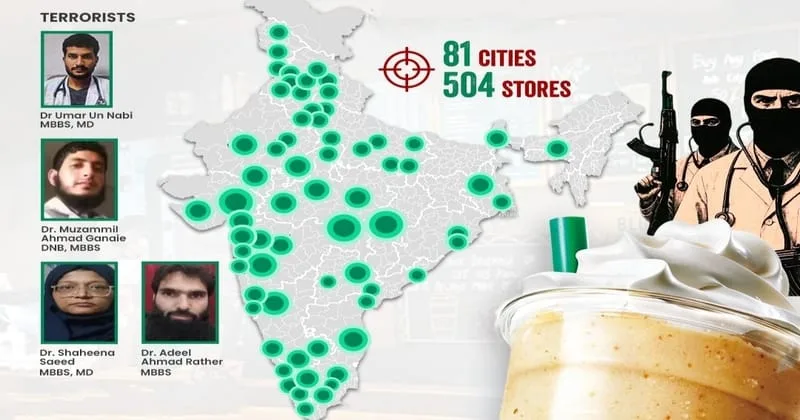
While initial reports suggested a localised terror incident, intelligence agencies now believe the attack was a pilot operation for a far larger, coordinated plot targeting 504 locations across 81 cities nationwide. Officials described the plan as unprecedented in scale and sophistication, highlighting a worrying evolution in domestic terrorism.
Your morning coffee spot was on a strategic Hit List.
On November 10, 2025, a blast in Delhi claimed 15 lives. But intelligence audits reveal that this was merely the pilot run of a much larger, coordinated synchronicity.
The plot aimed to target 504 stores across 81 cities… pic.twitter.com/M3nRhQceGl
— The Indian Matrix (@indianmatrix) February 5, 2026
Investigation and security response
The National Investigation Agency (NIA), working in coordination with the Delhi Police and multiple intelligence units, has launched a high-priority probe. Preliminary findings indicated that the attack was planned and executed by a highly educated terror module, whose members allegedly hail from professional and academic backgrounds.
Authorities stated the group included doctors, engineers, and graduates from humanities and commerce streams. The demographic audit of the alleged module shows:
* Engineering: 32.7 per cent
* Humanities: 32.7 per cent
* Medical: 9.7 per cent
* Commerce: 9.3 per cent
Raids are currently underway in multiple cities to track suspects and dismantle the alleged network. Security agencies have increased patrols at public spaces, shopping complexes, and transport hubs, warning citizens to remain vigilant.
National target grid
Analysis of intercepted communications and planning documents suggests a pan-Indian target grid. The alleged locations cover both major metropolitan hubs and Tier-2 and Tier-3 cities:
* North: Srinagar, Jalandhar, Bathinda, Noida
* West: Mumbai, Pune, Surat, Goa
* South: Bengaluru, Hyderabad, Tirupati, Warangal
* East: Kolkata, Guwahati, Siliguri, Bhubaneswar
The selection of targets appears to be strategic in terms of social impact, rather than political or military gain. Investigators note that civilian spaces such as cafes, shopping areas, and cultural hubs were deliberately chosen to disrupt urban routines and instil widespread fear. The intelligence points to a sophisticated logistical network, capable of coordinating simultaneous attacks across diverse geographies, a scale of planning that experts describe as unprecedented in India’s history of domestic terror threats.
Ideological motives and global links
Early findings suggest that the target selection may have been influenced by perceived religious or ethnic ownership of establishments. Intelligence agencies caution that the attacks appear to be motivated by imported ideological conflicts, rather than domestic grievances or territorial disputes.
“This is a dangerous evolution,” said a counter-terrorism analyst. “The group is attempting to operationalise global ideological grievances within India, targeting civilians based on identity rather than location or political significance. It signals a shift toward ideology-driven urban terrorism.”
Experts warn that such attacks may have a psychological objective as much as a physical one: to make ordinary life itself a perceived risk. The deliberate targeting of public leisure spaces such as cafés and malls is consistent with this strategy.
The intelligence audit of the suspected module reveals a disturbing profile:
* Many members are highly educated, including MBBS and MD graduates from reputed institutions.
* A significant proportion come from engineering and humanities backgrounds, indicating that technical knowledge and social literacy were being leveraged for operational planning.
* Members are economically stable, socially integrated, and able to move in urban spaces without attracting suspicion.
Analysts have described this phenomenon as the emergence of the “intellectual terrorist”, a highly skilled, ideologically hardened individual capable of sophisticated operations while remaining embedded in everyday society.
The Delhi blast left a lasting imprint on the city. Survivors reported chaotic scenes of smoke, debris, and panic. Bystanders assisted victims trapped under rubble, while emergency services evacuated the injured to nearby hospitals.
Authorities have urged citizens to report suspicious activity, avoid crowded public spaces where possible, and adhere to official advisories. Security has been tightened in Delhi, Mumbai, Bengaluru, Hyderabad, and other major cities as a precautionary measure.
The Delhi blast highlights the need for new counter-terrorism strategies. Traditional approaches- monitoring financial transactions, tracking physical movement, and surveilling known networks—may no longer suffice. Security analysts argue that agencies must also focus on ideological tracking, early behavioural indicators, and monitoring patterns of online radicalisation, while remaining within legal boundaries. The emergence of professional, educated terror modules requires an evolution in both policy and operational tactics.
The November 10 blast was more than a tragic attack; it was a wake-up call. Intelligence suggests that India is facing a new class of terrorism: sophisticated, ideologically motivated, and socially integrated.