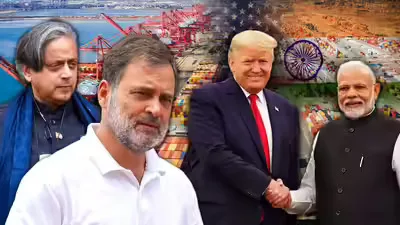
The proposed India-United States trade deal has emerged as one of the most politically charged economic issues of early 2026. At the heart of the debate lies a familiar concern: whether India’s farmers, long regarded as politically sensitive and economically vulnerable, stand to lose from deeper trade engagement with the world’s largest economy.
Over the past several days, the Congress has raised alarm, alleging that the Bharatiya Janata Party (BJP)-led government is compromising farmer interests to secure diplomatic and economic gains with Washington. Opposition leaders have warned of potential import surges, price shocks, and the erosion of domestic agricultural livelihoods.
However, senior government officials and ministers have countered these claims with categorical assurances, arguing that the core premise of the criticism does not align with the structure of the negotiations or the exclusions explicitly built into the agreement.
Food security: Declared non-negotiable
According to multiple government sources involved in the negotiation process quoted in media, India’s food security framework has remained completely non-negotiable throughout discussions with the United States.
Staple commodities that form the backbone of Indian agriculture, rice, wheat, maize (corn), soyabean, sugar, pulses, and dairy products have been kept entirely outside the scope of tariff concessions or market access commitments. Officials emphasise that these categories were “never on the table,” reflecting long-standing red lines maintained by successive Indian governments across political lines.
Agriculture accounts for livelihoods for nearly 45 per cent of India’s population, making any exposure of staple crops to global price volatility a politically and economically fraught proposition. The government’s insistence on excluding these items aligns with India’s broader trade policy history, including its positions at the World Trade Organisation (WTO).
What the deal does and does not include
Contrary to fears of a large scale influx of American agricultural products, officials clarify that any imports under the proposed agreement would be limited, selective, and niche in nature.
The categories under discussion are understood to include premium dry fruits such as almonds, walnuts, pistachios, pecans, and similar products that are not cultivated at scale in India and do not compete directly with mass-consumption staples. These items already enter Indian markets in limited quantities and primarily cater to urban, higher-income consumers.
“There is no scenario under which cheap foreign food floods Indian markets,” a senior official said as quoted in media, adding that anti-dumping safeguards and quantitative controls remain firmly in place.
This distinction between specialty imports and essential food items has been central to the government’s defence, showing that the bulk of what Indian farmers grow will not face external competition due to the deal.
Congress’s criticism and the missing fine print
Despite these clarifications, the Congress has continued to frame the trade deal as a threat to Indian farmers, arguing that increased market access for American agriculture will eventually hurt domestic producers.
However, many note that much of this argument has been advanced without reference to the actual text or contours of the agreement, which is still awaiting formal signature. Government sources in media reports point out that the Congress’s claims rest largely on assumptions rather than documented provisions.
This has led to questions about whether the opposition is repeating a familiar political strategy raising pre-emptive fears in the absence of evidence, rather than engaging with the specifics of the agreement as they stand.
Contrasting political precedents
If we draw a comparison with earlier moments in India’s political history when trade-offs in national interest received bipartisan backing. The Indo-US civil nuclear deal during the Manmohan Singh government is frequently cited as an example where opposition support was extended despite ideological differences, based on a shared assessment of strategic benefit.
In the current context, however, political polarisation appears to have narrowed the scope for consensus, even on issues where safeguards are explicitly stated.
Some of the confusion surrounding the trade deal has been fuelled by statements from American officials. US Agriculture Secretary Brooke Rollins, in a public post, welcomed the agreement as a boost for American farmers, stating that it would help export more US farm products to India and reduce the United States’ agricultural trade deficit with India, estimated at $1.3 billion in 2024.
While such statements are aimed at a domestic American audience, Indian officials have been quick to contextualise them. Commerce and Industry Minister Piyush Goyal clarified that stronger economic cooperation does not imply unilateral concessions.
He noted that tariff rationalisation and improved market access would also enhance India’s export competitiveness, benefiting Indian industries and producers beyond agriculture.
Government reassurance from agriculture ministry
Agriculture Minister Shivraj Singh Chouhan has taken a prominent role in addressing farmer concerns directly. Speaking to the media in Delhi, he reiterated that India’s grains, millets, fruits, vegetables, and dairy sectors face no threat from the agreement.
“Whether small farmers or large farmers, everyone’s interests are protected,” he said, adding that there would be no sudden or disruptive entry of foreign agricultural products into Indian markets.
Chouhan also addressed confusion arising from remarks by US officials, emphasising that Commerce Minister Goyal had already clarified India’s position in Parliament. According to him, India has not agreed to any provision that would pressure domestic farmers or dilute procurement mechanisms.
Timeline and transparency
Government sources in media reports indicate that the trade deal could be formally signed as early as March 2026. Prior to that, a joint India-US statement is expected within days, outlining the broad contours of the agreement and signalling forward momentum.
Officials stress that the joint statement will further clarify sectoral exclusions, potentially reducing speculation and political misinterpretation.
From a political standpoint, the controversy raises questions about the sustainability of the Congress’s narrative. With repeated assurances from multiple ministries, explicit exclusions of staples, and historical consistency in India’s trade policy approach, the claim that farmers are being “sold out” faces increasing scrutiny.
Unless concrete evidence emerges showing compromises on food security or procurement systems, the opposition’s argument may struggle to gain traction beyond its core support base.
India’s engagement with the United States through trade negotiations reflects a balancing act, expanding economic ties while safeguarding domestic priorities. Agriculture, given its social and political importance, remains a protected domain.
As it stands, the available facts suggest continuity rather than departure: food security remains intact, staple crops remain shielded, and any agricultural trade expansion is confined to non-essential, premium segments.
The India-US trade deal, still in the process of finalisation, has become a focal point for political debate. Yet, based on official clarifications, sectoral exclusions, and the structure of negotiations, fears of widespread agricultural disruption appear unsupported by the available evidence.
With staples protected and safeguards intact, the deal, at least in its current form, does not indicate a compromise on farmer interests. Whether political rhetoric adapts to these facts remains to be seen, but the contours of the agreement suggest that India has held firm on its agricultural red lines.