
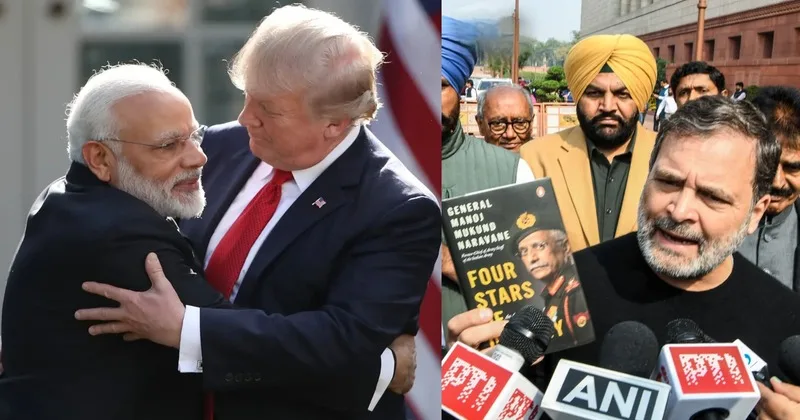
With reports confirming that the India–US trade agreement is finally becoming a reality, and that Donald Trump’s trade war posture is softening, India’s adversaries, led by opposition leader Rahul Gandhi, appear to have plunged into deep political despair. For weeks, Rahul’s visibility in national politics had ironically been sustained by Trump’s hostile rhetoric toward India. Rahul and his party repeatedly amplified Trump’s remarks, including the “dead economy” narrative, hoping that rising tariffs and strained bilateral ties would corner the Modi government. What Rahul never anticipated was Trump reversing course. Now, Rahul faces political disillusionment.
The Congress had bet heavily on the assumption that trade talks would collapse, import duties would rise, and India’s economy would suffer, triggering farmer protests and labour unrest. Instead, Trump himself announced progress in negotiations, alongside the US’s willingness to reduce tariffs on Indian goods to 18%. India’s firm stand on excluding agriculture and dairy from concessions delayed the deal, but New Delhi refused to yield. Rahul and Congress had assumed India would be forced into compromises, as many other countries had failed to resist Trump’s pressure. That expectation has now collapsed. Not just Rahul, China and Pakistan too were caught off guard by Trump’s declaration. This has led to frantic demands from Rahul and Left parties for details of the agreement, ostensibly in the name of transparency. In effect, they are echoing the anxieties of Beijing and Islamabad.
India’s expanding trade diplomacy extends beyond Washington. New Delhi has already signed trade pacts with the European Union, Oman, New Zealand, and the UK. Rahul understands that economic stability translates into political strength. To undermine this momentum and dim the success of the India–EU agreement, he attempted to raise claims about China allegedly seizing Indian land. This desperation spilled into Parliament recently, where Rahul publicly insulted Union Minister Ravneet Singh Bittu, calling him a traitor. What the nation witnessed was not opposition leadership, but political imbalance. Rahul succeeded only in reinforcing his image as hostile to national interests.
Rahul echoes China, Pakistan, and Bangladesh
The consequences of India–US cooperation extend far beyond Rahul Gandhi. A stronger India–US partnership directly challenges China’s strategic ambitions. This is not merely a trade pact, it carries economic and geopolitical significance, reinforcing mutual trust and enabling India to expand its global footprint. A small illustration emerged from Venezuela. While America’s intervention there is debatable, the exit of China-aligned President Nicolas Maduro opened global access to Venezuelan oil reserves, creating new opportunities for India. Subsequently, Venezuela’s Vice President Delcy Rodriguez personally called Prime Minister Narendra Modi, with both leaders agreeing to deepen cooperation across trade, energy, digital technology, health, and agriculture.
Meanwhile, the US has spearheaded a 50-nation alliance to counter China’s dominance, currently controlling nearly 90 per cent over rare earth minerals vital for defence and electric manufacturing. India was represented at the ministerial summit in Washington by External Affairs Minister S. Jaishankar.
India’s Rare Earth Corridor, announced in the 2026 budget across Odisha, Tamil Nadu, Kerala, and Andhra Pradesh, stands to benefit enormously from alignment with this global initiative. Even China has expressed interest in joining the US-led framework, revealing its strategic unease.
China had quietly hoped India–US relations would deteriorate. A successful agreement increases the likelihood of the US companies relocating to India. With democratic stability, lower production costs, and vast human capital, India is fast emerging as a global manufacturing hub, at China’s expense.
Pakistan and Bangladesh also share this discomfort. Even before recovering from the impact of the India–EU trade deal, they now face another setback. India’s entry into European textile markets threatens billions in export revenues for both countries. Previously, their products enjoyed lower tariffs due to GSP+ and LDC nation status under the World Trade Organisation, while Indian goods faced duties exceeding 12 per cent. With trade agreements reducing these barriers, India’s exports will surge, weakening Pakistani and Bangladeshi economies and increasing unemployment there. Predictably, a China–Pakistan–Bangladesh axis will attempt to portray India as an aggressor. Rahul Gandhi’s rhetoric conveniently supports this narrative.
Who really backed down?
The I.N.D.I Alliance, led by Rahul Gandhi, now claims Modi surrendered to Trump. Reality suggests otherwise. Trump is increasingly isolated. Europe rejected him over Greenland and tariffs. Russia distanced itself. Countries, including India, refused tariff coercion. Legal challenges on tariffs loom in the US Supreme Court, potentially forcing America to refund billions.
Trump even urged Europe to impose tariffs on India over Russian oil, but Europe refused and instead advanced trade talks with New Delhi. Britain’s Prime Minister visited China, while Canada’s leadership is reportedly engaging both China and India.
Having alienated allies, Trump revealed trade details prematurely to escape diplomatic isolation. India’s government has categorically stated that no agreement harms farmers, and full details will soon emerge. What must end, however, is Rahul Gandhi and Congress using speculation to fuel anti-national narratives.