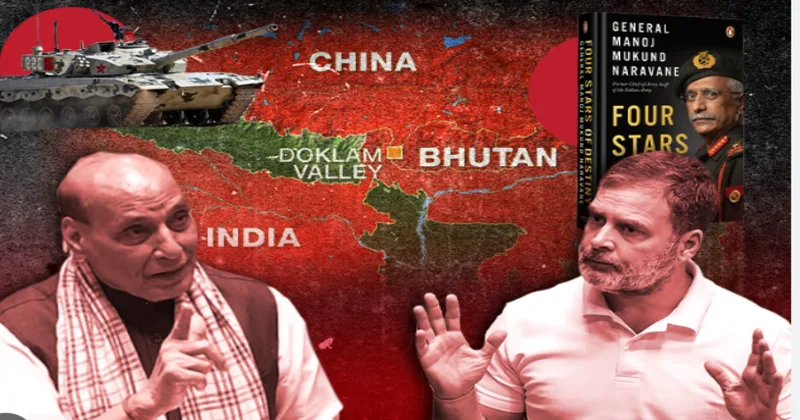
Over the past few days, the Bharatiya Parliament has been turned into an echo chamber for a carefully orchestrated falsehood that accuses India’s political leadership of cowardice during the 2020 Ladakh standoff. Aided and abetted by sections of the English-language media, this fiction has been aggressively pushed through selective and self-serving interpretations of a memoir attributed to former Army Chief M. M. Naravane. The Leader of the Opposition, Rahul Gandhi, has seized upon this distorted narrative to allege hesitation and leadership vacuum at a time when the nation was confronting open Chinese military coercion. The intent is unmistakable. To convert a calculated, disciplined, and ultimately successful national security response into a story of failure, to erode trust in India’s institutions, and to manufacture political outrage by misrepresenting professional military judgment as political weakness.
At the centre of this controversy lies a single phrase allegedly communicated to the Army Chief on the night of August 31, 2020: “Jo ucchit samjho, woh karo”, do what you deem appropriate. Critics have framed this as a sign of political ambiguity, even irresponsibility. Yet such a reading reveals more about the mindset of the critics than about the reality of India’s strategic decision-making. To understand why this charge is misplaced, and indeed dangerously misleading, we must examine the transformation of India’s strategic culture over the past decade, the realities of modern civil–military relations, and the specific context of the Ladakh standoff. What emerges is not a story of abdication, but of confidence; not of confusion, but of clarity; and not of political weakness, but of institutional maturity.
From Permission-Seeking to Professional Empowerment
For decades, India’s military operated under a culture of excessive political micromanagement. Tactical decisions, especially along sensitive borders, were often subject to approval chains extending all the way to New Delhi. This culture, justified in the name of “strategic restraint,” frequently resulted in delayed responses, lowered morale, and emboldened adversaries.
This was particularly evident during the United Progressive Alliance (UPA) years, when escalation aversion became doctrine. The mindset was simple: avoid confrontation at almost any cost, even if that meant absorbing repeated provocations. The cost of this approach was borne not by policymakers in air-conditioned offices, but by soldiers on the Line of Control and the Line of Actual Control.
The Modi government marked a decisive break from this paradigm. Since 2014, there has been a conscious effort to align India’s civil–military relationship with global best practices, where political leadership defines strategic objectives, and military commanders are trusted with tactical execution. This philosophy is neither novel nor reckless; it is standard in professional armed forces worldwide. When a Defence Minister tells an Army Chief to act as he deems appropriate within an already sanctioned operational framework, it is not abdication, it is empowerment.
The Rules of Engagement: Context Matters
A critical omission in the current discourse is the evolution of India’s Rules of Engagement (RoE) following the Galwan clash of June 2020. For years, India and China operated under agreements, dating back to 1996 and 2005, that restricted the use of firearms within a defined distance of the LAC. These confidence-building measures, while well-intentioned, became instruments of asymmetrical exploitation when the People’s Liberation Army (PLA) began using improvised melee weapons.
Galwan was the breaking point. The brutal loss of Indian soldiers exposed the untenability of legacy protocols in the face of an adversary willing to reinterpret restraint as weakness. In response, India recalibrated its RoE, granting field commanders greater latitude to respond to extraordinary situations, including the use of firearms if necessary. By August 2020, therefore, the Army Chief was not operating in a vacuum. He was acting within a revised doctrinal framework approved by the highest political authority. To suggest that he was “waiting for orders” misunderstands both the policy environment and the nature of modern military command.
The Night of August 31: Strategy, Not Stasis
The events of August 31–September 1, 2020, must be understood in the context of Operation Snow Leopard, a bold, pre-emptive manoeuvre in which Indian forces occupied key heights along the Kailash Range, including Rechin La and Rezang La. This operation fundamentally altered the tactical geometry of the standoff. For the first time in decades, Indian troops held dominating positions overlooking Chinese deployments. The subsequent movement of Chinese armour was not an offensive thrust but a coercive signal, an attempt to intimidate and probe India’s resolve. At such moments, the difference between tactical restraint and strategic surrender lies in judgment, not reflex.
Had India opened fire immediately, it might have satisfied the emotional instincts of armchair commentators but would have handed Beijing the escalation narrative it sought. Instead, Indian commanders maintained their positions, signalled readiness, and denied China both surprise and pretext. The tanks halted. The heights remained under Indian control. No shots were fired, but deterrence was unmistakably established. This was not indecision. It was controlled escalation at its most effective.
Civil–Military Trust and the Weight of Responsibility
General M.M. Naravane’s reflections on the “onus” being on him should be read not as a complaint but as an expression of professional seriousness. Every senior commander understands the gravity of decisions that can alter the course of nations. Acknowledging that weight is a sign of integrity, not grievance. Attempts to reinterpret this reflection as evidence of political abandonment distort both intent and context. In any mature democracy, the political leadership must trust its military professionals, especially in fast-moving, high-risk situations where delays can be fatal. To expect the Prime Minister or Defence Minister to micromanage tactical decisions from hundreds of kilometres away is not only unrealistic but dangerous. It reflects a mindset rooted in insecurity rather than confidence.
The Shadow of the Past: Lessons from Mumbai and Beyond
India’s history offers sobering lessons about the costs of hesitation. The 2008 Mumbai terror attacks remain a case study in delayed decision-making, where concerns about international optics paralysed decisive action. Similarly, for years along the LoC, commanders were required to seek clearance for proportional retaliation, often allowing adversaries to dictate tempo. These experiences shaped a generation of officers who learned, painfully, that bureaucratic caution could be as lethal as enemy fire.
The post-2014 shift sought to correct this imbalance, not by encouraging recklessness, but by restoring trust. Surgical strikes in 2016 and the Balakot air operation in 2019 exemplified this approach: clear political intent, professional execution, and strategic messaging. It is this same philosophy that guided India’s actions in Ladakh.
Infrastructure as Strategy
Another dimension often ignored by critics is the transformation of border infrastructure over the past decade. For years, India laboured under the flawed assumption that underdeveloped borders were inherently safer. This logic left Indian forces logistically disadvantaged, even as China built world-class infrastructure up to the LAC.
Since 2014, this approach has been decisively reversed. Projects such as the Atal Tunnel and the Darbuk–Shyok–DBO road have dramatically improved mobility, logistics, and operational flexibility. When the Ladakh crisis erupted, Indian commanders knew that reinforcements and supplies could move swiftly. This confidence underpinned both tactical boldness and strategic patience. Freedom of action is meaningful only when backed by capability. In Ladakh, India possessed both.
Noise Over Nation: When the Caravan Narrative Hijacks the Temple of Democracy
The recent ruckus orchestrated by Rahul Gandhi and sections of the Opposition in the hallowed halls of Parliament marks a troubling slide from democratic dissent into theatrical disruption. Waving and selectively quoting from an article published in The Caravan, Rahul Gandhi attempted to convert a speculative media narrative into a parliamentary indictment, presenting interpretation as evidence and conjecture as fact. Parliament, the Temple of Democracy, exists for reasoned debate and informed scrutiny, not for elevating magazine commentary to the level of official military assessment. By importing a politically charged article into the House and projecting it as an undeniable truth, the Opposition crossed the line between holding the government accountable and actively misleading the nation.
What makes this episode especially disturbing is the casual and irresponsible manner in which sensitive military issues were dragged into a partisan spectacle. Instead of raising structured questions through parliamentary mechanisms or seeking verified clarification from responsible authorities, the Opposition chose disruption by shouting slogans, stalling proceedings, and amplifying claims that rest on selective excerpts and interpretative leaps. This conduct reflects a deeper inability to understand institutional confidence, where professional military autonomy is mistaken for political weakness. The irony is unmistakable. A political culture once synonymous with excessive micromanagement and chronic hesitation now manufactures outrage simply because decisions were taken within a clear strategic framework without public theatrics.
Democracy demands vigilance, but it also demands responsibility. Criticism rooted in unverified media narratives does not strengthen parliamentary oversight; it corrodes it. By privileging a magazine driven narrative over constitutional decorum, the Opposition weakened not the government but the dignity of Parliament itself. In choosing noise over nuance, they revealed a preference for performance over principle, reducing serious national security debate to a momentary political spectacle unworthy of the institution they claim to defend.
The Myth of Territorial Loss
Perhaps the most damaging claim circulating today is that India “lost territory” due to delay or indecision. This assertion collapses under scrutiny. The occupation of the Kailash Range provided India with leverage that reshaped negotiations. It compelled China to engage seriously and ultimately contributed to the disengagement agreements. Winning without firing a shot is not weakness; it is the highest form of statecraft. Deterrence succeeded precisely because India demonstrated readiness without rashness.
Media, Narrative, and Responsibility
It is also necessary to reflect on the role of media in shaping public understanding of national security issues. Publications like The Caravan have every right to critique government policy. However, selectively amplifying unverified excerpts from sensitive military reflections, especially before formal clearance, raises serious questions about responsibility. In an era of information warfare, narratives themselves become tools of pressure. Undermining trust between the political executive and the military serves no national interest, regardless of political alignment. That such narratives were echoed uncritically by the Leader of the Opposition in Parliament is regrettable. National security should be the domain of informed debate, not partisan point-scoring.
Confidence Is Not Abdication
The Ladakh standoff was one of the most serious military challenges India has faced in decades. It tested not only troop endurance at extreme altitudes but also the maturity of India’s strategic culture. The outcome, no loss of position, enhanced leverage, and eventual disengagement, speaks for itself. The phrase “do what you deem appropriate” encapsulates a philosophy of trust. It reflects a nation confident enough to empower its professionals and wise enough to avoid unnecessary escalation. Those who mistake this confidence for confusion remain trapped in an older paradigm, one where permission replaced professionalism, and caution masqueraded as strategy. India has moved on from that era. Its political leadership stands behind its armed forces, not over their shoulders. That is the real lesson of Ladakh, and it is a lesson worth defending.