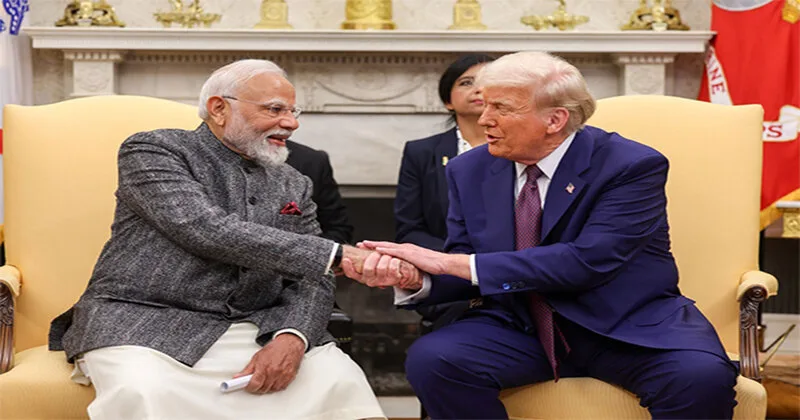
Prime Minister Narendra Modi on Feb 2, hailed a major breakthrough in India-United States trade relations after Washington confirmed a significant rollback in tariffs on Indian exports, reducing them from as high as 50 percent to 18 percent. Shortly after the announcement, Modi thanked US President Donald Trump, praising his leadership and underlining that cooperation between the two nations would benefit not just their economies but global stability as well.
The development followed a phone conversation between Modi and Trump, during which the two leaders discussed the contours of a long-pending trade agreement that had earlier stalled due to sharp differences over tariffs and energy purchases. The revised tariff structure is expected to provide a substantial boost to Indian exports, particularly under the government’s flagship ‘Make in India’ initiative.
In a post on X, Prime Minister Modi described his conversation with the US President as “wonderful” and expressed gratitude on behalf of India’s 1.4 billion citizens.
“Delighted that Made in India products will now have a reduced tariff of 18%. Big thanks to President Trump on behalf of the 1.4 billion people of India for this wonderful announcement,” Modi said.
Emphasising the broader significance of the agreement, the Prime Minister said closer economic cooperation between India and the US would translate into tangible benefits for citizens of both countries.
“When two large economies and the world’s largest democracies work together, it benefits our people and unlocks immense opportunities for mutually beneficial cooperation,” he noted.
Modi went on to laud Trump’s global role, stating, “President Trump’s leadership is vital for global peace, stability, and prosperity. India fully supports his efforts for peace. I look forward to working closely with him to take our partnership to unprecedented heights.”
The tariff rollback marks a decisive shift from the earlier regime, under which Indian goods faced cumulative duties of up to 50 percent, comprising a 25 percent reciprocal tariff and an additional 25 percent linked to energy-related concerns. These high duties had been a key reason behind prolonged negotiations, with the Trump administration repeatedly linking trade concessions to India’s purchase of Russian oil.
US President Trump confirmed the agreement on his social media platform Truth Social, stating that the United States would now charge a reduced reciprocal tariff of 18 percent on Indian products. He described the deal as a major reset in bilateral trade relations and said it would take effect immediately.
Clarifying the revised structure, US Ambassador to India Sergio Gor later confirmed that the earlier tariffs had been substantially cut, removing a critical irritant in India-US trade talks.
Union Home Minister Amit Shah welcomed the announcement, calling it a “big day for India-US ties” and congratulating both Modi and Trump for what he described as a mutually beneficial pact that strengthens strategic and economic cooperation.
Indian Ambassador to the United States Vinay Mohan Kwatra also termed the agreement a major diplomatic and economic win. Calling it an “exciting new phase” in bilateral relations, Kwatra said the deal reflected strong leadership at the highest levels in both countries.
“A big win for a consequential partnership under the leadership of Prime Minister Narendra Modi and President Donald Trump. Today’s announcements herald an exciting new phase in our partnership,” he said in a post on X.
While welcoming the tariff reduction, the Indian side remained cautious on some of the assertions made by President Trump. In his posts, Trump claimed that India had agreed to reduce tariffs and non-tariff barriers on US goods to zero and to stop purchasing Russian oil, instead increasing energy imports from the United States and possibly Venezuela.
Trump also linked the trade deal to broader geopolitical goals, saying his conversation with Modi included discussions on “ending the war with Russia and Ukraine.”
“This will help END THE WAR in Ukraine… with thousands of people dying each and every week,” Trump wrote.
However, Prime Minister Modi did not publicly mention any commitment on reducing tariffs on US goods to zero or halting Russian oil purchases. Indian officials have so far focused their messaging on the tariff rollback on Indian exports and the broader economic gains from the agreement.
Beyond economics, the agreement is also being viewed as a reaffirmation of the strategic partnership between New Delhi and Washington, particularly at a time of global economic uncertainty and geopolitical churn.
With both leaders signalling intent to deepen cooperation, the tariff rollback is being seen as a crucial step toward resetting India-US trade relations and pushing the partnership toward what Prime Minister Modi described as “unprecedented heights.”