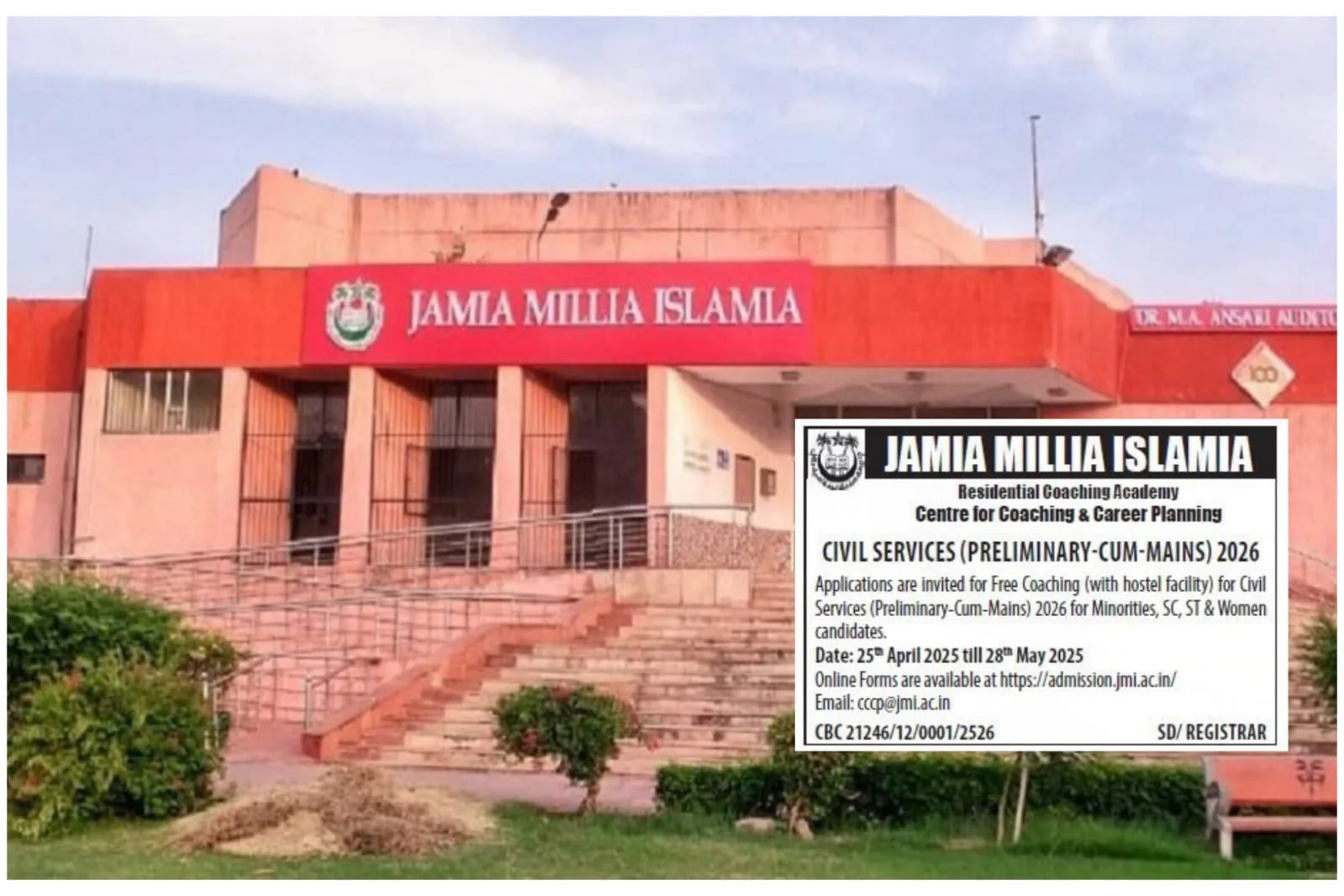
Jamia Millia Islamia’s UGC-funded Residential Coaching Academy (RCA) for Civil Services 2026 has triggered a major constitutional and social controversy after excluding General and OBC male candidates from free residential coaching. The move, now formally challenged by a legal advocacy group, has reopened uncomfortable questions around taxpayer-funded discrimination, campus demographics, and past patterns of religious influence targeting vulnerable groups.
The controversy stems from Jamia Millia Islamia’s official notification for its Residential Coaching Academy (RCA), Civil Services (Preliminary-cum-Mains) 2026, which claims to offer free coaching along with hostel facilities exclusively to Minority candidates, SC/ST candidates, and women.
Under the published eligibility framework, General and OBC male candidates are completely barred from applying, irrespective of income, academic merit, or socio-economic vulnerability. Applications for the programme were scheduled between April 25 and May 28, 2025, with the course conducted under Jamia’s Centre for Coaching and Career Planning, a facility sustained through public and UGC funding.
For the first time, a Central University has drawn an absolute exclusion line, not based on income or merit, but on gender and category alone.
Legal Challenge: Foundation moves to Registrar
In response, the Vidhii Setu Foundation (VSF) has submitted a detailed representation to the Registrar and the Office of the Vice-Chancellor, calling the policy “arbitrary, unconstitutional, and discriminatory”.
Signed by VSF Director Abhijeet Kumar Bhatt, the representation argues that Jamia Millia Islamia, as a government-funded Central University, is constitutionally bound to uphold Article 14 (Equality before Law) and Article 15 (Prohibition of Discrimination).
According to the foundation, affirmative action cannot legally morph into absolute exclusion, especially when public funds are involved.
‘No intelligible differentia’
At the heart of the legal argument lies the doctrine of intelligible differentia, a constitutional requirement for any classification under Indian law.
VSF argues that Jamia’s policy fails to explain why a General or OBC male student from a poor background is automatically less deserving of state-funded assistance than a candidate from another category with identical economic hardship.
The foundation terms the scheme a “closed-door, taxpayer-funded programme”, raising serious questions about whether constitutional equality has been replaced by administrative convenience.
Public funds, public accountability
Unlike private institutions, Jamia Millia Islamia functions on public money, including grants from the University Grants Commission.
While reservations and targeted schemes are constitutionally permissible, blanket exclusion without income-based assessment crosses a legal threshold, particularly in programmes linked to access to elite public services like the Indian Administrative Service.
This is not social justice but selective privilege under the cover of welfare.
Beyond Law: Campus demography and safety concerns
What elevates the issue beyond legal debate is the residential nature of the programme.
VSF’s representation flags concerns about a deliberately skewed residential demographic, where:
1. Women from all categories are eligible,
2. Minority men are eligible,
3. SC/ST men are eligible, but General and OBC men are excluded entirely.
According to the foundation, such demographic engineering without safeguards risks creating an environment vulnerable to social pressure, communal targeting, and ideological influence, particularly in a closed hostel ecosystem.
Conversion concerns in campus
These concerns do not arise in isolation.
Over the past several years, Jamia Millia Islamia has repeatedly found itself embroiled in serious and disturbing allegations that go far beyond isolated administrative lapses. From claims of coercive religious practices to accusations of discrimination against non-Muslims, Dalits and tribals, the centrally funded institution has increasingly come under scrutiny for what is described as a pattern of ideological coercion and institutional bias rather than sporadic misconduct.
Multiple complaints, testimonies and fact-finding reports over the years have alleged that Jamia’s internal grievance mechanisms either fail to protect complainants or are weaponised against them. Allegations of forced or pressured religious conversion, career stagnation for those refusing to comply, and administrative retaliation have surfaced with alarming regularity. In several cases, those who spoke up claim they were marginalised, transferred, or silenced instead of being heard.
It is against this troubling backdrop that a fresh and grave case recently emerged, involving allegations of caste abuse, physical assault and retaliatory administrative action against a Scheduled Tribe employee within the university premises. The case of Ram Phool Meena, an Upper Division Clerk at Jamia’s University Polytechnic, has brought these long-simmering concerns back into sharp focus.
According to Meena’s complaint to the Delhi Police, the abuse he faced was not merely professional hostility but explicitly targeted his tribal identity and religious background. The alleged use of caste slurs, references to his Adivasi identity, and remarks questioning his “audacity” to complain within what was described as a “Muslim institution” have raised serious questions about workplace safety and constitutional protections on campus.
What has further intensified outrage is Meena’s allegation that instead of acting against the accused faculty member, the administration issued a transfer order against him on the very day he sought protection, an act he describes as punitive and retaliatory.
This incident does not stand alone. In recent years, Organiser has reported multiple cases from Jamia involving Dalit, tribal and Hindu employees and students who alleged pressure to convert, ideological harassment, and discrimination. Despite official assurances of “zero tolerance” against forced conversion and bias, recurring allegations suggest a deep disconnect between policy statements and ground reality.
Foundation warns of structural vulnerability
VSF has clarified that it is not accusing Jamia Millia Islamia of conversion activities, but warns that administrative design itself can create vulnerability.
The representation states that excluding one male demographic while inviting women from the same communities into a religiously homogeneous environment raises serious questions about institutional responsibility.
These are warnings grounded in precedent, not paranoia, the foundation argues.
Abhijeet Kumar Bhatt minced no words in his submission: “If the government pays the bills, every Indian gets a seat at the table. Jamia cannot run a selective club on public money. This is not affirmative action, it is administrative segregation.”
He further called on the university to restore a merit-based, income-sensitive framework that aligns with constitutional spirit rather than ideological optics.
VSF has urged Jamia Millia Islamia to:
1. Withdraw the current notification,
2. Reissue eligibility based on Merit-cum-Means,
3. Ensure economic vulnerability, not identity, becomes the determining factor.
The foundation has also indicated that judicial remedies remain open if the university fails to act.
University silence, rising questions
As of now, Jamia Millia Islamia has issued no official response. There has been no clarification on: Why General and OBC men were excluded, whether economic criteria were considered, or how constitutional obligations were weighed.
The silence has only intensified scrutiny.
At stake is not merely one coaching programme but a deeper question:
Can taxpayer-funded institutions decide who is worthy of opportunity based solely on identity?
As debates around conversion, constitutional equality, and institutional accountability converge, Jamia’s RCA policy may well become a test case for how far selective welfare can go before it collides with the Constitution itself.