
Seven evidences suggesting Vedic connections beyond India
June 12, 2026
  • Read Ecopy
  • Circulation
  • Advertise
  • Careers
  • About Us
  • Contact Us
Android AppiPhone AppArattai
Organiser
  • ‌
  • Bharat
    • Assam
    • Bihar
    • Chhattisgarh
    • Jharkhand
    • Maharashtra
    • View All States
  • World
    • Asia
    • Europe
    • North America
    • South America
    • Africa
    • Australia
  • Editorial
  • International
  • Opinion
  • RSS @ 100
  • More
    • Op Sindoor
    • Analysis
    • Sports
    • Defence
    • Politics
    • Business
    • Economy
    • Culture
    • Special Report
    • Sci & Tech
    • Entertainment
    • G20
    • Azadi Ka Amrit Mahotsav
    • Vocal4Local
    • Web Stories
    • Education
    • Employment
    • Books
    • Interviews
    • Travel
    • Law
    • Health
    • Obituary
  • Subscribe
    • Subscribe Print Edition
    • Subscribe Ecopy
    • Read Ecopy
  • ‌
  • Bharat
    • Assam
    • Bihar
    • Chhattisgarh
    • Jharkhand
    • Maharashtra
    • View All States
  • World
    • Asia
    • Europe
    • North America
    • South America
    • Africa
    • Australia
  • Editorial
  • International
  • Opinion
  • RSS @ 100
  • More
    • Op Sindoor
    • Analysis
    • Sports
    • Defence
    • Politics
    • Business
    • Economy
    • Culture
    • Special Report
    • Sci & Tech
    • Entertainment
    • G20
    • Azadi Ka Amrit Mahotsav
    • Vocal4Local
    • Web Stories
    • Education
    • Employment
    • Books
    • Interviews
    • Travel
    • Law
    • Health
    • Obituary
  • Subscribe
    • Subscribe Print Edition
    • Subscribe Ecopy
    • Read Ecopy
Organiser
  • Home
  • Bharat
  • World
  • Operation Sindoor
  • Editorial
  • Analysis
  • Opinion
  • Culture
  • Defence
  • International Edition
  • RSS @ 100
  • Magazine
  • Read Ecopy
Home Bharat

From Mitanni to Mesopotamia: Seven intriguing evidences suggesting Vedic connections beyond India

Ancient Indian civilisation, often described as Bharatvarsha, is believed by some to have extended into regions like Mesopotamia and Mitanni. A range of archaeological and linguistic findings continues to fuel discussions on possible Vedic connections in West Asia

Nandini NairNandini Nair
Apr 11, 2026, 12:00 pm IST
in Bharat, Culture
Follow on Google News
Seven intriguing evidences suggesting Vedic connections beyond India

Seven intriguing evidences suggesting Vedic connections beyond India

FacebookTwitterWhatsAppTelegramEmail

For centuries, India has been described in traditional texts as “Jambudweepe Bharatkhande Aryavarte Bharatvarsh.” Some researchers say that its cultural footprint extended far beyond present-day borders into regions like Mesopotamia and Mitanni. While these claims remain debated, several pieces of evidence are often cited to support this idea.

Must read and share the thread here!

India was once “Jambudweepe Bharatkhande Aryavarte Bharatvarsh” and extended beyond “Mesopotamia” in Iraq, “Mitani” in Syria

Which still hold evidence of a Hindu civilisation

The Hindu archaeological evidences here include Hindu deities:… pic.twitter.com/vymGglMytF

— Comman Man (@CommanMan777589) April 5, 2026

The Mitanni Treaty: Vedic Gods in a West Asian Pact

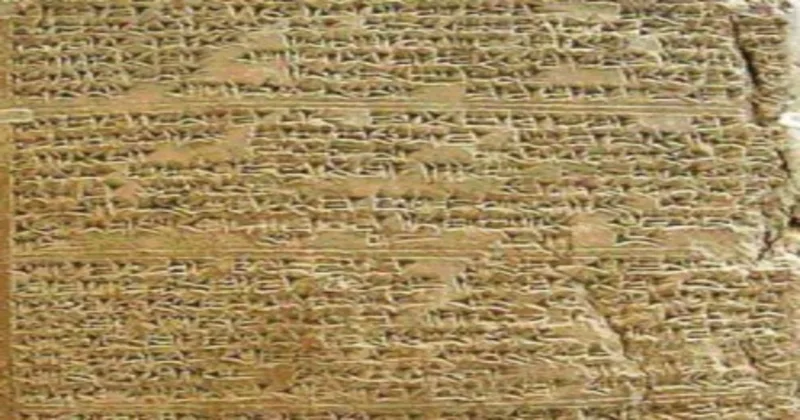
The Mitanni Treaty, discovered in Bogazkoy, is one of the strongest references cited in this discussion. This agreement between Suppiluliuma I and Shattiwaza invokes deities such as Indra, Mitra, Varuna, and Nasatya as witnesses to the oath. These names closely resemble those found in the Rig Veda, suggesting that Indo-Aryan linguistic or religious elements were present among the Mitanni elite, particularly in diplomatic and ceremonial contexts.

Kikkuli Text: Sanskrit-Like Terms in Horse Training

The Kikkuli Text (c. 1400 BCE), attributed to Kikkuli, is often cited as further linguistic evidence. This detailed manual outlines a 184-day training regimen for chariot horses and includes terms such as aika, tera, panza, satta, and nawa, which resemble Sanskrit numerals. These terms appear in structured training instructions like “aika-wartanna” (one turn) and “satta-wartanna” (seven turns), indicating that Indo-Aryan language elements were integrated into technical and military practices within the Mitanni kingdom.
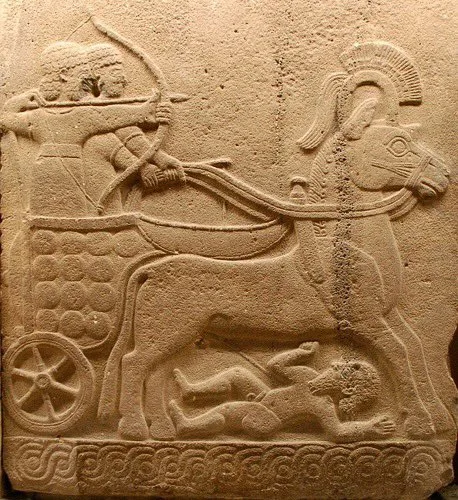
Ritual Patterns in the Syria-Levant Region

Excavations across the Levant have revealed ritual practices such as offerings, libations, and symbolic depictions of divine figures. Some interpretations suggest parallels with Hindu rituals, including structured ceremonies and sacred symbolism. However, most archaeologists view these as part of independent Near Eastern religious traditions, noting that similar ritual patterns can emerge across cultures without direct influence.
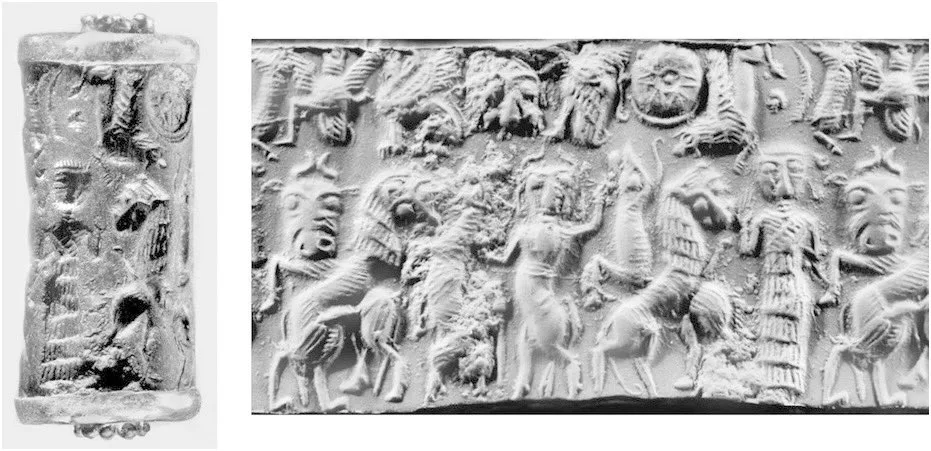
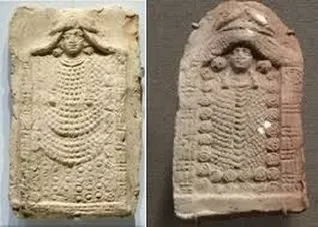
Mesopotamian Divine Couple Figures

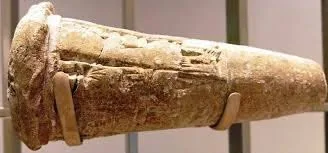
Artefacts from the Old Babylonian Period in southern Mesopotamia include clay plaques depicting male and female divine figures together. Some observers compare these figures to Venkateswara and Padmavati, pointing to similarities in posture, attire, and ornamentation such as garlands. However, mainstream interpretations identify these figures as indigenous Mesopotamian deities or priestly representations, with no confirmed link to later Hindu iconography.
Ishtar and Durga: Symbolic Similarities
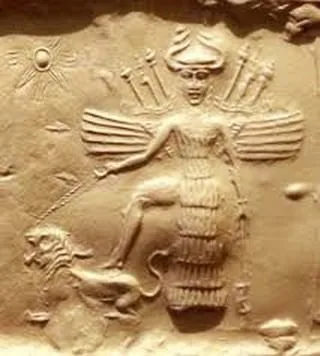
The Mesopotamian goddess Ishtar (Inanna) is often depicted alongside lions and associated with war and fertility, traits also linked to Durga. Some cylinder seals show a deity overcoming a bull or bull-like figure, which has been compared to the Mahishasura Mardini motif. While these visual and thematic similarities are striking, historians generally interpret them as parallel developments in mythology rather than evidence of direct cultural transmission.

Also Read: India’s Living Canvas: Unveiling 11 stunning traditional art forms rooted in history and culture

Moon God Sin and Shiva Comparisons

The Mesopotamian moon god Sin (Suen) has sometimes been associated with Shiva in his lunar aspect, such as Somnath. Additionally, certain oval-shaped ritual stones found in Mesopotamia have been compared to the Shivling, and iconographic parallels are occasionally drawn with the Pashupati Seal from the Indus Valley Civilisation. Despite these comparisons, scholars caution that such forms and symbols can arise independently in different cultures.

Belula Pass Relief: A Contested Interpretation
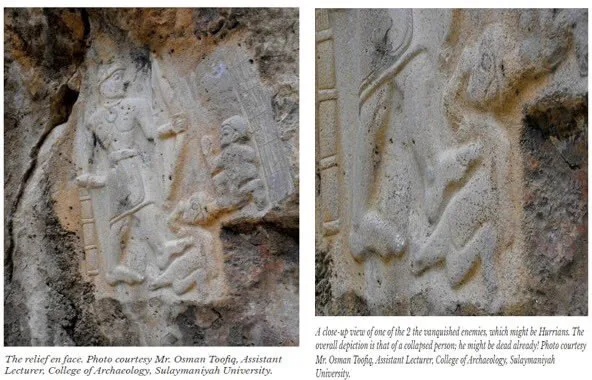
The rock relief at Belula Pass in Sulaymaniyah is widely identified by archaeologists as depicting an Akkadian ruler, often linked to Tardunni, celebrating a military victory. Some alternative interpretations suggest the imagery resembles Rama and Hanuman. However, this view is not supported by mainstream scholarship, which attributes the relief firmly to Mesopotamian historical context.

These seven pieces of evidence highlight intriguing linguistic, cultural, and visual parallels between ancient India and West Asia. While there is credible evidence of Indo-Aryan influence, particularly in the Mitanni kingdom, most historians interpret these findings as the result of migration, interaction, and shared Indo-European roots rather than the spread of a unified Hindu civilisation across these regions.

 

Topics: archaeologyancient indiaAncient culturesMesopotamiaMitanniVedic civilisationIndo-AryanHindu history
Nandini Nair
Nandini Nair
Nandini Nair is a Subeditor-cum-Content Manager at Organiser Digital with more than 3.5 years of experience covering international, national, cultural and current affairs. Also tracks and develops impactful stories emerging from social media discourse, delivering engaging digital reporting [Read more]
ShareTweetSendShareSend
✮ Subscribe Organiser YouTube Channel. ✮
✮ Join Organiser's WhatsApp channel for Nationalist views beyond the news. ✮
Previous News

Telangana: ATF urges Court to direct GHMC to act against AIMIM for obstructing officials in old city Hyderabad

Next News

Keralam Polls 2026: Internal dissent rocks Church as mouthpiece Deepika, bishops face heat over pro-congress call

Related News

A massive 200-kg Shivling recovered from the waters of the Ganga in Varanasi

Hidden Beneath the Ganga for 2,500 Years? 200 kg Shivling discovery draws thousands of devotees in Kashi

The terracotta dice that challenges historical assumptions and highlights India's millennia-old civilisational heritage

How a 4,500-year-old terracotta dice is reviving the debate on India’s civilisational continuity & Vedic heritage

The Pashupati Seal of the indus valley civilisation and the continuity of India’s shaivite spiritual traditions

Pashupati Seal of Mohenjo-daro: The 4,300-year-old symbol of India’s unbroken spiritual & civilisational continuity

Representative Image

The scientific soul of India beyond western narratives

The Brahuis of Balochistan and their ancient Dravidian heritage

Language Without Borders: How the Brahuis carry Tamil and Telugu culture into the northwest

Fathers of Science (Image Source: X0

From Aryabhata to Charaka: 36 visionary sants who shaped the foundations of modern science and knowledge

Load More

Latest News

US: Anshul Kuncha’s death exposes anti-India racist racket; Assaulting the community that powers American economy!

Security forces undertake anti-Maoist campaign in Odisha in Kandhamal and Malkangiri and seize huge cache of arms

Odisha: Security forces recover caches of weapons of Maoists in Kandhamal and Malkangiri in last three days

Kashmiri Pandits at Kheer Bhawani Temple(File Photo)

J&K: Exiled Kashmiri Pandits throng temples amid enhanced security; Crowd peaks on Jyestha Ashtami at Kheer Bhawani

Global Peace Index Farce: Does the GPI penalise democracies fighting terrorism? India’s case explained

Five Ayush hospitals cum medical colleges to come up in Uttar Pradesh (This is an AI generated image)

Uttar Pradesh plans five integrated AYUSH Colleges and Hospitals to expand traditional healthcare and medical education

(Left) Site of the protest (Right) NIA team in JNIMS hospital

Manipur: NIA starts forensic probe of abduction and killings of 6 Naga civilians by Kuki militants

Prime Minister Narendra Modi

The MODI Era: Legacy of 4399 days of Transformation

Late Laxmananda Saraswati (File Photo)

Missing Swami Laxmananda murder judicial inquiry report triggers FIR in Odisha; BJP targets Naveen Patnaik

4,399 days of Prime Minister Narendra Modi

The Meaning of 4,399 Days: Why Even the Opposition Must Now Play by the New Rules Set in the Modi Era

Keralam: Audit finds gold and silver ornaments missing from nearly 20 temples under Neyyattinkara Devaswom sub group

Load More
  • Privacy
  • Terms
  • Cookie Policy
  • Refund and Cancellation
  • Delivery and Shipping

© Bharat Prakashan (Delhi) Limited.
Tech-enabled by Ananthapuri Technologies

  • Home
  • Search Organiser
  • Bharat
    • Assam
    • Bihar
    • Chhattisgarh
    • Jharkhand
    • Maharashtra
    • View All States
  • World
    • Asia
    • Africa
    • North America
    • South America
    • Europe
    • Australia
  • Editorial
  • Operation Sindoor
  • Opinion
  • Analysis
  • Defence
  • Culture
  • Sports
  • Business
  • RSS @ 100
  • Entertainment
  • More ..
    • Sci & Tech
    • Vocal4Local
    • Special Report
    • Education
    • Employment
    • Books
    • Interviews
    • Travel
    • Health
    • Politics
    • Law
    • Economy
    • Obituary
  • Subscribe Magazine
  • Read Ecopy
  • Advertise
  • Circulation
  • Careers
  • About Us
  • Contact Us
  • Policies & Terms
    • Privacy Policy
    • Cookie Policy
    • Refund and Cancellation
    • Terms of Use

© Bharat Prakashan (Delhi) Limited.
Tech-enabled by Ananthapuri Technologies