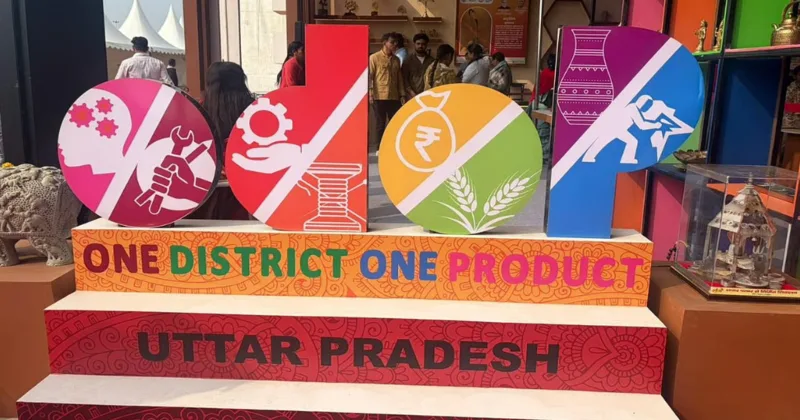
LUCKNOW: Uttar Pradesh’s ambitious One District One Product (ODOP) initiative has transformed into a national model for grassroots-led economic development. It has revolutionised local economies and empowered millions of artisans across the state. Launched in 2018 under the visionary leadership of Chief Minister Yogi Adityanath, the UPOP programme aims to identify, promote, and scale up one unique indigenous product from each district of Uttar Pradesh, linking traditional craftsmanship with modern markets and technology.
What began as a state-level effort to preserve traditional industries and promote local entrepreneurship has now evolved into a comprehensive development model recognised across India. By focusing on district-specific strengths, the ODOP initiative has successfully converted local skills into engines of growth, creating new avenues for employment, self-reliance, and export expansion.
The fundamental idea behind ODOP is simple yet transformative, i.e., to connect each district of Uttar Pradesh with a product that embodies its cultural heritage and craftsmanship. For instance, Moradabad is synonymous with brassware, Banaras with handlooms, Firozabad with glassware, Kannauj with perfumes, and Bhadohi with carpets. This district-based specialisation not only preserves traditional skills but also enhances their marketability in domestic and international markets.
Under ODOP, artisans and small-scale producers have received vital assistance in product design, branding, marketing, and access to finance. The programme emphasises capacity building through training and workshops, ensuring that traditional artisans are equipped with modern skills and business knowledge. The government’s focused interventions have helped many local enterprises scale up their operations, formalise their businesses, and integrate into the global supply chain.
Uttar Pradesh’s One District One Product (ODOP) initiative has emerged as a national model for grassroots-led economic development, successfully transforming traditional skills into drivers of growth. Launched in 2018 under the leadership of Hon'ble Chief Minister Yogi Adityanath… pic.twitter.com/cYC8kqJcuK
— INVEST UP (@_InvestUP) January 28, 2026
The economic impact of ODOP is particularly visible in the state’s remarkable export performance. Uttar Pradesh’s total exports have surged from Rs 88,000 crore in 2017 to Rs 1.86 lakh crore in 2024, a growth of over 110 per cent. Out of this, ODOP products alone contributed Rs 93,000 crore, focusing on their growing importance in Uttar Pradesh’s trade portfolio.
The initiative has made significant contributions in several sectors from handicrafts and handlooms to food processing and agro-based industries. By supporting artisans through financial assistance, branding support, and easier access to markets, ODOP has strengthened Uttar Pradesh’s position as one of India’s leading exporting states. The programme’s success is a testament to how local skill development and regional identity can drive macroeconomic growth when combined with policy support and infrastructure.
Boost to MSMEs and Rural Employment
A crucial component of the ODOP framework has been its integration with the Micro, Small and Medium Enterprises (MSME) ecosystem. Over 6,000 crore worth of projects have been approved under the ODOP Margin Money Scheme, offering financial assistance and credit support to small manufacturers. The initiative has distributed over 1.25 lakh toolkits to artisans and workers, helping them upgrade their production capabilities.
This targeted financial and infrastructural support has led to the establishment of thousands of new enterprises in rural and semi-urban areas, creating sustainable livelihoods and curbing migration to cities. The ODOP model, therefore, not only promotes entrepreneurship but also strengthens the rural economy by providing local employment.
By connecting local talent to national and global markets, the ODOP scheme has created a strong value chain that ensures fair returns to producers. Women entrepreneurs, in particular, have benefited immensely, with many self-help groups (SHGs) and small cooperatives now contributing to ODOP product clusters.
One of the defining features of ODOP is its dual approach i.e., preserving traditional craftsmanship while promoting innovation. For example, the perfume makers of Kannauj, who once relied solely on age-old distillation techniques, are now adopting eco-friendly extraction methods and modern packaging to appeal to international customers. Similarly, Banaras weavers are experimenting with new designs and digital marketing, while Bhadohi carpet makers are participating in global exhibitions and e-commerce platforms.
This fusion of heritage and modernity has made ODOP products not only commercially successful but also culturally valuable. The initiative has given new life to dying art forms and motivated younger generations to pursue traditional crafts as viable career options. By linking heritage with economic opportunity, ODOP has transformed Uttar Pradesh’s cultural assets into instruments of inclusive growth.