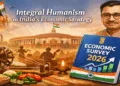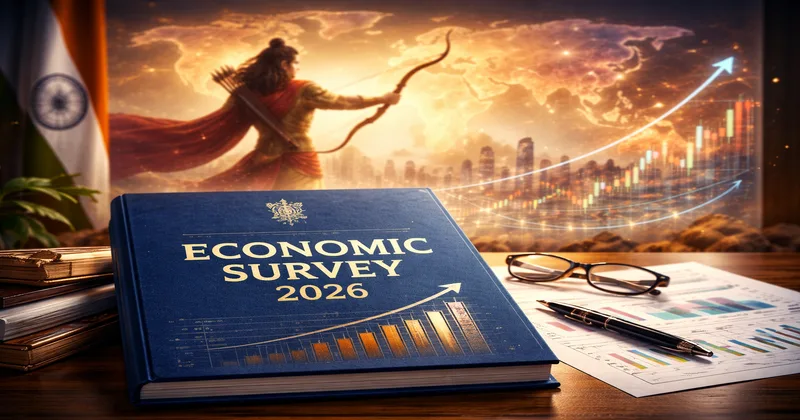
India’s Economic Survey 2026 reaches beyond balance sheets and growth charts, invoking a civilisational metaphor from the Ramayana to frame one of its starkest warnings yet about the global order. In a section titled “Deepening uncertainties lie ahead,” the Survey draws from the Yuddha Kanda, recalling the moment after Ravana’s defeat when Bhagwan Ram urges Lakshman to learn wisdom even from an adversary—without absorbing his values.
The message is unmistakable. In a world where trade, capital flows, technology and supply chains are increasingly weaponised, learning from rivals is not weakness. Dependence, however, is.
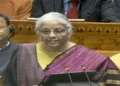
Tabled in Parliament on January 29 by Finance Minister Nirmala Sitharaman, the Survey argues that the assumptions underpinning three decades of globalisation—predictable rules, open markets and apolitical interdependence—are eroding rapidly. What is emerging instead is a more fragile, contested global economy shaped by strategic rivalry rather than efficiency.
The Ramayana metaphor sets the stage for the Survey’s analysis of China’s Hainan Free Trade Port, which became fully operational in December 2025. Unlike conventional special economic zones, Hainan transforms an entire island province into a low-tariff, services-oriented trade and investment hub, marked by relaxed customs procedures, tax incentives, easier visas and fewer capital controls.
For India, the Survey cautions, Hainan is not an immediate shock but a slow, structural shift. Over time, it could reshape supply-chain routes, tourism flows and investment patterns across Asia and the northern Indian Ocean. Its importance lies less in direct competition and more in its timing—emerging precisely as the global economy becomes less coordinated and more politically charged.
The Survey notes that trade, finance and technology can no longer be treated as neutral economic variables. They are now deeply entangled with national security and geopolitics. This reality, it argues, marks the end of the era when countries could simply “muddle through” periods of global stress.
Despite global growth holding up better than expected through 2025, the Survey warns that the probability of moderate to severe disruption in global affairs now exceeds the likelihood of a stable status quo. For India, which remains reliant on global capital flows, this raises concerns around liquidity buffers, external financing and the risk of sudden capital flight.
New vulnerabilities are also emerging. The Survey flags potential pressures from US dollar-linked stablecoins, which could complicate capital movement and financial stability in an already volatile environment.
Yet the assessment is not alarmist. The Survey maintains that India is better positioned than many economies to sustain growth, citing its domestic demand base, improving macroeconomic fundamentals and institutional reforms. But it is candid about persisting vulnerabilities—particularly dependence on external capital, energy imports and critical inputs such as fertilisers.
Resilience, the document stresses, is not automatic. It must be built deliberately through stronger institutions, competitive firms and a culture of rule-based governance. Citizens and businesses alike, the Survey argues, must internalise rules rather than negotiate around them.