In the civilisational vision of India, health has never been conceptualised as an independent state issue. Right from the village vaidya systems to the contemporary institutions of medical excellence, swasthya has been perceived as an integral part of social cohesion, economic efficiency and national preparedness. The Union Budget 2026-27, presented by Finance Minister Nirmala Sitharaman, focuses on the commitment to this long-term vision of nation-building, aligning with Viksit Bharat 2047 and Aatmanirbhar Bharat.
This tradition of community-based healthcare effortlessly integrates with the ever-expanding public health infrastructure of the State under the National Health Mission and the integrating framework of Ayush systems. The ground-level presence of bodies like Seva Bharati has often been in align with the NHM emphasis on maternal health, nutrition, sanitation and disease prevention, while its stress on yoga, Ayurveda and lifestyle interventions has been in sync with the Ayush model. he Union Budget 2026–27 builds upon this broader ecosystem, recognising that sustainable health outcomes arise from the convergence of community service, institutional capacity and public investment for national health.
This years budget represents a continuity and gradually bold consolidation of indigenous strength, decentralised infrastructure development and universal access. When the country is confronted with the double challenge of an ageing population and an increasing incidence of non-communicable diseases, the healthcare budget allocations support the governance vision that is firmly grounded in Antyodaya, self-reliance and long-term institutional transformation.
Health Sector: Strengthening the Foundations
The Ministry of Health & Family Welfare is allocated Rs 1,05,530.42 crore in FY 2026-27, registering an increase of 8.96% over the revised estimates of FY 2025-26. This is over 176 per cent cumulative growth since FY 2014-15, which speaks volumes about the commitment of the present government and not just fiscal statements.
In this budgt the scheme-based expenditure is set to increase by Rs 6,175.96 crore (10.78 per cent), and the non-scheme expenditure by Rs 2,500.96 crore (6.32 per cent). This balanced approach will not only strengthen the delivery mechanisms of primary healthcare, disease control and public health infrastructure but also supports cutting-edge research and institutional strengthening.
The allocation is a result of a comprehensive transformation that is in line with the Prime Minister of India, Narendra Modi’s vision of health being one of the foundational pillars of Viksit Bharat. This increase in budget is not metro-centric but is designed to reach the states and districts.
National Health Mission: Antyodaya in Action
At the grassroots level the National Health Mission (NHM) remains the backbone of the public healthcare system in India. The allocation increases to ₹39,390 crore, up by Rs 2,289.93 crore (6.17 per cent) from the previous year.
The NHM role is very important in the aspirational districts and rural areas of the country, where the results are not measured by the headline institutions but by the last-mile workers, sub-centres and district hospitals. The increased allocation is a sign of a governance approach that emphasises seva and samarpan, which are core to the RSS ideology.
Expanding Medical Education and Infrastructure
The Pradhan Mantri Swasthya Suraksha Yojana (PMSSY), which provides support for the growth of AIIMS and the tertiary sector, gets Rs 11,307 crore, an increase of Rs 407 crore (or 3.73 per cent). This will help 22 AIIMS, out of which 18 are already operational, and has led to the doubling of MBBS and nursing seats since 2014.
This growth is not just about scaling up but also about addressing the imbalances of the past. By locating AIIMS in areas that lack access to quality healthcare, the strategy not only promotes equitable access but also helps create a pool of medical talent that is a critical ingredient for self-reliance in the healthcare sector.
Ayushman Bharat: Insurance with Indian Characteristics
Ayushman Bharat continues to be an integral part of the universal health coverage strategy in India. The Pradhan Mantri Jan Arogya Yojana (PM-JAY) has been allocated Rs 9,500 crore, a rise of ₹500 crore (5.56%) over the revised estimates of FY 2026. This will continue to provide cashless access to healthcare for over 50 crore beneficiaries.
The continued reliance on the Pradhan Mantri Swasthya Suraksha Nidhi is a symbol of fiscal prudence and not populism. The PM-JAY scheme, which is insurance-based, technology-driven and beneficiary-centric, shows how social welfare can be delivered in a cost-effective manner without distorting markets.
Health Infrastructure Mission and Digital Public Goods
The Pradhan Mantri Ayushman Bharat Health Infrastructure Mission (PM-ABHIM) records a drastic increase of 67.66 per cent, touching Rs 4,770 crore. This includes ₹570 crore as central sector support and Rs 4,200 crore as centrally sponsored components. The emphasis is on critical care hospital blocks, diagnostic labs and district-level infrastructure less flashy than mega hospitals but much more important.
To complement the infrastructure development is the Ayushman Bharat Digital Mission, which records an increase of 7.94% to touch ₹350 crore. By facilitating digital health records, telemedicine and interoperability, India is continuing to develop health sector digital public goods, which is the often-overlooked aspect of Aatmanirbhar Bharat.
Ayush: Civilisational Knowledge in Public Health
The Ministry of Ayush is allocated Rs 4,408.93 crore, an increase from Rs 3,671.82 crore in the FY 2026 revised estimates. The National Ayush Mission itself sees a transfer of Rs 1,275 crore from the states, boosting Ayurveda, Yoga, Unani, Siddha and Homoeopathy systems at the grassroots level.
The establishment of three new All India Institutes of Ayurveda signals a major move towards formalising traditional knowledge systems. Although the budget for the existing AIIAs is set at Rs 270.2 crore, the focus is on development and integration rather than mere preservation.
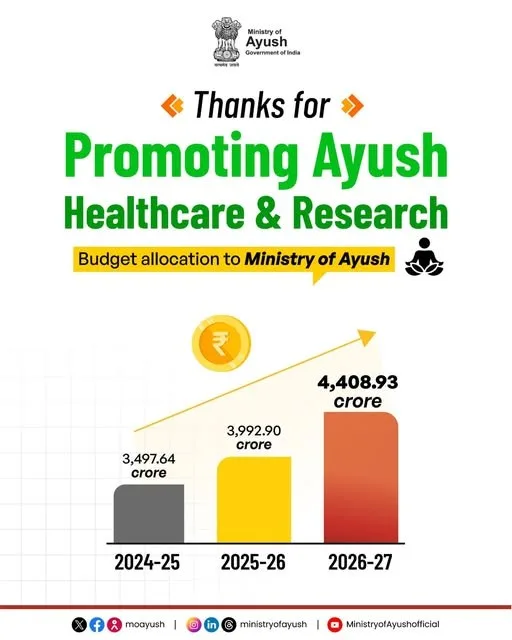
Government increases budget for Ayush in Public Health
The incorporation of Ayush into the public health system via the Ayurswasthya Yojana and Centres of Excellence, revised to Rs 16.75 crore indicates a strategy that seeks to combine preventive, lifestyle and cultural approaches with modern medicine.
Emergency Care, Human Resources and Allied Health
The budget reaffirms the commitment to “24×7 emergency care for all,” with trauma centers to be established in each district hospital. Improvements in cancer centres, super-speciality blocks and AI-based facilities enhance secondary and tertiary care.
The Human Resources for Health gets Rs 1,725 crore, a 5.83 per cent hike which will help increase medical and nursing colleges. In addition, a three-year plan of Rs 980 crore will help set up allied health institutes in 10 disciplines, producing one lakh professionals and 1.5 lakh geriatric caregivers.
This allocation not only meets the demographic imperatives but also makes India the world leader in healthcare manpower and healthcare export from strength.
Research, Pharma and Strategic Capability
The Department of Health Research is allocated ₹4,821.21 crore, a 24 per cent hike and 176 per cent increase since 2014. The Indian Council of Medical Research is allocated Rs 4,000 crore, a 26.98 per cent increase from the previous year.
The “Bio Pharma Shakti” initiative with an outlay of ₹10,000 crore over five years indicates the government’s intent. The program includes biologics, biosimilars, three new NIPERs, seven upgradations and 1,000 clinical trial sites. Enhancing CDSCO and providing exemptions on customs duty for 17 life-saving drugs and seven rare disease drugs further emphasises pharmaceutical autonomy.
Mental Health, Disease Control and Equity
Mental health facilities get an upgrade with improvements in Ranchi and Tezpur institutions and the announcement of a new NIMHANS facility in North India. The National AIDS and STD Control Programme gets a 30.64 per cent hike to Rs 3,477 crore, while blood services increase to Rs 275 crore, a 37.5 per cent.
The allocations to the Central Government Health Schemes increase to ₹8,697.86 crore (7.29 per cent) and for central hospitals the allocation is Rs 4,599.66 crore (9.34 per cent ). AIIMS New Delhi and PGIMER Chandigarh also get increased allocations, maintaining excellence in tertiary care.
The media has reported the magnitude of the health expenditure of Rs 1.05 lakh crores, the robustness of PM-JAY and the expansion of the Ayush institutions. The important aspect is the continuity of institution-building and not experimenting with new models.
Ranging from insurance-based protection and digital health infrastructure to indigenous systems of medicine and cutting-edge research, the Union Budget 2026-27 treats healthcare as a social responsibility and a strategic resource. It reiterates a ‘Made in India’ model of development, Swadeshi-inspired, technology-driven and civilisation-based.