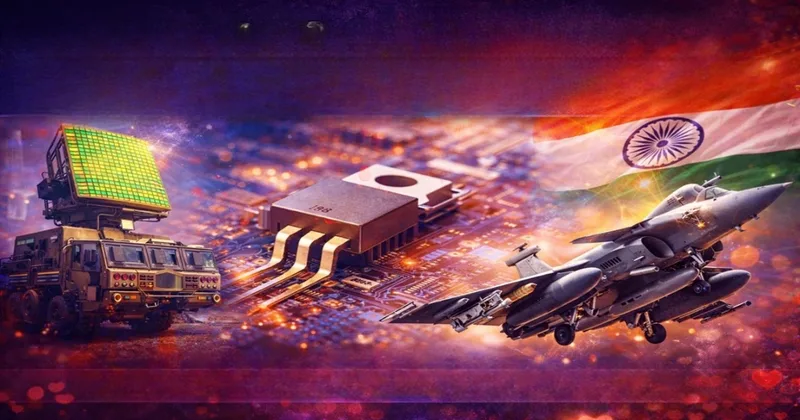
In a major strategic victory to defend the national security apparatus, India has cracked the secret code of Rafale that was rejected by France to transfer to India. The Defence Research and Development Organisation(DRDO), country’s premium defence think tank has indigenously developed the Gallium Nitride(GaN) semiconductor chips, which is a critical and cutting-edge technology underlying the overarching defensive performance of the Rafale fighter aircrafts. With this incredible innovation, India has etched a place in the global elite military club.
This is hence the saga of India from denial to development. A story that resonates the stellar indigenous defence capabilities of India and its resolve to seek strategic autonomy and self-reliance in the path comprehending the national security architecture. With the indigenous development of the Gallium Nitride semiconductor chip that is a critical component for the Rafale fighter aircrafts, India is among the elite military club who have cracked this state-of-the-art technology code that includes only six nations-the US, France, Russia, Germany, South Korea and China.
France denial to transfer technology and the path ahead
The resolve of India to craft a fully indigenous cutting-edge technology, the Gallium Nitride semiconductor chip was stimulated as France rejected to transfer the technology to manufacture the chips in India. In the year 2016, an intergovernmental agreement was signed between India and France for the procurement of 36 Rafale fighter jets. The deal had a mandatory 50 per cent offset clause. This clause translated to the acknowledgement that French-based firms should reinvest the money in India, which was hitherto transferred under the Rafale deal.
Accordingly, Rs. 30,000 crore has to be rechannelized into India in the form of technology transfer, business opportunities or research and development support. As per this clause, India pitched with France to transfer the technology related to the development of Gallium Nitride(GaN) chips. However, France refused to transfer this chip manufacturing technology to India under the offset framework. France aimed to retain the exclusivity of the GaN chips given its strategic importance and state-of-the-art potential. With this denial, Paris aspired to maintain the primacy in critical military technology.
Rejection led to resolve and innovation
This rejection to transfer the technology underlying the solid performance of the Rafale fighter jets, made India innovate and craft indigenous Gallium Nitride chips. DRDO, in a decisive step, invented this critical compound semiconductor technology with holistic indigenous elements. The indigenous development of the GaN chips was deemed as a strategic mission and commitment to defend national security. The intense experiments, trial and errors conducted at the Solid State Physics Laboratory of the DRDO, ultimately yielded results, thus championing India as an emerging epicentre for state-of-the-art defence manufacturing.
With the accomplishment of manufacturing GaN with fully home-grown technology and components, India has scripted history in the geopolitical landscape which is earmarked with unanticipated conflicts and unprecedented threats, where self-reliant military apparatus is inevitable to defend the sovereignty. Moreover, the emerging nature of modern warfare which is attributed beyond conventional methods, demands self-reliance and mastery in military technology. The latest innovation of GaN chips strikes merits for India in this domain of kinetic warfare which is predominantly autonomous and unmanned.
Technical soundness and military superiority of GaN chips
The Gallium Nitride(GaN) semiconductor chips are monolithic microwave integrated circuits(MMICs). They are also called compound semiconductors as they combine more than one element and are used in specialized and complex operations. They have higher efficiency and swift switching capabilities(300 times faster than the silicon semiconductor chips) and are suitable for extreme environments because of greater chemical stability & inertness, thus suitable for military operations. They also have high stability at extreme temperatures and have very less transmission loss. These unique features make GaN chips extremely strategic and vital in the defence set up.
Due to its cutting-edge features, GaN chips widely help in navigation, range finding, night vision and surveillance, camouflage detection, target tracking, missile guidance, imaging amidst fog, mist and intense clouds and other forms of emerging electronic warfare. Thus, they are extensively used in advanced military drones, missiles, radars, fighter aircrafts and naval platforms. To illustrate, using GaN chips in the sensors helps to analyse and interpret movement, light, sound, pressure and other surrounding changes. It will instantly convert these physical aspects into signals and will swiftly trigger the necessary kinetic action to protect national security.
With the invention of GaN chips, thus India has triggered a revolution in military technology as the nature of warfare undergoes a significant change. With the attributes of 21st century warfare accelerating a monumental transformation in terms of pace, uncertainty and the underlying technology, an indigenous GaN chip, will add a big strategic advantage to India in protecting the nation from enemy threats. This will help India, indigenously develop the critical military weapon systems with sheer swiftness without any foreign dependence. This is a clear sign of strategic autonomy and self-reliance.
Foreign Denials and endless delays led to innovatation: DRDO
While speaking to a private media platform, Suma Varughese, Director General of the Micro Electronic Devices and Computational Systems & Cyber Security, DRDO, asserted that delay or denial by the foreign companies to render the strategic GaN chips could disrupt the ambitious defence programmes of India. Export control, hegemonic ambitions and resistance to technology transfer, export restrictions under the International Traffic in Arms Regulation could act as a prickle in the path of India’s defence indigenisation and manufacturing vision. Thus, seeking self-reliance in critical military technologies such as GaN chips is vital. Suma Varughese further explained that depending on foreign sources for strategic technology is no longer feasible. Given the extent of geopolitical uncertainty and power competition an embargo can arrive at any moment. Thus, self-reliance in critical military technologies is the bedrock to boost sovereign capabilities.
Meena Mishra, Director of the SSPL wing of DRDO, further explained the intense process involved in developing the GaN chips. “Reaching that point involved a long technology development process. The teams have worked day and night to make it happen. One cycle of fabrication and testing takes around 80 days and involves hundreds of processes; each has to be executed to its finest detail. The final run is carried out once optimization of all processes has been finished. In layman’s language the dough is now ready; India can use it to make any bread of its choice”, Meena Mishra explained while speaking to a private media platform.
India: The emerging hub for strategic military technology
The Gallium Nitride compound semiconductor chips developed by DRDO is not just a lab prototype. They are ready for integration and deployment. They can be inflicted into Rafale and other missiles, drones or other aircraft systems. This has rendered India a massive strategic merit in the geopolitical calculus. India is emerging as a dominant player and powerhouse in military technology in Asia and beyond. World nations are turning towards India as a credible defence partner, as it is capable of keeping the defence supply chain intact.
Self-sufficiency in critical defence technology also helps India to carve strategic deterrence against enemy threats. It boosts strategic independence to take swift decisions and actions by reducing dependency on alien nations that too in a cost effective manner. Thus, with the indigenous invention of the GaN chips, India has heralded a new chapter in the global military technology paradigm and in the regional geopolitical latitude. A micro chip crafted by New Delhi has indeed redefined the security and strategic algorithm across the emerging nature of non-conventional warfare. India is at the epicentre of this strategic shift and defence indigenisation momentum, which ensures national, regional and collective security devoid of tilted hegemonic aspirations. The invention helps to ensure balance of power as well.