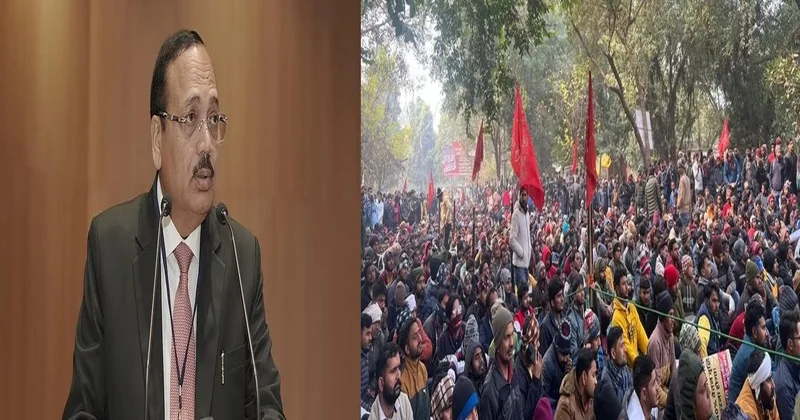
Trade unions have stalled India’s industrial growth: CJI Surya Kant
June 10, 2026
  • Read Ecopy
  • Circulation
  • Advertise
  • Careers
  • About Us
  • Contact Us
Android AppiPhone AppArattai
Organiser
  • ‌
  • Bharat
    • Assam
    • Bihar
    • Chhattisgarh
    • Jharkhand
    • Maharashtra
    • View All States
  • World
    • Asia
    • Europe
    • North America
    • South America
    • Africa
    • Australia
  • Editorial
  • International
  • Opinion
  • RSS @ 100
  • More
    • Op Sindoor
    • Analysis
    • Sports
    • Defence
    • Politics
    • Business
    • Economy
    • Culture
    • Special Report
    • Sci & Tech
    • Entertainment
    • G20
    • Azadi Ka Amrit Mahotsav
    • Vocal4Local
    • Web Stories
    • Education
    • Employment
    • Books
    • Interviews
    • Travel
    • Law
    • Health
    • Obituary
  • Subscribe
    • Subscribe Print Edition
    • Subscribe Ecopy
    • Read Ecopy
  • ‌
  • Bharat
    • Assam
    • Bihar
    • Chhattisgarh
    • Jharkhand
    • Maharashtra
    • View All States
  • World
    • Asia
    • Europe
    • North America
    • South America
    • Africa
    • Australia
  • Editorial
  • International
  • Opinion
  • RSS @ 100
  • More
    • Op Sindoor
    • Analysis
    • Sports
    • Defence
    • Politics
    • Business
    • Economy
    • Culture
    • Special Report
    • Sci & Tech
    • Entertainment
    • G20
    • Azadi Ka Amrit Mahotsav
    • Vocal4Local
    • Web Stories
    • Education
    • Employment
    • Books
    • Interviews
    • Travel
    • Law
    • Health
    • Obituary
  • Subscribe
    • Subscribe Print Edition
    • Subscribe Ecopy
    • Read Ecopy
Organiser
  • Home
  • Bharat
  • World
  • Operation Sindoor
  • Editorial
  • Analysis
  • Opinion
  • Culture
  • Defence
  • International Edition
  • RSS @ 100
  • Magazine
  • Read Ecopy
Home Bharat

SC slams Communists: “Trade unions have stalled India’s industrial growth,” says CJI Surya Kant

In sharp and candid remarks on labour reforms and trade unionism in India, Chief Justice of India Surya Kant on observed that trade unions were “largely responsible” for stalling industrial growth across the country, leading to the closure of numerous traditional industrial units

WEBDESKWEBDESK
Jan 29, 2026, 05:00 pm IST
in Bharat, Delhi, Law
Follow on Google News
Trade unions have hurt industrial growth, many units shut because of them: CJI Surya Kant

Trade unions have hurt industrial growth, many units shut because of them: CJI Surya Kant

FacebookTwitterWhatsAppTelegramEmail

NEW DELHI: In a set of candid and far-reaching observations on trade unionism, labour reforms, and industrial growth, Chief Justice of India (CJI) Surya Kant on January 29 remarked that trade unions were “largely responsible” for stalling the country’s industrial development and forcing the closure of several traditional industries. The remarks were made during the hearing of a public interest litigation (PIL) seeking welfare measures and minimum wage protection for domestic workers, a case the Supreme Court ultimately declined to entertain.

A Bench comprising Chief Justice Surya Kant and Justice Joymalya Bagchi was hearing a petition filed by Penn Thozhilargal Sangam and other workers’ unions, which sought to bring domestic workers under minimum wage notifications and provide statutory welfare safeguards. However, the proceedings quickly widened into a broader critique of trade union practices, labour market realities, and the unintended consequences of well-intentioned reforms.

CJI Surya Kant 🔥

"How many industrial units closed in the country due to trade unions..they are largely responsible for stopping industrial growth in the country…."
(Livelaw) pic.twitter.com/EE7IsgHz5s

— Megh Updates 🚨™ (@MeghUpdates) January 29, 2026

PIL on Domestic Workers and Court’s Initial Reluctance

As soon as the matter was taken up, the Chief Justice expressed disinclination to entertain the petition, cautioning that judicial intervention in this sphere could lead to excessive litigation at the household level.

“If you enforce minimum wages across the board, every household will be in litigation,” CJI Kant remarked, indicating that domestic employment, by its very nature, differed from industrial or institutional labour.

The petitioners sought directions to the Union and State governments to extend minimum wage protections to domestic workers, arguing that the absence of such safeguards resulted in systemic exploitation and violated constitutional guarantees under Articles 21 and 23.

‘Trade Unions Have Shut Down Industries’: CJI’s Strong Remarks

During the hearing, CJI Kant made sharp comments on the role of trade unions in India’s industrial decline, stating that excessive unionism had crippled productivity and driven industries to closure.

“How many industrial units in the country have been closed thanks to trade unions? Let us know the realities. All traditional industries in the country, all because of these jhanda unions, have been closed,” the Chief Justice observed.

He further remarked that many trade union leaders resisted work and reforms, instead obstructing growth. While acknowledging that labour exploitation existed, the CJI argued that it should have been addressed through awareness, skill development, and structural reforms rather than disruptive unionism.

“Of course exploitation is there, but there are means to address exploitation. People should have been made more aware of their individual rights, more skilled. Several other reforms should have been done,” he said.

Minimum Wages and the Risk of Job Losses

CJI Kant repeatedly cautioned against rigid wage mandates, especially in a country grappling with high unemployment and skewed demand-supply dynamics.

“You fix a minimum wage, people will refuse to hire. This will cause further hardship,” he said, warning that excessive regulation could unintentionally reduce employment opportunities, particularly for informal workers like domestic help.

Senior Advocate Raju Ramachandran, appearing for the petitioners, countered that collective bargaining was a legitimate and effective mechanism, stressing that the unions involved were registered bodies and not “interlopers.” He urged the Court not to generalise trade unions.

However, the Chief Justice maintained that such generalisations were grounded in decades of observed outcomes.

Employment Agencies as ‘Real Exploiters’

Shifting focus, the CJI identified employment agencies as the primary exploiters of domestic workers in urban India, arguing that over-regulation had paved the way for intermediaries who profited at the workers’ expense.

“In all major cities, these big entities are there, who are exploiting these people. They are the real exploiters,” CJI Kant said, adding that he could not even use the term commonly associated with such agencies in open court.

He cited a startling example from the Supreme Court itself: while the apex court paid Rs 40,000 per worker to an agency, the actual worker received only Rs 19,000.

“I have personally and officially seen this,” he said, underlining the deep disparity created by intermediary-driven employment.

Trust-Based Domestic Employment vs Institutional Hiring

CJI Kant also spoke about the erosion of trust in domestic employment, suggesting that traditional household arrangements often rested on personal relationships rather than contractual enforcement.

“Millions of families engage domestic help and treat them as part of the extended family. They stay in the same house, have the same food, because the element of trust is there,” he observed.

He warned that replacing this trust with agency-mediated hiring could lead to alienation and even criminal incidents due to the absence of a human connection.

Constitutional Arguments and State Responsibility

Ramachandran argued that paying inadequate wages amounted to bonded labour or begar, relying on the Supreme Court’s judgment in Bandhua Mukti Morcha. He submitted that the exclusion of domestic workers from minimum wage notifications was arbitrary and violated Articles 21 and 23 of the Constitution.

He also pointed out that while some States had notified minimum wages for domestic workers, many had failed to do so, despite the nature of domestic employment remaining consistent across states.

However, the Union Government maintained that labour regulation fell within the domain of the States.

Court Declines Mandamus, Urges States to Act

Ultimately, the Bench refused to entertain the petition, holding that the reliefs sought amounted to a judicial directive to enact legislation, which was beyond the Court’s jurisdiction.

“The reliefs sought are in the nature of mandamus to enact laws, which this Court cannot direct,” the Bench observed.

The petition was disposed of with an advisory to States to examine the grievances raised by domestic workers and consider appropriate measures, leaving the larger policy debate open-ended.


Topics: Supreme Court Of IndiaChief Justice Surya KantSenior Advocate Raju Ramachandran
ShareTweetSendShareSend
✮ Subscribe Organiser YouTube Channel. ✮
✮ Join Organiser's WhatsApp channel for Nationalist views beyond the news. ✮
Previous News

Millets Queen of Madhya Pradesh: How Lahari Bai, a Vanvasi farmer, is preserving over 150 traditional Millet varieties

Next News

Love Jihad in Karnataka: Kodagu sees huge protest over alleged rise in interfaith marriages

Related News

SIR and Article 324: Supreme Court strengthens the constitutional spine of Indian Democracy; Reaffirms ECI’s authority

Supreme Court of India bench hears Sabarimala review pleas as Justice B. V. Nagarathna questions non-devotee challenges to rituals

Sabarimala Case: “Believers don’t question rituals; non-believers can’t challenge them,” says Justice B. V. Nagarathna

During Sabarimala review hearings, Supreme Court underscores limits of reform and cautions against diluting core religious beliefs

Religion cannot be “Hollowed Out” in the name of social reform, says Supreme Court in Sabarimala case

Supreme Court hearing focuses on mandir customs, faith practices, and the balance between rights and religious traditions

Sabarimala Women Entry Case: Supreme Court says Mandir rituals must be followed, stresses limits of judicial role

SIR process happening across Bharat (Representative image)

‘Won’t tolerate’: CJI warns against questioning judicial officers during Bengal SIR

Representative image

Beyond Religious Freedom: How the Chhattisgarh burial case has become a test of Vanvasi land rights & village autonomy

Load More

Latest News

India Deploys 12 Nuclear Warheads: Heralds doctrinal shift to script strategic deterrence against multi-front threat

J&K: Zojila tunnel clears key hurdle; Signals new era of connectivity for Ladakh

How Cockroach politics is hollowing out Bharatiya democratic culture

RSS centenary year is a time for renewed resolve and greater commitment to nation-building: Dr Mohan Bhagwat

Ex-DMK Minister Senthil Balaji (Right Side-File Photo)

Tamil Nadu: CBI books Rs 397 cr transformer tender scam from ex-DMK Minister Senthil Balaji’s tenure (2021-2023)

Border Security Force (BSF) officials inspect the Single Row Fencing (SRF) at a Border Out Post area (India-Bangladesh border)

Infiltration and Border Management: Saving the Siliguri corridor

External Affairs Ministry spokesperson Randhir Jaiswal, slams Pakistan over the recent killings in POJK

‘Hope Pakistan is held accountable’: India reacts after 20 killed in Pakistan Occupied Jammu & Kashmir

China’s anti-BLA offensive hits snag as UN members demand proof

UN Setback for China and Pakistan: US and allies stall move to ban Baloch Liberation Army

West Asia Conflict: Collective response to energy crisis

Atul Limaye Ji Sah Sarkaryavah, Rashtriya Swayamsevak Sangh while addressing a Pramukh Jan Gosthi Rashtriya at Raipur, Chhattisgarh

Chhattisgarh: Society must lead its own transformation through collective initiative: Atul Limaye

Load More
  • Privacy
  • Terms
  • Cookie Policy
  • Refund and Cancellation
  • Delivery and Shipping

© Bharat Prakashan (Delhi) Limited.
Tech-enabled by Ananthapuri Technologies

  • Home
  • Search Organiser
  • Bharat
    • Assam
    • Bihar
    • Chhattisgarh
    • Jharkhand
    • Maharashtra
    • View All States
  • World
    • Asia
    • Africa
    • North America
    • South America
    • Europe
    • Australia
  • Editorial
  • Operation Sindoor
  • Opinion
  • Analysis
  • Defence
  • Culture
  • Sports
  • Business
  • RSS @ 100
  • Entertainment
  • More ..
    • Sci & Tech
    • Vocal4Local
    • Special Report
    • Education
    • Employment
    • Books
    • Interviews
    • Travel
    • Health
    • Politics
    • Law
    • Economy
    • Obituary
  • Subscribe Magazine
  • Read Ecopy
  • Advertise
  • Circulation
  • Careers
  • About Us
  • Contact Us
  • Policies & Terms
    • Privacy Policy
    • Cookie Policy
    • Refund and Cancellation
    • Terms of Use

© Bharat Prakashan (Delhi) Limited.
Tech-enabled by Ananthapuri Technologies