Chhattisgarh Burial Case: Test of Vanvasi land rights
June 10, 2026
  • Read Ecopy
  • Circulation
  • Advertise
  • Careers
  • About Us
  • Contact Us
Android AppiPhone AppArattai
Organiser
  • ‌
  • Bharat
    • Assam
    • Bihar
    • Chhattisgarh
    • Jharkhand
    • Maharashtra
    • View All States
  • World
    • Asia
    • Europe
    • North America
    • South America
    • Africa
    • Australia
  • Editorial
  • International
  • Opinion
  • RSS @ 100
  • More
    • Op Sindoor
    • Analysis
    • Sports
    • Defence
    • Politics
    • Business
    • Economy
    • Culture
    • Special Report
    • Sci & Tech
    • Entertainment
    • G20
    • Azadi Ka Amrit Mahotsav
    • Vocal4Local
    • Web Stories
    • Education
    • Employment
    • Books
    • Interviews
    • Travel
    • Law
    • Health
    • Obituary
  • Subscribe
    • Subscribe Print Edition
    • Subscribe Ecopy
    • Read Ecopy
  • ‌
  • Bharat
    • Assam
    • Bihar
    • Chhattisgarh
    • Jharkhand
    • Maharashtra
    • View All States
  • World
    • Asia
    • Europe
    • North America
    • South America
    • Africa
    • Australia
  • Editorial
  • International
  • Opinion
  • RSS @ 100
  • More
    • Op Sindoor
    • Analysis
    • Sports
    • Defence
    • Politics
    • Business
    • Economy
    • Culture
    • Special Report
    • Sci & Tech
    • Entertainment
    • G20
    • Azadi Ka Amrit Mahotsav
    • Vocal4Local
    • Web Stories
    • Education
    • Employment
    • Books
    • Interviews
    • Travel
    • Law
    • Health
    • Obituary
  • Subscribe
    • Subscribe Print Edition
    • Subscribe Ecopy
    • Read Ecopy
Organiser
  • Home
  • Bharat
  • World
  • Operation Sindoor
  • Editorial
  • Analysis
  • Opinion
  • Culture
  • Defence
  • International Edition
  • RSS @ 100
  • Magazine
  • Read Ecopy
Home Bharat

Beyond Religious Freedom: How the Chhattisgarh burial case has become a test of Vanvasi land rights & village autonomy

The burial dispute from Bastar, now before the Supreme Court of India, has moved beyond religious freedom, raising deeper questions about Vanvasi ancestral land and village autonomy. At its core, the case tests the balance between individual rights and constitutionally protected community governance in Scheduled Areas

WEBDESKWEBDESK
Feb 28, 2026, 04:00 pm IST
in Bharat, Chhattisgarh
Follow on Google News
Representative image

Representative image

FacebookTwitterWhatsAppTelegramEmail

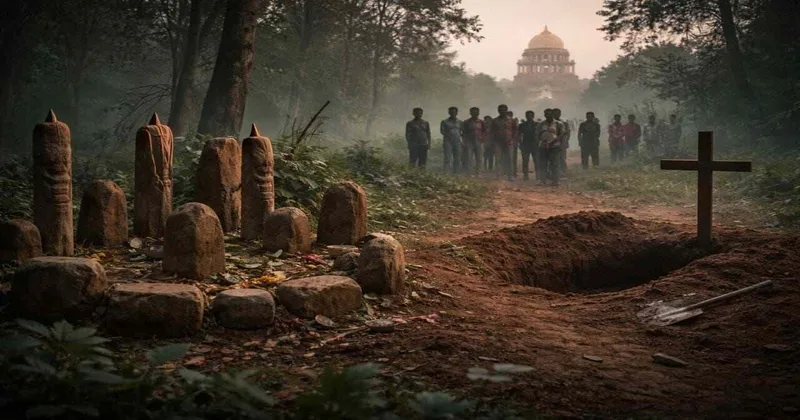
The Chhattisgarh burial dispute now pending before the Supreme Court of India has evolved beyond a narrow question of religious freedom. For many Vanvasi communities, it represents what they see as an unethical assertion over ancestral land and a direct challenge to village autonomy.

On February 18, 2026, while hearing a petition titled Chhattisgarh Association for Justice and Equality & Ors. v. State of Chhattisgarh, the Supreme Court issued notice and, through an interim order, directed that no further exhumation of bodies buried in Chhattisgarh would be permitted.

Many Vanvasi communities perceive it as an external religious claim over their ancestral lands. For them, village boundaries, forest tracts, and traditional cremation grounds are not just parcels of land; they are sacred spaces connected to ancestors, shrines, and community identity. The establishment of new burial sites for what they regard as foreign religious practices within village limits, or the installation of religious symbols on private land, is seen as interference with their cultural and spiritual fabric.

The petitioners’ synopsis argues that they are being prevented from using burial sites within village limits while other communities are permitted to do so. Although the Supreme Court has halted further exhumations and issued notice, a final decision is yet to be delivered. Meanwhile, debate has intensified over whether private religious claims on village community land align with the constitutional framework.

Earlier, on January 16, 2025, the Chhattisgarh High Court ruled that allowing such burials within village limits could disturb public order, noting that a separate Christian cemetery was already available nearby. The court clarified that last rites could be conducted there, but burials on private land within the village would not be permitted. Many Vanvasi groups viewed this as an affirmation of their traditional governance structure.

Also Read: PM Modi becomes first world leader to cross 100 million followers on Instagram

Under the Panchayat Raj Rules of 1999 applicable in the state, no location other than one approved by the Panchayat may be used for the disposal of bodies. The constitutional position also clarifies that while the right to dignity under Article 21 includes the right to a decent funeral, it remains subject to “procedure established by law.” In simple terms, the right to funeral rites exists, but their place and manner can be regulated within the legal framework.

Additionally, under the Fifth Schedule of the Constitution, Gram Sabhas in Scheduled Areas enjoy special protections and powers. These regions cannot be treated as ordinary administrative units; they are constitutionally safeguarded. Therefore, individual rights must be interpreted in harmony with these structural protections and community-based governance systems.

The Bastar region has witnessed several burial-related disputes in recent years. From Kanker to Sukma, attempts by converted Christians to conduct burials on traditional lands have reportedly triggered social tensions. In areas such as Amabeda, allegations of organised efforts to assert land claims through burial practices have also surfaced.

Vanvasi organisations argue that when burials take place on private land without community approval, the act is not merely religious; it creates a permanent marker and, in their view, a long-term claim over sacred land.

At the heart of the controversy lies a larger constitutional question: Is this purely an issue of religious freedom, or does it also concern the moral and legal rights of Vanvasi communities over ancestral lands? If the court treats burial within village boundaries as an absolute right, the authority of the Gram Sabha and Panchayat could be diluted. Conversely, if burial is recognised as a regulated civic activity, the argument for protecting ancestral land and community autonomy may gain strength.

For now, the Supreme Court has only issued notice and ordered maintenance of the status quo. The final verdict will take time. Yet it is evident that the case is no longer just about religious practice. It has become a broader test of Vanvasi identity, community land rights, and constitutional balance.


 

Topics: Panchayat Raj RulesChhattisgarhSupreme Court Of IndiaFifth ScheduleReligious freedomVanvasi rightsBurial disputeGram Sabha powers
ShareTweetSendShareSend
✮ Subscribe Organiser YouTube Channel. ✮
✮ Join Organiser's WhatsApp channel for Nationalist views beyond the news. ✮
Previous News

Al-Falah University Under the Lens: From Red Fort blast terror links to alleged financial & regulatory irregularities

Next News

Swift Action at 14,000 Feet: Indian Army masters high-altitude rescue operations in extreme himalayan terrain

Related News

Once known for maoist violence, Minpa now leads healthcare revolution with telemedicine services in Sukma

From Maoist Stronghold to Healthcare Hub: How Chhattisgarh’s Minpa is transforming through telemedicine & development

200 people, including pastor, return to "original faith" in Chhattisgarh

Ghar wapsi in Chhattisgarh: 200 tribals, including pastor, return to Sanatan Dharma in Kawardha

Headmistress of girls’ primary school suspended for luring students into Christianity, made children recite ‘God is Great’ and ‘Hallelujah’ in morning assembly

Illegal Conversion Row in Chhattisgarh School: Headmistress suspended, replaced ‘Hallelujah’ with prayer

Supreme Court of India bench hears Sabarimala review pleas as Justice B. V. Nagarathna questions non-devotee challenges to rituals

Sabarimala Case: “Believers don’t question rituals; non-believers can’t challenge them,” says Justice B. V. Nagarathna

Corporatisation of grooming gangs: Need clarity over correctness

During Sabarimala review hearings, Supreme Court underscores limits of reform and cautions against diluting core religious beliefs

Religion cannot be “Hollowed Out” in the name of social reform, says Supreme Court in Sabarimala case

Load More

Latest News

Back-to-Back Love Jihad Cases in Lucknow: PGI Woman Goes Missing, Another Alleges Conversion Pressure After Marriage Promise

Back to back Love Jihad in Lucknow: PGI woman missing after meeting Irshad, Another alleges conversion by Zubair Ansari

New update in Nashik TCS Coporate Jihad Case as accused were asked to read a book titled The Life of Muhammad

Nashik TCS Corporate Jihad: Investigators probe claims victims were asked to read book ‘The Life of Muhammad’

MEA hails 12 years of Modi government

MEA celebrates PM Modi’s 12 years in office, says India “witnessed remarkable transformation” in foreign policy

Hawkers protest in West Bengal

The Left’s Selective Morality: From Sainbari to Hawker protests

Odisha CM Mohan Charan Majhi and Union Minister of Law and Justice Arjun Ram Meghwal along with other dignitaries on the stage on the occasion of completion of 12 years of the Central Government

PM Modi’s 12-years of governance marks era of transformation, growth & global recognition: Odisha CM Mohan Majhi

Modi govt clears Rs 13,000 Crore Great Nicobar Airport Project (This is an AI generated image)

India’s strategic move in Great Nicobar: Rs 13,000 crore airport to double strength in the Indian Ocean

Redistricting efforts across the United States continue to redefine electoral boundaries and congressional competition before the 2026 midterms.

America’s electoral map shifts ahead of 2026 Midterms; Courts back redistricting push

India Deploys 12 Nuclear Warheads: Heralds doctrinal shift to script strategic deterrence against multi-front threat

J&K: Zojila tunnel clears key hurdle; Signals new era of connectivity for Ladakh

How Cockroach politics is hollowing out Bharatiya democratic culture

Load More
  • Privacy
  • Terms
  • Cookie Policy
  • Refund and Cancellation
  • Delivery and Shipping

© Bharat Prakashan (Delhi) Limited.
Tech-enabled by Ananthapuri Technologies

  • Home
  • Search Organiser
  • Bharat
    • Assam
    • Bihar
    • Chhattisgarh
    • Jharkhand
    • Maharashtra
    • View All States
  • World
    • Asia
    • Africa
    • North America
    • South America
    • Europe
    • Australia
  • Editorial
  • Operation Sindoor
  • Opinion
  • Analysis
  • Defence
  • Culture
  • Sports
  • Business
  • RSS @ 100
  • Entertainment
  • More ..
    • Sci & Tech
    • Vocal4Local
    • Special Report
    • Education
    • Employment
    • Books
    • Interviews
    • Travel
    • Health
    • Politics
    • Law
    • Economy
    • Obituary
  • Subscribe Magazine
  • Read Ecopy
  • Advertise
  • Circulation
  • Careers
  • About Us
  • Contact Us
  • Policies & Terms
    • Privacy Policy
    • Cookie Policy
    • Refund and Cancellation
    • Terms of Use

© Bharat Prakashan (Delhi) Limited.
Tech-enabled by Ananthapuri Technologies