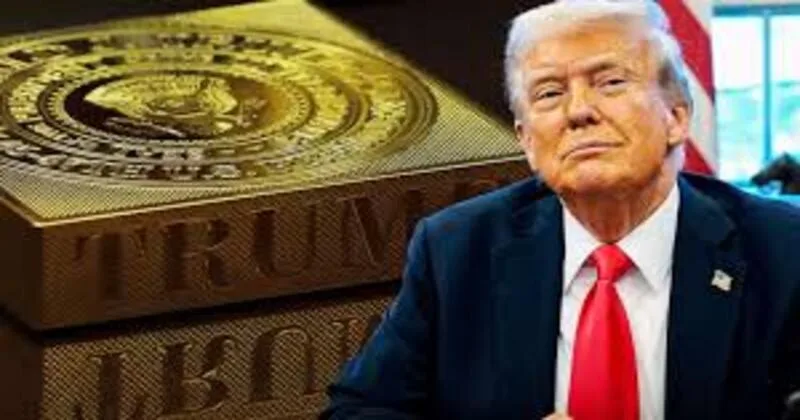
Berlin/ Washington: As US President Donald Trump intensifies tariff threats and the global economy drifts deeper into uncertainty, a growing chorus of voices in Germany is calling for the return of the country’s gold reserves held at the US Federal Reserve. Trump’s unpredictable political conduct, including his controversial announcement about annexing Greenland, has reignited concerns in Berlin about whether the United States remains a reliable custodian of Germany’s most strategic financial asset.
There is an increasing sentiment within Germany that “US can no longer be trusted.” Trump’s aggressive posture on the Greenland issue has shocked German political and economic circles. Several experts warn that Trump could take extreme steps to raise revenue or exert leverage, and that countries whose gold remains under US custody could face serious risks if Washington decides to act unilaterally. Against this backdrop, German lawmakers and economists have renewed calls for the repatriation of gold reserves stored in the United States. These demands have grown louder as global political uncertainty deepens. The renewed debate follows Trump’s announcement signalling a willingness to seize Greenland, an episode that has reinforced fears in Germany about the erosion of international norms. In April last year, senior figures within the Christian Democratic Union (CDU)-led government reportedly discussed the need to bring Germany’s gold back home, citing concerns over trust and sovereignty.
Germany holds the second-largest gold reserves in the world. The country possesses a total of 3,350.25 tonnes of gold. Roughly half of these reserves are stored in Frankfurt, Germany’s fifth-largest city and the headquarters of the Bundesbank. However, about 37 per cent, approximately 1,236 tonnes, are held at the Federal Reserve Bank of New York. A further 13 per cent is stored at the Bank of England in London. In total, it is estimated that around 6,300 tonnes of gold belonging to nearly 30 countries are held in the custody of the US Federal Reserve. Germany’s gold was originally transferred to the United States in the aftermath of the Second World War, when the Soviet Union occupied large parts of Germany. Storing gold abroad was seen as a strategic necessity during the Cold War. However, following the global financial crisis of 2008, political opinion in Germany began to shift. A growing number of lawmakers argued that Germany’s gold should no longer remain overseas and should instead be repatriated to ensure national control and transparency.
Since 2013, the Bundesbank has been gradually implementing a policy to retrieve gold stored abroad. As part of this effort, 300 tonnes of gold were repatriated from New York. An additional 374 tonnes were returned from Paris, where Germany had previously stored gold at the Banque de France. These moves were framed as technical and logistical decisions, but they also reflected deeper anxieties about financial sovereignty. Emmanuel Monch, a prominent economist and former head of research at the Bundesbank, has warned that the current global political climate makes it risky to keep such large quantities of gold in the United States. He argued that if Germany seeks greater diplomatic independence from Washington, reclaiming its gold reserves would be a prudent step. According to Monch, gold is not merely a financial asset but a symbol of national autonomy.
Michel Joger, head of both the European Taxpayers’ Association and the German Taxpayers’ Association, has expressed similar concerns. He stated that it is impossible to predict Trump’s future actions and warned that Trump could resort to any measure to generate revenue. Joger cautioned that if the US were to adopt an aggressive strategy, similar to its stance on Greenland, there could be no guarantee that Germany’s gold would ever be returned. Katharina Beck, finance spokesperson for the opposition Green Party in the German parliament, has also called for the gold’s return. She emphasised that gold plays a critical role in ensuring confidence and economic stability during times of crisis and should never be used as a tool or weapon in international political conflicts.
In contrast, the ruling Christian Democratic Union has downplayed the issue. Stefan Cornelius, a spokesperson for Friedrich Merz’s coalition government, stated that the idea of bringing back gold from the United States had not been seriously considered. Bundesbank President Joachim Nagel has also sought to reassure political leaders and the public. Speaking at an International Monetary Fund meeting in Washington, DC, in October, Nagel said he had no concerns about Germany’s gold reserves held by the Federal Reserve. However, scepticism persists. A previous request by Marco Wanderwitz, a CDU minister, to inspect Germany’s gold stored in the US was rejected, further fuelling doubts among critics. As geopolitical tensions rise and trust in global institutions weakens, the debate over Germany’s gold is likely to remain unresolved.