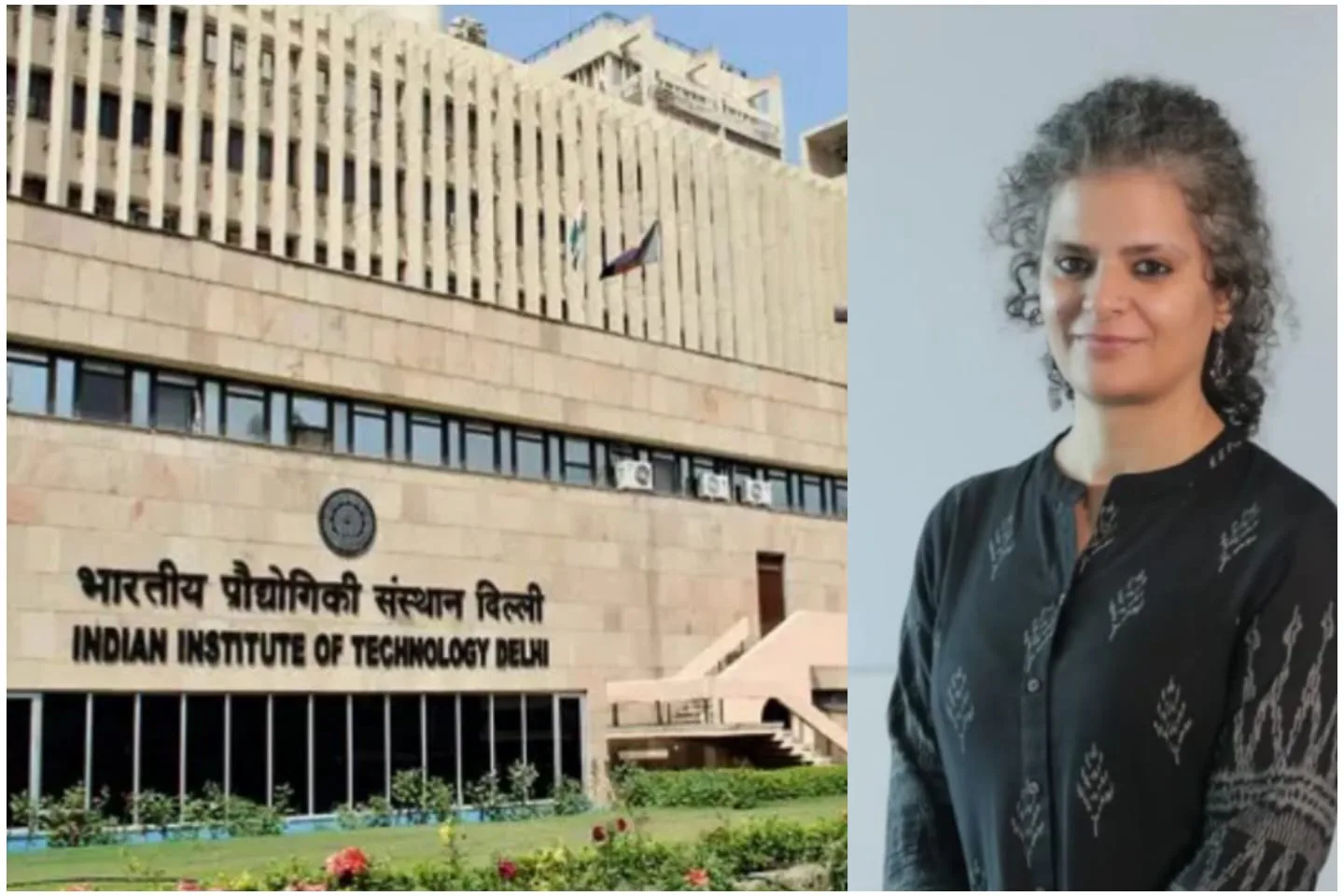
The Indian Institute of Technology (IIT) Delhi, one of the country’s most prestigious publicly funded institutions, is once again at the centre of an ideological storm following renewed attention on a research paper titled “Tyranny of Indian Nationalism and Resistance in Kashmir: Reading a Kashmiri Narrative with Iqbal and Freud.” The paper, authored by Nazia Amin, who is currently listed as an Assistant Professor in the School of Liberal Studies at BML Munjal University and affiliated with IIT Delhi’s Department of Humanities and Social Sciences at the time of publication, has raised serious questions about the academic framing of Kashmir, nationalism, and political resistance within elite Indian universities.
The paper, published online in March 2023 in the journal Psychoanalysis, Culture & Society under Springer Nature, presents Indian nationalism in Kashmir as a coercive and violent force. Drawing heavily on Freudian psychoanalytic theory, particularly the “myth of the primal horde,” the author likens the India’s role in Kashmir to that of a “primal father” seeking obedience and identification from what she terms “non-consenting Kashmiri subjects.”
What the paper argues
According to the abstract and arguments outlined in the paper, Indian nationalism is portrayed as an assimilative project that seeks to “violently extract identification and obedience” from Kashmiris in order to absorb them into an Indian nationalist mass. The paper frames resistance in Kashmir not merely as political dissent but as a form of psychic and existential opposition to Indian national identity.
The author further employs the philosophy of poet-philosopher Muhammad Iqbal to interpret Kashmiri resistance as an act of “disidentification” from Indian nationalism. The narrative suggests that Kashmiri identity must remain distinct and separate from the Indian national framework, presenting resistance as a morally and psychologically necessary act. At one point, the paper explicitly questions whether the Kashmiri resistance movement itself might replicate nationalist demands for unwavering allegiance, but this inquiry is framed within an overarching critique of Indian state authority.
The language used throughout the paper is not neutral. Terms such as “tyranny,” “violent extraction,” “primal father,” and “mass assimilation” are repeatedly invoked, creating a portrayal of the Indian nation-state as inherently oppressive in Kashmir. Such framing goes far beyond academic critique and enters the realm of ideological advocacy.
Institutional affiliation and academic responsibility
What has intensified the controversy is the institutional backdrop against which the paper was produced. The author’s affiliation, as listed in the publication, places her within the Department of Humanities and Social Sciences at IIT Delhi, a department that has in recent years faced repeated criticism for hosting events, conferences, and academic engagements that describe as ideologically one-sided.
IITs are funded by Indian taxpayers and are expected to maintain academic rigour, balance, and neutrality, particularly on sensitive national issues such as Kashmir. While academic freedom is a cornerstone of higher education, detractors argue that freedom does not absolve scholars of responsibility, especially when research outputs align closely with narratives commonly advanced by separatist or anti-national discourse.
The fact that such a paper emerged from within IIT Delhi’s humanities ecosystem has led many to question whether internal peer review mechanisms sufficiently account for national sensitivity, scholarly balance, and the difference between critique and delegitimisation.
A pattern within IIT Delhi’s humanities discourse
The Kashmir paper controversy does not exist in isolation. It follows earlier scrutiny of the Department of Humanities and Social Sciences for hosting the “Critical Philosophy of Caste and Race (CPCR3)” conference, which many observers accused of promoting activist-driven narratives under the guise of academic inquiry.
That conference, held at IIT Delhi’s Senate Hall, featured sessions drawing parallels between Dalits and Palestinians, framed caste issues through global race politics, and repeatedly relied on Western critical theory while offering limited space for alternative Indian civilisational perspectives. The event was chaired by Divya Dwivedi, a recurring figure in several ideologically charged academic forums.
The same intellectual ecosystem that produced CPCR3 also nurtures scholarship that views Indian nationalism primarily through frameworks of oppression, violence, and exclusion, often borrowing conceptual tools from Western postcolonial, psychoanalytic, and critical race theories without sufficient contextual grounding in India’s constitutional, historical, and security realities.
Kashmir: academic inquiry or political positioning?
The Kashmir issue remains one of India’s most sensitive and complex challenges, shaped by decades of terrorism, cross-border interference, constitutional evolution, and human suffering. While scholarly engagement with Kashmir is necessary, portraying Indian nationalism as “tyrannical” without adequately addressing Pakistan-sponsored terrorism, ethnic cleansing of Kashmiri Pandits, or the constitutional framework of Indian sovereignty presents a dangerously incomplete picture.
The paper makes little reference to the violent Islamist insurgency that has plagued the region for decades or the role of external actors. Instead, resistance is largely romanticised as an organic Kashmiri response to Indian nationalism, framed in psychological and philosophical terms rather than geopolitical reality.
This selective framing has led commentators to question whether the paper implicitly legitimises separatist sentiment by couching it in academic language, thereby offering intellectual cover to political narratives that challenge India’s territorial integrity.
Use of Freud and Iqbal: scholarship or symbolism?
Another point of contention is the paper’s reliance on Sigmund Freud’s psychoanalytic allegories and Muhammad Iqbal’s philosophical poetry to interpret contemporary political conflict. While interdisciplinary approaches are common in humanities research, employing metaphors like the “primal father” to describe the Indian state risks reducing complex constitutional and democratic processes into simplistic, emotionally charged symbols.
Iqbal, whose philosophical legacy is itself contested due to his ideological role in the intellectual foundations of Pakistan, is presented as a key lens through which Kashmiri resistance is interpreted. This choice has further fuelled criticism that the paper selectively draws from figures and frameworks aligned with separatist interpretations while sidelining Indian constitutional thought or pluralistic nationalist traditions.
Academic freedom vs public accountability
Supporters of the paper argue that academic freedom must include the right to critique nationalism and state power. They maintain that universities should remain spaces where uncomfortable ideas can be explored without fear of political backlash.
However, opponents counter that academic freedom does not mean ideological monopoly. When entire departments or academic networks repeatedly foreground similar narratives, whether on caste, nationalism, or Kashmir, it raises legitimate concerns about intellectual diversity and balance.
The debate has thus shifted from a single paper to a broader question: are India’s elite institutions fostering genuine pluralism of ideas, or are they increasingly becoming echo chambers for specific ideological positions?
The controversy has renewed calls for greater transparency, accountability, and diversity of perspectives within humanities departments at premier institutions. Many scholars argue that critical inquiry must include engagement with multiple viewpoints, especially on issues tied to national sovereignty and internal security.
There is also growing concern that young students exposed predominantly to one ideological framework may internalise political narratives as academic consensus, blurring the line between scholarship and activism.
As India invests heavily in higher education and research, particularly through institutions like IITs, the expectation remains that such spaces will uphold the highest standards of intellectual integrity, balancing critique with context, and freedom with responsibility.
An unresolved debate
As of now, IIT Delhi has not issued any formal clarification regarding the paper or its broader humanities discourse. The silence has only intensified public debate, particularly as similar controversies continue to surface across campuses nationwide.
Whether the paper represents an isolated academic position or reflects a deeper ideological trend within elite institutions remains a subject of intense discussion. What is clear, however, is that the intersection of academia, ideology, and national interest is no longer confined to seminar rooms, it is now firmly part of India’s public conversation.