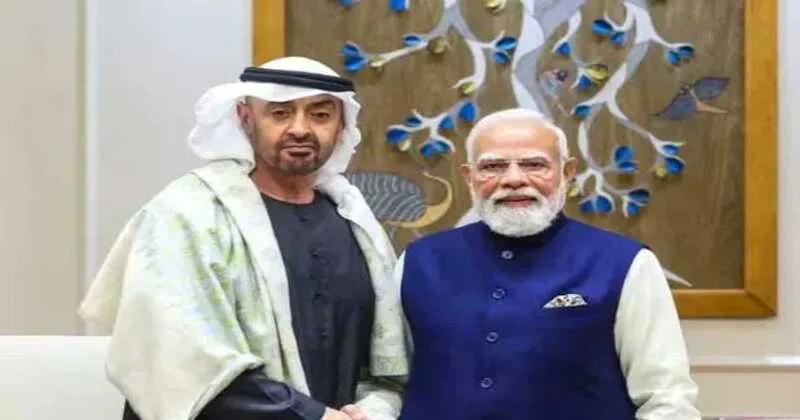
Islamabad: Pakistan has suffered a major diplomatic and economic setback following the recent visit of the United Arab Emirates President Sheikh Mohammed bin Zayed Al Nahyan to India. In a significant reversal, the UAE has withdrawn its proposal to take over the operation of Islamabad International Airport, scrapping a deal that had been under negotiation since August 2025. The decision came soon after the UAE President’s three-hour visit to New Delhi, a timing that has fuelled speculation about shifting regional alignments.
According to Pakistan’s leading daily, The Express Tribune, the official reason cited for cancelling the contract was the failure to find a suitable local partner for airport operations. However, political factors behind the collapse of the agreement have not been formally acknowledged. There are growing indications that deeper geopolitical tensions lie behind the decision, particularly the widening differences between the UAE and Saudi Arabia, as well as Pakistan’s own strategic choices.
The UAE and Saudi Arabia have reportedly developed disagreements on several regional issues, including the war in Yemen and broader Middle East security arrangements. At the same time, Pakistan has been making visible efforts to draw closer to Saudi Arabia, while the UAE appears to be recalibrating its regional partnerships by strengthening ties with India. This strategic divergence is widely seen as a key factor behind Abu Dhabi’s decision to walk away from the Islamabad airport project.
A successful visit concludes!
The visit of President HH Sheikh @MohamedBinZayed led to significant outcomes and further deepening of comprehensive strategic partnership between India and UAE. He was seen off by EAM @DrSJaishankar.
🇮🇳- 🇦🇪 pic.twitter.com/U9Ei8qmkVa
— Randhir Jaiswal (@MEAIndia) January 19, 2026
Pakistan is currently attempting to build what it describes as an ‘Islamic NATO’ with Saudi Arabia. Under a defence agreement signed between Islamabad and Riyadh in September 2025, an attack on one country would be treated as an attack on both. In contrast, the UAE has been moving rapidly to deepen defence, trade and strategic cooperation with India, reflecting a clear shift in priorities.
During Sheikh Mohammed bin Zayed’s visit to New Delhi, the two countries signed a major energy agreement that underlined the growing strength of India–UAE relations. Hindustan Petroleum Corporation and Abu Dhabi National Oil Company Gas entered into a 10-year contract under which India will purchase 5 lakh tonnes of liquefied natural gas annually from the UAE, beginning in 2028. The agreement is expected to bolster India’s energy security and support its rising demand, while both sides also agreed to work towards doubling bilateral trade.
The visit produced another strong symbolic gesture when the UAE President ordered the release of 900 Indian prisoners, a move widely interpreted as a demonstration of goodwill and political trust. Analysts see this decision as a clear signal that India has emerged as a preferred strategic partner for Abu Dhabi, even as relations with Pakistan continue to cool.
For Pakistan, the loss of the airport deal is particularly damaging given the long history of close economic ties with the UAE. For decades, the UAE was Pakistan’s largest trading partner and a major source of foreign exchange. Tens of thousands of Pakistani nationals continue to work in the Gulf state across construction, services and energy sectors. The two countries have also cooperated extensively in defence, investment and infrastructure projects.
However, these ties have steadily weakened in recent years. Persistent security concerns, regulatory disputes, and outdated infrastructure have undermined investor confidence in Pakistan. Licensing problems and political interference have further complicated foreign participation in key sectors, including aviation.
A recent report highlighted how political meddling has inflicted heavy losses on Pakistan’s state-owned enterprises, which are then sold off at nominal prices. Pakistan International Airlines was privatised last year amid a deep financial crisis, underscoring the fragile state of public sector management. Despite the UAE’s global experience in operating airports under difficult conditions, its decision to withdraw from Islamabad International Airport is widely viewed as a sign of declining confidence in Pakistan’s governance and business environment. Meanwhile, the UAE is moving decisively to strengthen its partnership with India. The release of Indian prisoners, the long-term LNG agreement and expanding defence and trade cooperation all point to a new phase in bilateral relations. As Abu Dhabi draws closer to New Delhi, Pakistan is left grappling with the diplomatic and economic costs of losing one of its most important regional partners.