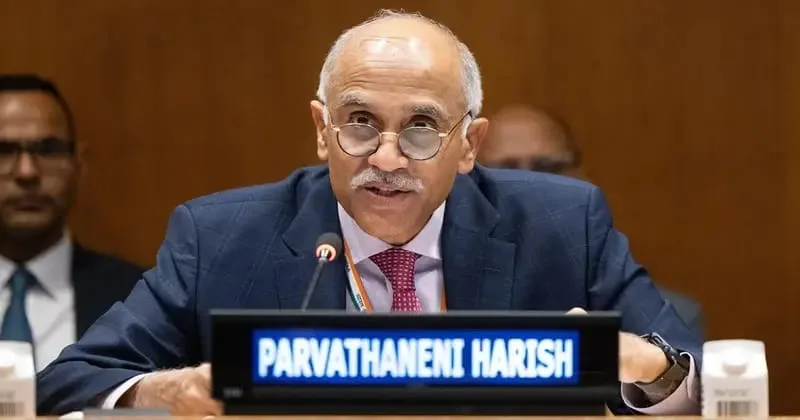
New Delhi: India delivered a sharp rebuttal at the UN Security Council, condemning the Pakistani envoy for promoting a “false and self-serving” narrative regarding ‘Operation Sindoor.’ It also emphasised that it is unacceptable to tolerate Islamabad’s continued use of terrorism as a tool of state policy. The remarks were made by India’s Permanent Representative to the UN, Ambassador Parvathaneni Harish, in response to statements by Pakistan’s Ambassador to the UN, Asim Iftikhar Ahmad.
🚨 India SLAMS Pakistan at the UNSC, EXPOSING its hollow sermons on rule of law & calling out the military-engineered “Constitutional Coup” at home.
🗣️ Pakistan has NO locus standi on India’s internal matters.
J&K is, was, & will always remain an INTEGRAL PART of India. pic.twitter.com/YGM8XS3LlA
— Megh Updates 🚨™ (@MeghUpdates) January 27, 2026
Ahmad had addressed Operation Sindoor, J&K, and the Indus Waters Treaty during Monday’s UNSC open debate on “Reaffirming International Rule of Law: Pathways to Reinvigorating Peace, Justice, and Multilateralism.”
Harish accused Pakistan of having a singular agenda: harming India and its citizens. Responding to Ahmad’s claim that Pakistan’s response to Operation Sindoor demonstrated that no “new normal” could be built on coercion or impunity, Harish asserted that terrorism can never be normalised.
“We have heard talk from the Representative of Pakistan about the new normal. Let me reiterate: terrorism can never be normalized as Pakistan wishes. It is not normal to tolerate Pakistan’s continued use of terrorism as an instrument of state policy. This hallowed chamber cannot become a forum for Pakistan to legitimize terrorism,” he said.
Harish also criticised Pakistan’s envoy for “advancing a false and self-serving account” of Operation Sindoor, which India launched in May last year to target nine terror infrastructures in Pakistan and Pakistan-occupied Kashmir. The operation was a retaliatory response to the April 22 Pahalgam attack, which killed 26 innocent civilians.
“The facts are clear. Pakistan-sponsored terrorists killed 26 innocent people in a brutal attack in Pahalgam in April 2025. This august body itself called for holding the perpetrators, organisers, financiers, and sponsors of this reprehensible act accountable. That is exactly what we did,” Harish stated.
He highlighted that India’s response was measured, non-escalatory, and focused on dismantling terrorist infrastructure. “Until May 9, Pakistan was threatening further attacks on India. But on May 10, the Pakistani military contacted our forces directly, pleading for a cessation of hostilities,” he added, noting that images of destroyed runways and burnt-out hangars at multiple Pakistani airbases are publicly available.
“The Union Territory of J&K has been, is, and will always remain an integral and inalienable part of India,” Harish reaffirmed.
Turning to the Indus Waters Treaty, he noted that India entered the agreement 65 years ago in good faith, with a spirit of goodwill and friendship. “Over these six and a half decades, Pakistan has repeatedly violated the spirit of the Treaty, through three wars and thousands of terror attacks against India. Thousands of Indian lives have been lost to Pakistan-sponsored terrorism,” he said.
In response to the Pahalgam terror attack, Harish explained that India was compelled to place the Treaty in abeyance “until Pakistan, a global epicentre of terror, credibly and irrevocably ends its support for cross-border and all other forms of terrorism.” India further asserted that Pakistan should reflect on its adherence to the rule of law. “It could begin by asking how it allowed its armed forces to orchestrate a constitutional coup through the 27th Amendment, granting lifetime immunity to its Chief of Defence Forces,” he added, referring to the amendment passed in November last year under Prime Minister Shehbaz Sharif, which provides Field Marshal Asim Munir immunity from any legal prosecution.