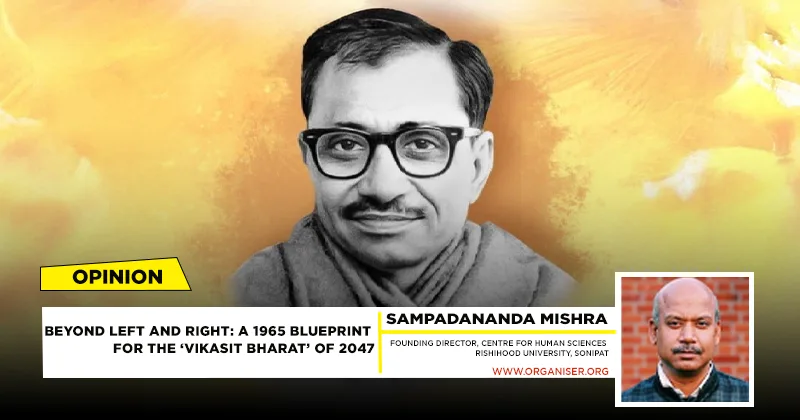
Beyond Left and Right: 1965 blueprint for ‘Vikasit Bharat’ of 2047
July 14, 2026
  • Read Ecopy
  • Circulation
  • Advertise
  • Careers
  • About Us
  • Contact Us
Android AppiPhone AppArattai
Organiser
  • ‌
  • Bharat
    • Assam
    • Bihar
    • Chhattisgarh
    • Jharkhand
    • Maharashtra
    • View All States
  • World
    • Asia
    • Europe
    • North America
    • South America
    • Africa
    • Australia
  • Editorial
  • International
  • Opinion
  • RSS @ 100
  • More
    • Op Sindoor
    • Analysis
    • Sports
    • Defence
    • Politics
    • Business
    • Economy
    • Culture
    • Special Report
    • Sci & Tech
    • Entertainment
    • G20
    • Azadi Ka Amrit Mahotsav
    • Vocal4Local
    • Web Stories
    • Education
    • Employment
    • Books
    • Interviews
    • Travel
    • Law
    • Health
    • Obituary
  • Subscribe
    • Subscribe Print Edition
    • Subscribe Ecopy
    • Read Ecopy
  • ‌
  • Bharat
    • Assam
    • Bihar
    • Chhattisgarh
    • Jharkhand
    • Maharashtra
    • View All States
  • World
    • Asia
    • Europe
    • North America
    • South America
    • Africa
    • Australia
  • Editorial
  • International
  • Opinion
  • RSS @ 100
  • More
    • Op Sindoor
    • Analysis
    • Sports
    • Defence
    • Politics
    • Business
    • Economy
    • Culture
    • Special Report
    • Sci & Tech
    • Entertainment
    • G20
    • Azadi Ka Amrit Mahotsav
    • Vocal4Local
    • Web Stories
    • Education
    • Employment
    • Books
    • Interviews
    • Travel
    • Law
    • Health
    • Obituary
  • Subscribe
    • Subscribe Print Edition
    • Subscribe Ecopy
    • Read Ecopy
Organiser
  • Home
  • Bharat
  • World
  • Operation Sindoor
  • Editorial
  • Analysis
  • Opinion
  • Culture
  • Defence
  • International Edition
  • RSS @ 100
  • Magazine
  • Read Ecopy
Home Bharat

Beyond Left and Right: A 1965 blueprint for the ‘Vikasit Bharat’ of 2047

Long before contemporary debates on growth models, sustainability and governance, a profound alternative framework was articulated in 1965 by Pandit Deendayal Upadhyaya through his lectures on Integral Humanism

Prof. (Dr.) Sampadananda MishraProf. (Dr.) Sampadananda Mishra
Jan 23, 2026, 08:00 pm IST
in Bharat, Opinion
Follow on Google News
Beyond Left and Right: A 1965 blueprint for the ‘Vikasit Bharat’ of 2047

A 1965 blueprint for 'Vikasit Bharat'

FacebookTwitterWhatsAppTelegramEmail

In April 1965, nearly two decades after Independence, India stood at a philosophical crossroads. The political atmosphere was thick with the binary Cold War rhetoric of Western Capitalism and Soviet Communism. It was in this context that Pt. Deendayal Upadhyaya ji delivered four seminal lectures on “Integral Humanism” in Bombay. He posed a question that remains hauntingly relevant as we sprint toward the centenary of our independence: “Now that we are independent, what shall be the direction of our progress?” Today, as the clarion call for a ‘Vikasit Bharat’ (An intensely aspiring nation for its holistic development to serve the world) resonates, we risk making the same error Deendayal ji warned us against: defining “development” solely through imported lenses. A close reading of his 1965 lectures offers not just philosophy, but a structural roadmap. If we distil his thesis, we find ‘12 Foundational Truths’ that offer a pathbreaking framework for India’s rise—one that champions a “Third Way” distinct from the West’s individualism and the East’s collectivism.

The Soul of the Nation

The first pillar of this framework is the assertion of identity. Deendayal ji argued that just as an individual has a personality, a nation has a soul, or “The Law of ‘Chiti’.” To build a developed India on a Western template is to create a “Frankenstein’s monster”—wealthy perhaps, but spiritually dead. Development policies must align with our historic national consciousness. This leads to the principle of  “Integral Humanism (Ekatma Manavata)”. The West fragments the human into the “Economic Man” or the “Political Man.” Deendayal ji posited that a Vikasit Bharat must cater to the whole being—simultaneously satisfying the Body (resources), Mind (peace), Intellect (knowledge), and Soul (purpose). GDP growth that results in social alienation and excessive exploitation of natural resources, is not development; it is regression. To achieve this, the state must facilitate “The Quartet of Well-being.” An economy driven solely by Kama (consumerism) destroys the planet; one ignoring Artha (wealth) breeds poverty. The modern Indian framework must be a Dharma-regulated capitalism, where wealth creation is balanced and becomes the basis of ethical responsibility and spiritual liberation.

Redefining the State

Deendayal ji’s lectures dismantle the Western “Social Contract” theory. He proposes that “Society is a Living Organism”, not a business deal between individuals. Therefore, the conflict between the Individual and the State is artificial. In a developed India, the citizen and the Nation should function like the cell and the body—mutually sustaining. This brings us to the governance model: “Dharma Rajya.” This is often mistranslated as a theocratic state. In reality, Deendayal ji defined it as the ‘Rule of Sustenance’. The State is not supreme; Dharma (the law of righteousness and public welfare) is. A government’s legitimacy in a Vikasit Bharat comes not just from a majority vote—which can theoretically be manipulated to validate atrocities—but from its adherence to Dharma. Structurally, this nation requires a “Unitary Soul, Decentralised Body.” While the cultural consciousness of Bharat is one, the administration must be radically decentralised. Power must flow from the ‘Janapada’ (district/village) up, not from New Delhi down.

The Economic “Third Way”

Perhaps the most radical insights from 1965 concern our economy. Deendayal ji warned against the “blind worship of the machine.” The goal of a developed India must be “The Right to Meaningful Work.” The economic slogan must shift from “One who earns will feed” to “One who eats must work.” We need a labour-intensive industrialisation that dignifies the human, rather than automation that renders our demographic dividend redundant. This ties into “Technological Swadeshi.” Science is universal, but technology must be local. Importing machinery designed for labour-scarce Western nations is a recipe for unemployment in India. Innovation in Vikasit Bharat must solve Indian problems using Indian resources. Furthermore, we must adopt an “Economy of Milking, Not Exploitation.” Long before “sustainability” became a buzzword, Deendayal ji argued that we must “milk” nature like a mother, taking only what can be replenished, rather than “exploiting” it like a mine. A linear consumption model is Adharma. Finally, to prevent the dehumanisation seen in both American capitalism and Soviet communism, India must champion “Decentralised Ownership.” The concentration of wealth—whether in the hands of a few tycoons or the State—is detrimental. The backbone of Vikasit Bharat must be small-scale entrepreneurs and cooperatives.

The Global Destiny

The final component of this framework is the psychological awakening of the “Virat (National Vitality).” Resources and policies are useless without a disciplined, socially conscious citizenry. A developed nation requires the awakening of this collective energy, where every citizen feels an “affectionate oneness” with the whole. Ultimately, this leads to  “Universalism through Nationalism.” Deendayal ji argued that a strong India is a prerequisite for a peaceful world. We do not rise to dominate, but to contribute our unique cultural truths to the “Common Store of Human Knowledge.” As we debate the trajectory of India at 2047, we would do well to revisit these truths. Deendayal ji did not want India to be a shadow of the West. He envisioned a modern nation standing firmly on its own philosophical feet. That vision is the only authentic blueprint for a truly Vikasit Bharat.

 

Topics: Deendayal Upadhyaya's Integral HumanismVikasit Bharat’ of 2047Deendayal Upadhyay
Prof. (Dr.) Sampadananda Mishra
Founding Director, Centre for Human Sciences, Rishihood University, Sonipat [Read more]
ShareTweetSendShareSend
✮ Subscribe Organiser YouTube Channel. ✮
✮ Join Organiser's WhatsApp channel for Nationalist views beyond the news. ✮
Previous News

Ram Mandir: A landmark of a blessed era!

Next News

The Digital Currency Revolution: India’s bold BRICS proposal

Related News

Prajna Pravah to go ahead with ‘Ekatma Manava Darshan’ conference from March 25 despite cancellation reports

Developement Paradigm of selfhood

Sangh and Swadeshi: Epitome of selfhood

Pandit Deendayal Upadhyay: An ideal symbol of integral humanism, antyodaya, and swadeshi ideas

Cabinet Minister Mangal Prabhat Lodha (Left) and Pandit Deendayal Upadhyay (Right)

“Today’s leadership is inspired by the philosophy of Ekatma Manav Darshan,” says Cabinet Minister Mangal Prabhat Lodha

Prime Minister Narendra Modi

PM Modi to address mega congregation, ‘Karyakarta Mahakumbh’ of BJP workers in poll-bound Madhya Pradesh

Load More

Latest News

Rupee-Rupiah trade, digital payments and strategic cooperation mark a new chapter in the India-Indonesia economic partnership.

India, Indonesia advance de-dollarisation with Rupee-Rupiah local currency settlement framework

BMS hosts 15th BRICS Trade Union Forum (TUF) Summit 2026 in Hyderabad; Calls for worker-centric global order

A car fire inside the Airport Tunnel on the Gurugram–Dwarka Expressway showcased how smart safety systems can save lives

Airport Tunnel Fire: How smart safety systems on the Gurugram–Dwarka Expressway averted a major disaster

India's petroleum exports are set to surge 25 per cent, strengthening its position as a global energy export powerhouse

India’s Energy Revolution: How a 25% surge in petroleum exports is transforming India into a global export leader

Shri Nandkishore Goenka ji

Renowned social worker Nandkishore Goenka passes away; RSS pays tribute to his lifelong commitment to Goseva

The organisers of the 'Melbourne Meets Modi' community have issued a strongly worded open letter to Rahul Gandhi

Don’t insult Indian-Australians: Melbourne Meets Modi organisers demand apology from Rahul Gandhi over paid crowd claim

Tiruvananthapuram Mayor Adv. V.V. Rajesh administers oath to BJP councillor R. Sugatan at Viyyoor Central jail, Thrissur

Keralam: Tiruvananthapuram BJP Councillor R Sugatan retakes oath in Viyyoor Central Jail after Kerala HC intervention

Bhojshala Case: Supreme Court Declines Muslim Plea, No Namaz Allowed on Premises

Bhojshala: SC refuses to stay Madhya Pradesh HC order; No namaz allowed within premises, Bars structural changes by ASI

Tamil Nadu: Supreme Court stays Madras HC order directing state govt to ensure no cow slaughter

Pahalgam Terror Attack: NIA Court Issues Non-Bailable Warrant Against LeT Chief Hafiz Saeed

Pahalgam Terror attack: NIA court issues non-bailable warrant against LeT chief Hafiz Saeed, who resides in Pakistan

Load More
  • Privacy
  • Terms
  • Cookie Policy
  • Refund and Cancellation
  • Delivery and Shipping

© Bharat Prakashan (Delhi) Limited.
Tech-enabled by Ananthapuri Technologies

  • Home
  • Search Organiser
  • Bharat
    • Assam
    • Bihar
    • Chhattisgarh
    • Jharkhand
    • Maharashtra
    • View All States
  • World
    • Asia
    • Africa
    • North America
    • South America
    • Europe
    • Australia
  • Editorial
  • Operation Sindoor
  • Opinion
  • Analysis
  • Defence
  • Culture
  • Sports
  • Business
  • RSS @ 100
  • Entertainment
  • More ..
    • Sci & Tech
    • Vocal4Local
    • Special Report
    • Education
    • Employment
    • Books
    • Interviews
    • Travel
    • Health
    • Politics
    • Law
    • Economy
    • Obituary
  • Subscribe Magazine
  • Read Ecopy
  • Advertise
  • Circulation
  • Careers
  • About Us
  • Contact Us
  • Policies & Terms
    • Privacy Policy
    • Cookie Policy
    • Refund and Cancellation
    • Terms of Use

© Bharat Prakashan (Delhi) Limited.
Tech-enabled by Ananthapuri Technologies