MYSORE: A massive fake driving licence scam involving officials of the Motor Vehicles Department (MVD) in Mysore, Karnataka, and Kerala has been unearthed, revealing a well-organised interstate racket that enabled applicants to obtain licences without appearing for mandatory driving tests. The scam has led to the suspension of two officials from the Tirurangadi Sub-Regional Transport Office (RTO) in Malappuram district and triggered a wider vigilance investigation into the alleged network of officials and middlemen.
According to officials, Motor Vehicle Inspector (MVI) George and clerk Najeeb of the Tirurangadi RTO have been suspended for their alleged role in facilitating the fraudulent conversion of driving licences obtained from Mysore into Kerala-issued licences. The Kerala Transport Commissioner has also recommended a vigilance probe against the entire chain involved in the scam, including possible complicity of officials in Mysore.
Licence without a driving test
Investigations have revealed that a gang, operating primarily in north Kerala, arranged driving licences from Mysore through agents without applicants ever appearing for a driving test. Once these licences were obtained, MVD officials allegedly helped convert them into Kerala licences by changing key details such as address, photograph and signature.
Officials said that after Kerala tightened driving test norms to curb road accidents, there was a noticeable increase in applicants seeking licences through agents in neighbouring states like Karnataka and Tamil Nadu. Exploiting this loophole, the racket flourished by bypassing legal procedures with the active involvement of corrupt officials.
Case that exposed the fraud
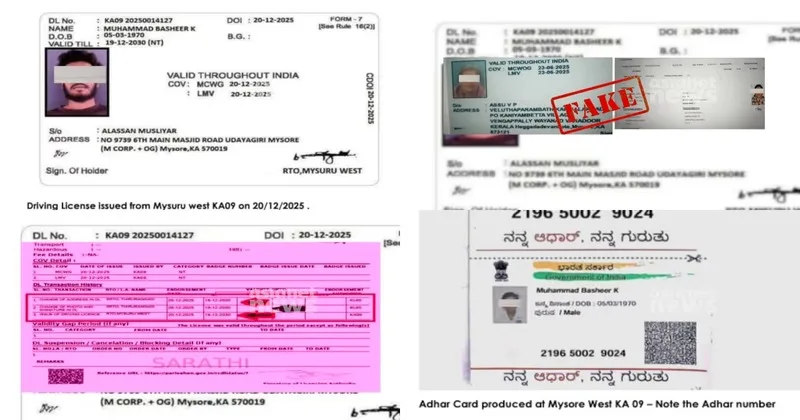
One of the cases that brought the scam to light involved Mohammed Basheer, a resident of Malappuram. Records show that a driving licence was issued to him by the Mysore West RTO on December 20 last year, purportedly at a Mysore address. However, the licence carried the photograph of a much younger person, raising suspicion.
Within days, Basheer applied to the Tirurangadi Sub RTO for a change of address, signature and photograph. Shockingly, on December 28, a new driving licence was issued from Tirurangadi with a completely different photograph and signature, now showing a Kerala address. Investigators later found that two Aadhaar cards were submitted—each bearing different photographs corresponding to the Mysore and Malappuram addresses.
Officials say several similar cases have surfaced, indicating a pattern where licences were first obtained in Mysore using fake or mismatched identity details and later “regularised” in Kerala through address-change applications.
Role of officials under scrutiny
The alleged fraud raises serious questions about the role of officials on both sides. How licences were issued in Mysore without applicants taking driving tests, and how Kerala MVD officials approved address changes despite glaring discrepancies in photographs and documents, are key aspects under investigation.
Transport Commissioner V.H. Nagaraju confirmed that the Vigilance Division of the Motor Vehicles Department has initiated an internal probe. “The matter has come to our notice, and a detailed vigilance investigation is under way to identify everyone involved, including officials and agents,” he said.
Preliminary scrutiny of departmental records from June and July reportedly shows an unusually high number of address-change applications being cleared within a very short time, further strengthening suspicions of systemic wrongdoing.
Public safety concerns
The exposure of the scam has sparked concerns over road safety, as individuals with fake or illegally obtained licences are allowed to drive on public roads without adequate training or testing. Officials admit that stringent driving test norms, introduced to reduce accidents, were undermined by corrupt practices.
As the vigilance probe expands, more suspensions and criminal proceedings are expected. Authorities have indicated that strict action will be taken against all those found guilty, stressing that the integrity of the licensing system is critical to public safety.