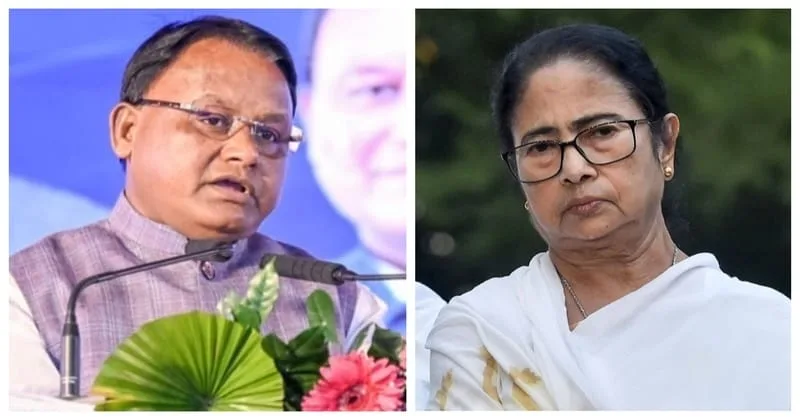
Kolkata: West Bengal’s decline is not an accident of history. It is the direct consequence of political choices, administrative decay, and a governance model that prioritises control over growth. Once celebrated as India’s industrial jewel, Bengal today stands reduced to an economic cautionary tale, an example of how ideology, appeasement politics, and institutionalised corruption can dismantle decades of progress.
As Bengal sinks deeper into stagnation under the Trinamool Congress (TMC) and Chief Minister Mamata Banerjee, a powerful contrast is emerging next door. Odisha, once considered economically behind Bengal, is now racing ahead, attracting investment, creating jobs, and offering hope to its youth. The story of eastern India’s development today is no longer written in Kolkata. It is being rewritten in Bhubaneswar.
West Bengal: From India’s Industrial Jewel to TMC’s Industrial Graveyard
Odisha is showing India how it’s done. Chief Minister Mohan Majhi has just secured a massive ₹1.03 lakh crore in investments.
ODISHA LEADS THE WAY — A VISION FOR PURVODAYA
While West Bengal’s industrial… pic.twitter.com/vzzbZ8depK
— BJP West Bengal (@BJP4Bengal) January 20, 2026
Bengal’s Lost Legacy
For decades after Independence, West Bengal was synonymous with industry. From Howrah’s engineering hubs to Durgapur’s steel plants, from Kolkata’s ports to its financial institutions, Bengal was the economic backbone of eastern India. It had everything—skilled labour, academic excellence, connectivity, and entrepreneurial spirit. What it did not survive was decades of hostile governance toward industry, culminating in the TMC era, which replaced ideological rigidity with something even more destructive: chaos without vision. Under Mamata Banerjee, industry in Bengal has not merely slowed—it has been actively driven away.
Since 2011, 6,688 companies have shifted their registered offices out of West Bengal. This statistic alone exposes the hollowness of TMC’s claims of development. Businesses do not flee states without reason. They flee when policy is unpredictable, when law and order are compromised, and when political interference becomes the cost of survival.
Investors cite familiar reasons:
* Extortion disguised as “party donations”
* Syndicate raj controlling contracts and logistics
* Political intimidation at the local level
* Lack of administrative transparency
* Zero confidence in long-term policy stability
This is not “pro-poor” governance. It is anti-growth governance.
Under the TMC, West Bengal has developed a parallel economy, one where nothing moves without commissions, and no project survives without political blessings. The infamous cut-money culture has become synonymous with governance in the state, corroding institutions from the panchayat level to major infrastructure projects.
Entrepreneurs are not treated as partners in development but as targets for extraction. This environment does not nurture innovation; it suffocates it. As a result, Bengal’s youth, once the pride of India’s intellectual capital, are migrating out in search of dignity and opportunity. A state that exports talent but imports nothing but debt is not progressing. It is collapsing.
Odisha shows what governance can do
The contrast with Odisha could not be more humiliating for the TMC. Chief Minister Mohan Majhi, in just two days of meetings in Kolkata, secured Rs 1.03 lakh crore in investment commitments. These were not symbolic announcements but serious industrial MoUs backed by timelines and employment projections.
* Rs 81,864 crore through 27 MoUs
* Over 90,000 jobs for youth
* Investments across steel, IT, manufacturing, and green energy
* A clear roadmap toward Samruddha Odisha by 2036
This is governance driven by confidence, clarity, and credibility, three qualities completely absent in West Bengal today. Bengal’s own industrialists are now choosing Odisha as their destination of growth.
Mamata Banerjee’s politics of obstruction
Mamata Banerjee has built her political career on protest, obstruction, and confrontation. Her government has consistently:
* Opposed industrial land acquisition without offering alternatives
* Politicised administration and police forces
* Replaced governance with personality-driven theatrics
Development requires stability. Investors seek predictability. Bengal offers neither.
West Bengal should have been the natural leader of the Purvodaya vision, India’s eastern resurgence. Instead, it has become the biggest obstacle to its own progress. Odisha’s rise exposes Bengal’s failure in the harshest possible way. It proves that geography is not destiny, and history is not a guarantee. What matters is leadership. When a state with Bengal’s advantages is overtaken by one it once dwarfed, the verdict is unavoidable.
Mamata Banerjee and the TMC have not merely failed to industrialise Bengal, they have actively dismantled its economic foundations. By normalising syndicate culture, institutionalising cut-money, and driving away investors, they have converted one of India’s most promising states into an industrial graveyard.