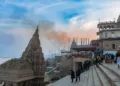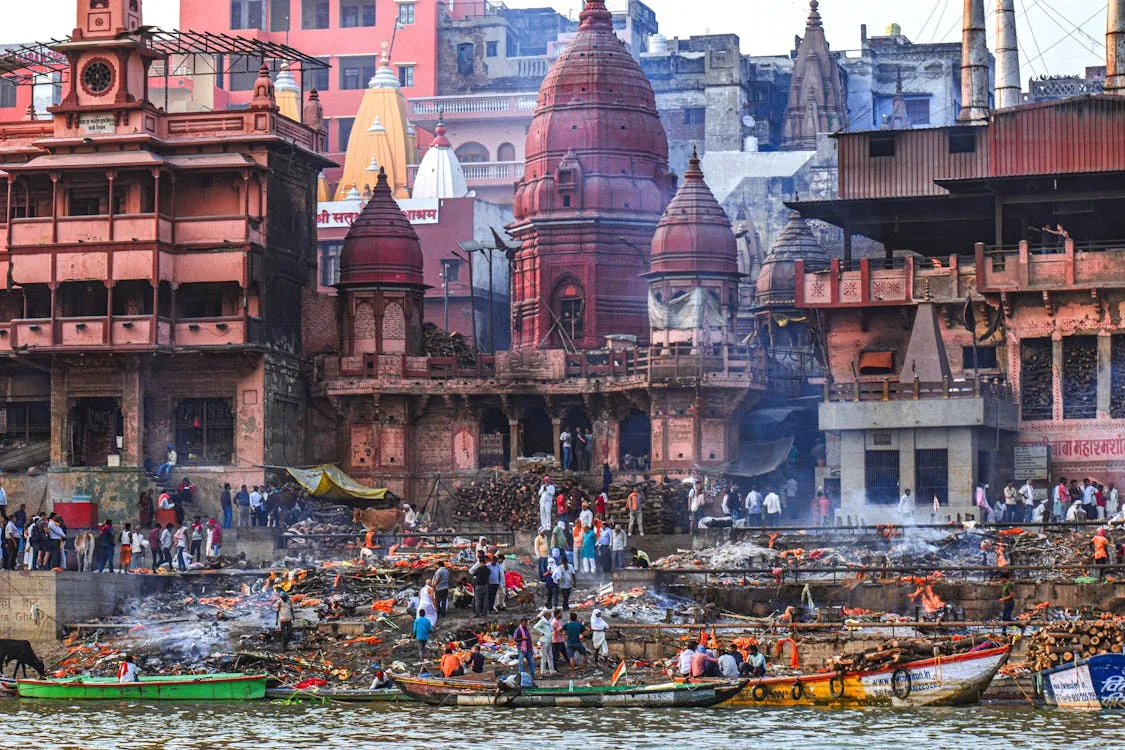
A very few places in Bharat carry the spiritual and cultural significance of Manikarnika Ghat. For Hindus, it is not merely a spot along the Ganga, but a sacred threshold where the cycle of life and death meets the promise of liberation. It is here, amid the smoke of pyres and the rhythm of ritual, that death is transformed into moksha, and Shiva is believed to whisper the taraka mantra into the ears of the departing soul.
Every stone, every platform, every stretch of the riverbank holds centuries of devotion, prayer, and sacred memory. To intervene here is not just a matter of construction or maintenance, it requires deep respect, humility, and a careful understanding of the spiritual and cultural significance of the site.
It is precisely this sanctity that has now been caught in a storm of political controversy. Opposition leaders have attacked the ongoing renovation work at Manikarnika Ghat, calling it an assault on Bharat’s civilisational heritage. Terms such as “destruction,” “erasure,” and “tearing apart history” have been freely used, and the project has been painted as sacrilegious, even sinful. Headlines and social media commentary have amplified this narrative, framing a practical initiative in terms of cultural and religious alarm.
Yet, behind the attempt lies a more important and uncomfortable question: does true respect for the sacred mean allowing chaos, congestion, and indignity to continue at one of Hinduism’s most revered sites? The ghat currently faces severe challenges. Narrow pathways force mourners, priests, and tourists to jostle for space. Ash and debris often flow unchecked into the Ganga, and informal wood storage creates fire hazards amid hundreds of daily cremations. These are not abstract inconveniences, they affect the dignity of the dead, the safety of the living, and the purity of the river, which has been worshipped as a Maa for millennia.
In this context, the renovation cannot simply be viewed as a matter of bricks and mortar. It is a moral and civilisational responsibility to ensure that even in death, human dignity is preserved, sacred rituals are unhindered, and the sanctity of the ghat is maintained. The question, therefore, is not whether development should occur, but how it can be carried out with sensitivity, cultural awareness, and deep respect for the traditions that have defined Manikarnika for thousands of years.
Understanding what the project actually is
Stripped of political exaggeration, the Manikarnika Ghat project is modest in scope and practical in intent. With an estimated cost of around Rs 17.5 crore, it does not seek to redesign ritual, alter theology, or commercialise death. Its objectives are basic:
1. Widen pathways so funeral processions can move without obstruction,
2. Create safer, more organised cremation platforms,
3. Replace haphazard timber storage with a designated wood plaza,
4. Introduce ramps for the elderly and disabled, and improve sanitation in an area that witnesses between 150 and 400 cremations daily.
This is not an attempt to sanitise death or aestheticise moksha. It is an attempt to manage scale. What might have sufficed centuries ago can no longer cope with today’s numbers, footfall, and urban pressure.
Sensitivity matters, so does reality
Critics are right about one thing: Manikarnika is not just another infrastructure site. The presence of bulldozers near a cremation ground unsettles even those who support development. The government must acknowledge this emotional reality rather than dismiss it.
But sensitivity cannot become paralysis.
Today, smoke from open pyres routinely chokes mourners. Ash and debris flow into the Ganga unchecked. Narrow lanes force grieving families to navigate crowds, tourists, vendors, and two-wheelers. Informal wood dumps pose fire hazards in one of the densest urban spaces in the country.
Is this what sanctity looks like, or is it neglect disguised as tradition?
The idea that Varanasi represents an untouched, pristine civilisational relic is historically false. Kashi is among the world’s oldest continuously inhabited cities precisely because it has been rebuilt, again and again.
Temples have been destroyed and reconstructed. Ghats have shifted. Lanes have expanded and contracted. The Kashi Vishwanath Temple itself bears scars of demolition and renewal, from medieval invasions to Ahilyabai Holkar’s reconstruction in the 18th century.
Change, in Kashi, is not an aberration. It is the rule.
To claim that any modern intervention automatically violates heritage is to misunderstand how living sacred cities survive across millennia.
Lessons from the Kashi Vishwanath corridor
The Manikarnika project cannot be viewed in isolation. It follows the logic, and the experience, of the Kashi Vishwanath Corridor, inaugurated in 2021 amid similar protests and predictions of cultural catastrophe.
Those fears did not materialise.
Instead, access to the temple improved dramatically. The shrine, once hemmed in by illegal construction and dark alleys, now opens onto the Ganga. Pilgrim footfall multiplied. Forgotten temples emerged from behind encroachments. Public space was reclaimed without altering ritual practice.
The corridor did not diminish sanctity; it restored dignity.
That experience matters, because it demonstrates a crucial principle: development need not be anti-tradition when guided by cultural intent.
What weakens the opposition’s critique is not merely its timing but its emptiness. Loud condemnation has not been accompanied by a single credible alternative plan.
If not renovation, then what?
How should hundreds of daily cremations be managed in a congested, fire-prone, sanitation-starved space?
How should mourners be protected from physical danger and exploitation?
How should the Ganga be shielded from constant pollution at the ghat?
Silence follows these questions.
This is not heritage protection; it is opposition for its own sake. Governance demands solutions, not slogans.
Whose interests are being defended?
It is also necessary to acknowledge an uncomfortable truth: not all resistance to change is spiritual.
Manikarnika hosts a deeply entrenched informal economy around death, wood suppliers, intermediaries, ritual gatekeepers, some of whom profit from opacity, confusion, and distress. Over time, economic interests have been layered over ritual authority, making reform appear as sacrilege.
This does not mean livelihoods should be ignored. They must be accommodated with care and dialogue. But to equate all opposition with civilisational concern is misleading. Sometimes, disorder benefits a few while harming many.
Scholars of Varanasi have long documented how public land, lanes, and even temples were gradually absorbed into private structures. Shrines were built inside houses. Mythologies evolved to justify occupation. What emerged was not organic tradition but accumulated encroachment.
The corridor project revealed more than 40 long-lost temples buried inside homes and shops. This was not preservation; it was erasure by neglect.
Cleaning, restoring, and reorganising such spaces is not vandalism. It is an archaeological and cultural recovery.
Congress’s sudden discovery of Hindu sentiment
The outrage also raises a political irony. For decades, governments led or supported by the Congress showed little urgency about the state of Kashi’s sacred spaces. Projects were shelved, delayed, or ignored.
Today, the same party positions itself as the guardian of Hindu heritage, without explaining why it never acted when it had the authority to do so.
This pattern is familiar. Similar objections were raised over the Parliament redevelopment, Jallianwala Bagh renovation, and temple corridors elsewhere. The accusation is always identical: that development equals erasure, that the present seeks to overwrite the past.
Yet the past still stands. What has changed is access, safety, and scale.
Supporting development does not mean endorsing every administrative misstep.
Communication has been uneven. Local anxieties could have been addressed earlier and more empathetically. The temporary relocation of artefacts, even when documented, fuels mistrust in an age of viral misinformation. Visuals matter, especially at a cremation ground.
The state must remember: legitimacy flows not just from authority but from trust.
Transparency, timelines, and continuous engagement with priests, workers, and residents are not optional here, they are essential.
Development as a civilisational duty
At its core, the debate forces a deeper reflection: what does civilisation mean?
Is it the preservation of inconvenience because it is old?
Or is it the ability to adapt sacred practice to changing human realities without losing meaning?
Hindu civilisation has never feared change. It absorbed invasions, philosophies, and social transformations without losing its metaphysical core. It understands continuity without rigidity.
Ensuring that the dead are cremated with dignity, that mourners are safe, that rivers are protected, and that rituals are not performed amid chaos is not Westernisation. It is dharma in practice.
Manikarnika should not be the end but part of a broader, careful effort to reclaim Bharat’s sacred geography, Ayodhya, Ujjain, Mathura, Puri, cities where devotion has long coexisted with neglect.
Development here must be different from commercial urban renewal. It must be slower, consultative, symbolically aware. But it must happen.
The choice is not between holiness and hygiene. It is between responsible stewardship and abdication.
Decay is not authenticity
Manikarnika’s fires have burned uninterrupted for millennia. A wider path, safer platforms, and organised resources will not extinguish them. What truly threatens Kashi is the romanticisation of decay, the belief that suffering validates sanctity.
Civilisations endure not by freezing themselves, but by renewing themselves without forgetting who they are.
To protect Manikarnika is not to preserve every inconvenience of the past, but to ensure that even in death, human dignity remains intact. Development, done with reverence, is not a sin.
Neglect is.