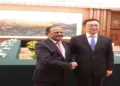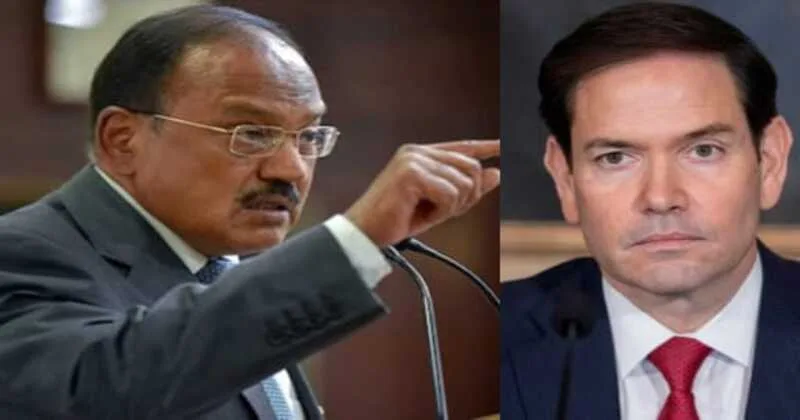
New Delhi: In the aftermath of the newly announced India–US trade understanding, a report by Bloomberg has revealed how New Delhi quietly but decisively resisted pressure from the Donald Trump administration during a particularly strained phase in bilateral relations, signalling that the Modi government would not be forced into an unfavourable agreement. According to the report, India’s National Security Adviser Ajit Doval delivered a blunt message to US Secretary of State Marco Rubio in early September. Doval reportedly said that India was prepared to wait out the remainder of Trump’s term if Washington continued its confrontational rhetoric and pressure tactics.
This exchange came at a time when India–US ties were under stress, driven by punitive tariffs and sharp public criticism from Trump. The US President had publicly disparaged India’s economy and accused New Delhi of indirectly financing Russia’s war in Ukraine by continuing to import Russian crude oil. Simultaneously, Washington imposed steep duties on several Indian exports, further escalating tensions. Doval made it clear that while India was open to moving beyond the hostility and resuming meaningful trade talks, this could only happen in an environment free from public insults and coercion. He also reminded US officials that India had navigated difficult administrations in the past and was willing to take a long-term view if necessary.
Shortly after this diplomatic intervention, the tone from Washington began to change. On September 16, Trump called Prime Minister Narendra Modi on his birthday and praised his leadership, a marked departure from earlier remarks. The two leaders subsequently held several conversations, gradually reopening channels for constructive engagement. This week, Trump announced that the United States and India had reached a trade understanding that would reduce US tariffs on Indian goods to 18% and remove an additional 25% levy tied to India’s purchase of Russian oil. He also claimed that India had agreed to expand imports of American products and lower tariffs on US goods. However, New Delhi has yet to officially confirm the full scope of the agreement or release any written documentation.
India’s strengthened negotiating position appears to have been shaped by a broader strategic realignment. In 2025, New Delhi concluded a trade pact with the United Kingdom. Earlier this year, it signed multiple agreements with the United Arab Emirates, and most recently, finalised a long-pending free trade agreement with the European Union. Prime Minister Modi also held high-profile meetings with Vladimir Putin and Xi Jinping last year, encounters after which Trump reportedly lamented that the US may have “lost” India to China.
Taken together, these developments highlighted India’s effort to diversify its economic partnerships rather than rely solely on Washington.
That broader outreach appears to have increased pressure on the US to repair ties. The outcome suggests that New Delhi may have emerged from the standoff with enhanced leverage, and possibly the stronger end of the bargain, reinforcing India’s growing confidence in pursuing an independent and multi-aligned economic strategy.