Somnath sits on the Western shore of Saurashtra. The sea strips away time here. The temple rises repeatedly. Each ruin and each rebuilding spells a chapter in Bharat’s long civilisational tale. Somnath Mandir is not merely a shrine of Shiva. It is a record of assault and recovery. It is a measure of how a civilisation responds when its sacred core is attacked.
For over a millennium, Somnath Mandir has embodied a simple truth: Bharat was wounded but never erased. Its survival and rejuvenation form one of the most consequential stories of Indian civilisation—one that modern historiography has too often tried to dilute, explain away, or neutralise.
Somnath’s antiquity is not a matter of belief alone. Literary references, inscriptions, and archaeological remains establish Prabhas Patan as a major sacred and cultural centre well before the medieval period. The temple’s fame was such that it attracted pilgrims across regions—and, inevitably, invaders. The raid of 1026 CE by Mahmud of Ghazni marked a civilisational rupture. Persian chronicles describe the destruction with triumph. The shrine was looted. Its wealth was carried away. Its sanctity was deliberately violated. This was not incidental violence. It was symbolic iconoclasm. What followed matters more than the act itself.
Against Erasure, For Continuation
Inscriptions and material layers show repeated cycles of destruction and reconstruction across centuries. Each rebuilding was an act of cultural defiance. The temple’s persistence exposed the limits of conquest. Power could break stones, but not memory. This is where modern debates begin to fray.
Undermining Somnath’s Significance
Sections of Left historiography have attempted to reduce Somnath Mandir to a “constructed narrative,” arguing that its importance was exaggerated by later nationalism. At the centre of this intellectual project stands Romila Thapar.
Thapar’s approach is marked by relentless skepticism toward Hindu sources and traditions, coupled with an indulgent caution toward Persian chronicles. By emphasising ambiguities and silences, she has sought to strip Somnath of its moral clarity. Her framing dissolves destruction into “multiple voices,” as though civilisational trauma were merely a matter of interpretive preference. This is not balanced. It is asymmetry.
No serious historian denies exaggeration in medieval sources. But to weaponise uncertainty only in one direction—to cast doubt on Hindu memory while treating iconoclasm as administratively routine—is an ideological choice. Archaeology confirms repeated destruction and rebuilding. Living tradition confirms uninterrupted sanctity. To deny their combined force is to deny how civilisations function. Ironically, some colonial administrators displayed greater honesty. Figures like James Fergusson acknowledged temple destruction and documented architectural continuity without pretending it was all invention. Colonial scholarship was often patronising, but it was rarely embarrassed by Hindu antiquity. Many Left historians today appear more anxious to distance themselves from civilisational inheritance than their colonial predecessors ever were. That anxiety shaped the early Republic. And it provoked a response.
KM Munshi’s Seminal Work
No one understood Somnath’s meaning more clearly than KM Munshi. Munshi was not merely a politician or litterateur. He was a civilisational thinker. In his seminal work Somnatha: The Shrine Eternal, he argued that Somnath symbolised the crushed yet unconquered soul of Bharat. For Munshi, rebuilding Somnath was not about religious triumph. It was about restoring self-respect to a people long taught to normalise their own humiliation.
He grasped a truth many elites missed: political freedom without cultural redemption is incomplete. After Independence, when Sardar Patel supported the reconstruction of Somnath, Munshi became its intellectual and organisational spearhead. He mobilised public support, articulated its significance, and defended it against critics who dismissed the project as regressive. Those critics included the Prime Minister.
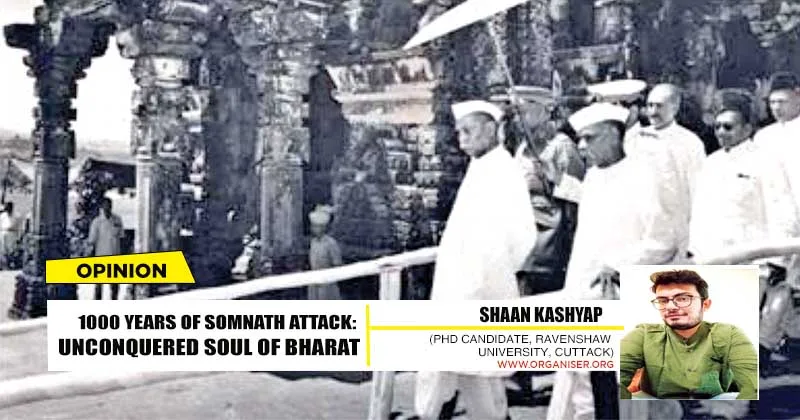
Jawaharlal Nehru opposed the reconstruction’s official endorsement. He argued that state association with a temple violated secular principles. His objections were couched in constitutional language, but they revealed a deeper discomfort with civilisational assertion rooted in Hindu tradition. Munshi responded with clarity. Secularism, he argued, could not mean cultural amnesia. A civilisation does not become modern by amputating its sacred geography. Europe rebuilt churches destroyed in war. China restored temples razed by revolution. Only in Bharat was civilisational repair treated as ideological danger. The culmination came in 1951, when Rajendra Prasad consecrated the rebuilt Somnath temple. His presence was decisive. It affirmed that the Republic need not be ashamed of its civilisational roots. The Constitution did not demand self-denial. It demanded dignity. That moment was an act of redemption.
Rejuvenation of the Republic
The rebuilt Somnath was not a call to vengeance. It was a declaration of continuity. It said that Bharat would remember its wounds without being imprisoned by them. It would honour its past without surrendering to it. Above all, it would refuse the idea that cultural self-respect is incompatible with modern nationhood.
Left historians continue to bristle at Somnath because it exposes a flaw in their framework. Civilisations are not sustained by footnotes alone. They are sustained by memory, symbols, and acts of collective will. Munshi understood this. Nehru did not. Somnath stands today as a rebuke to both invaders and deniers. It reminds us that Bharat resisted—not always with arms, but with endurance. It was rebuilt—not once, but repeatedly. And in doing so, it preserved a civilisational spine that no conquest could snap. Somnath matters because it refuses erasure. It endures because Bharat endured. And its rejuvenation remains one of independent Bharat’s most profound acts of civilisational self-recognition.
Was Ellenborough more pro-Bharat than Leftist Historians?
In September 1842, as Company forces marched from Kandahar to Kabul via Ghazni, Lord Ellenborough issued a striking directive. He ordered the army to enter Ghazni, remove the “Gate of Somnath” from the tomb of Sultan Mahmud, and carry it back to Bharat in a public and ceremonial return—an act intended to reverse, in symbol, the long memory of spoliation and restore a fragment of a wounded civilisation’s pride:
“The insult of eight hundred years is at last avenged. The gates of the temple of Somnauth, so long the memorial of your humiliation, become the proudest record of your national glory, the proof of your superiority in arms over the nations beyond the Indus.”
“To you, Princes and Chiefs of Sirhind, of Rajwarra, of Malwa, and of Guzerat, I shall commit this glorious trophy of successful war.” Cited in Edward Thompson and GT Garratt, Rise and Fulfilment of British Rule in India (London: Macmillan and Co, 1935), 353.