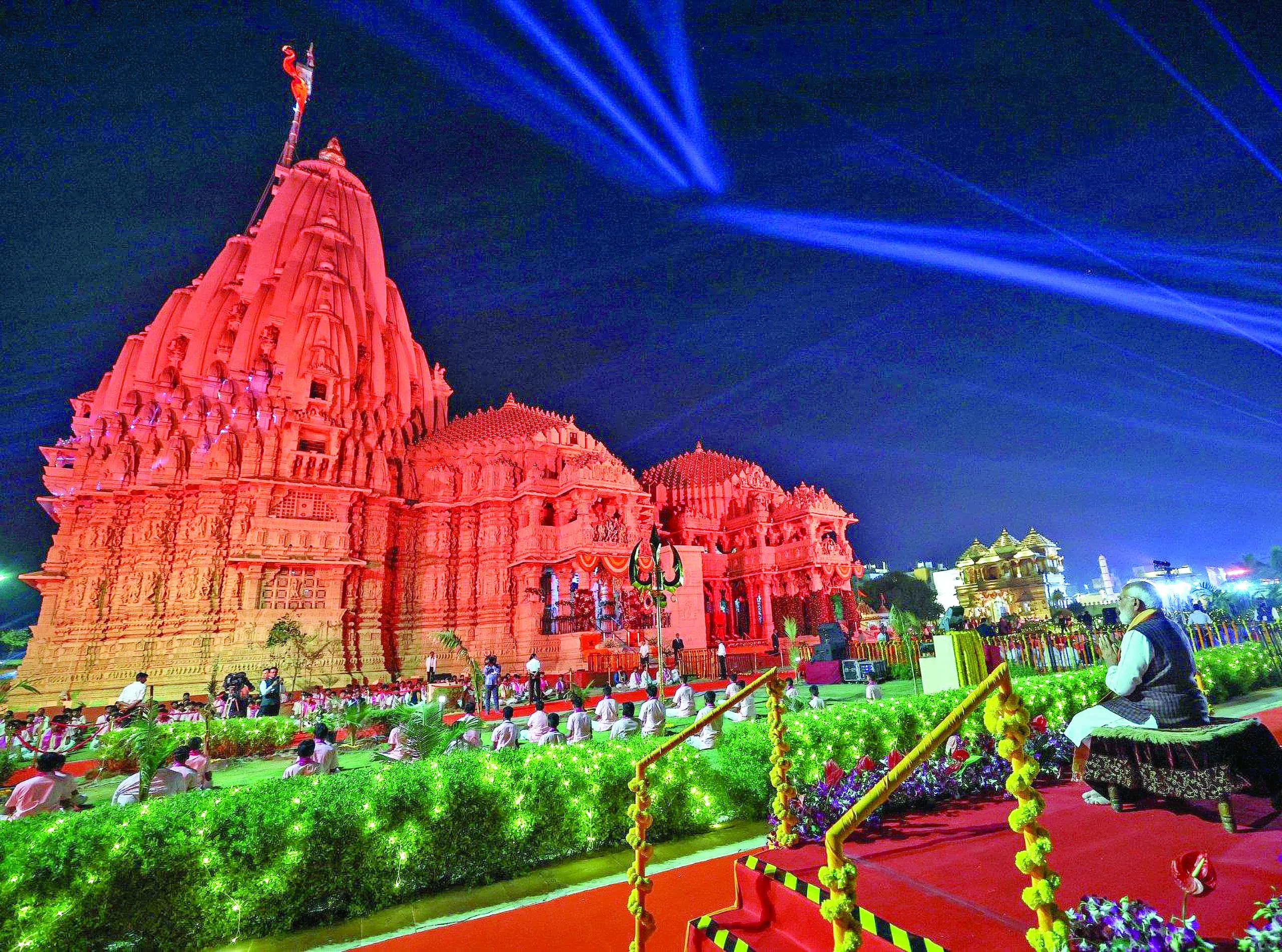
Somnath mandir does not stand simply as a place of worship on the western edge of Bharat; it stands as a civilisational statement. Facing the Arabian Sea at Prabhas, Somnath Mandir represents that which could never be extinguished in the Bharatiya experience—the inner continuity of dharma, memory, and sacred order. Its stones were shattered, its walls dismantled, yet Somnath Mandir never disappeared from the civilisational consciousness of this land. Its repeated resurrection tells us something fundamental about Bharat: that destruction does not possess finality, and history does not have the last word.
In Bharatiya Knowledge Systems, civilisation is not understood as a linear sequence of rise and fall. It is understood as sanatan—that which renews itself across time. History, therefore, is not merely a record of events, but a rhythm of loss and renewal. The Upanishadic vision expresses this civilisational truth with clarity:
न जायते म्रियते वा कदाचित् नायं भूत्वा भविता वा न भूयः। (Kathopanishad 2.18)
That which truly exists is never born and never dies. Somnath belongs to this ontological grammar. Its material form could be damaged; its civilisational essence could not.
As the first among the twelve Jyotirlingas, Somnath signifies Śhiva not as a confined icon, but as Jyoti—the self-luminous principle underlying creation, dissolution, and renewal. The Shiva Purana affirms:
न मूर्तिः न च लिङ्गं स्यात् ज्योतिरेव सनातनम्।
The sacred in Bharat is not imprisoned in stone. It resides in consciousness, practice, and remembrance. This is why repeated destruction could not erase Somnath from the civilisational landscape. What endured was not architecture alone, but smriti—collective memory sustained through ritual time and lived participation.
Prabhas occupies a distinctive place in Bharatiya sacred geography. The Skanda Purana declares:
प्रभासं तीर्थमासाद्य नरो मुच्येत किल्बिषात्।
Prabhaasa is not merely a pilgrimage destination; it is a space of moral recalibration. Even the Mahabharat situates here the end of the Yadava lineage. This is a striking indication of civilisational maturity. Bharatiya civilisation does not suppress its moments of rupture. It integrates them into ethical reflection. Loss becomes a source of wisdom, not erasure.
This perspective explains why Somnath Mandir was rebuilt again and again. Each reconstruction was not an act of retaliation, but of punarsthapana—the restoration of civilisational balance. In the Bharatiya tradition, rebuilding after destruction is not political assertion; it is dharmic responsibility. When a sacred centre falls silent, society responds to reawaken it.
Endurance Of Somnath
Somnath’s position by the sea deepens this understanding. Bharat has never been a closed, inward-looking civilisation. The Arabian Sea before Somnath symbolises movement, exchange, pilgrimage, and dialogue. For millennia, this coastline connected Bharat with the wider world—economically, culturally, and spiritually. Bharatiya civilisation absorbed influences without losing itself, just as the ocean receives rivers without surrendering its identity. This civilisational resilience explains why Somnath survived even when it stood without walls. Pilgrimage continued. Ritual calendars endured. Oral memory carried meaning forward. Continuity in Bharat has never depended solely on unbroken stone; it has depended on unbroken participation.
Living Testimony of Cultural Resurgence
- The Somnath Mandir is located in Prabhas Patan in Saurashtra, West Gujarat in Bharat – at the confluence of Saraswati, Hiranya and Kapila rivers – the Triveni Sangam
- It is considered to be the first of the jyotirlingas – the first place where Bhagwan Shiva manifested himself
- It is believed that the original Somnath Mandir was built by the Chandra Dev with gold in the Satya Yuga; by Ravana in Treta Yuga in silver; and by Bhagwan Krishna in Dwapara Yuga in sandalwood
- This Mandir has been looted and demolished many times by various invaders – by Mahmud of Ghazni (1026), Afzal Khan, Ala-ud-din Khilji’s commander (1296), Muzaffar Shah (1375), Mahmud Begada (1451), and later Aurangzeb (1665)
- Many rulers reconstructed Mandir: Shri Vikramaditya of Ujjaini (about 2500 years ago), the Vallabhi kings (in the period 480-767 CE), Bhimadeva of Anhilawada (in 11th century AD), and Khangara, the king of Junagadh (in 1351 AD) among many others
- It has been reconstructed about 17 times! The modern structure has been constructed by India’s former deputy Prime Minister Sardar Vallabhai Patel between 1947 and 1951 in sandstone
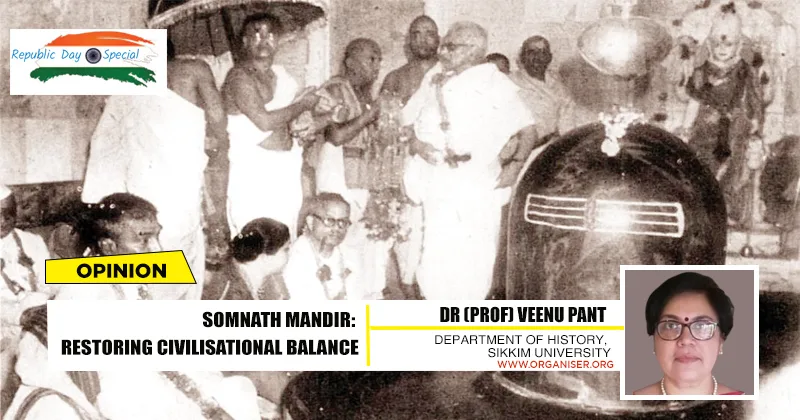
The reconstruction of Somnath Mandir in 1951 must be understood within this framework. It was not a reaction against history, nor an act of grievance. It was an affirmation of continuity after a long interruption. It expressed national self-respect rooted in cultural confidence, not antagonism. Independent Bharat signalled that it would no longer treat its sacred geography as a closed chapter, but as a living inheritance.
Yet Somnath mandir also places a responsibility upon the present. Civilisation does not survive by memory alone; it survives through practice. Heritage in the Bharatiya sense is not a possession, but a discipline. Sacred spaces live only when society returns to them—not just physically, but ethically and intellectually.
Somnath mandir cautions us against a shallow understanding of resurgence. Renewal is not about recreating an imagined past, nor about denying historical complexity. It is about restoring balance. Each rebuilding of Somnath was a re-anchoring in civilisational purpose, not a performance of grievance. True resurgence is quiet, steady, and inwardly anchored.
Bharatiya civilisation also teaches restraint in remembrance. Prabhas is remembered both for sanctity and for loss. A civilisation that forgets its fractures loses wisdom; one that dwells only on them loses balance. Somnath holds both memory and renewal together.
In the Bharatiya worldview, temples are not museums of faith. They are institutions of civilisation—organising ritual time, transmitting values, sustaining memory, and integrating society with cosmic order. Even when Somnath stood without walls, it lived through pilgrimage, oral tradition, and recurring ritual. Continuity lay not in preservation alone, but in participation.
Somnath therefore is not a relic of the past. It is a living centre of cultural resurgence. It affirms a deeper truth: that the atman of Bharat, like the sea before Somnath, cannot be conquered or silenced. Waves of history may rise and fall, but the ocean remains.
Somnath teaches us that Bharat did not endure because it was never wounded, but because it possessed the wisdom to renew itself. What could never be destroyed was not merely a temple, but the civilisational self—rooted, resilient, and enduring beyond time.
Why Somnath Matters Today
Somnath matters today because it reminds Bharat that civilisation survives not by avoiding rupture, but by renewing meaning after it. In an age inclined to treat heritage as spectacle or history as grievance, Somnath offers a different lesson: continuity is sustained through smriti, practice, and ethical responsibility.
Somnath mandir also matters because it restores confidence without hostility. Its reconstruction affirmed cultural self-respect rooted in remembrance, not resentment.
At a time when Bharat is rediscovering its place in the world, Somnath stands as a reminder that strength lies in balance—between memory and renewal, tradition and engagement, inward depth and outward openness. Like the sea before it, Bharat can absorb disruption without losing direction. Above all, Somnath matters because it teaches that what truly endures is not stone, but civilisation itself—lived, remembered, and renewed
across generations.