Somnath at 1000: A millennium of Hindu resilience
June 21, 2026
  • Read Ecopy
  • Circulation
  • Advertise
  • Careers
  • About Us
  • Contact Us
Android AppiPhone AppArattai
Organiser
  • ‌
  • Bharat
    • Assam
    • Bihar
    • Chhattisgarh
    • Jharkhand
    • Maharashtra
    • View All States
  • World
    • Asia
    • Europe
    • North America
    • South America
    • Africa
    • Australia
  • Editorial
  • International
  • Opinion
  • RSS @ 100
  • More
    • Op Sindoor
    • Analysis
    • Sports
    • Defence
    • Politics
    • Business
    • Economy
    • Culture
    • Special Report
    • Sci & Tech
    • Entertainment
    • G20
    • Azadi Ka Amrit Mahotsav
    • Vocal4Local
    • Web Stories
    • Education
    • Employment
    • Books
    • Interviews
    • Travel
    • Law
    • Health
    • Obituary
  • Subscribe
    • Subscribe Print Edition
    • Subscribe Ecopy
    • Read Ecopy
  • ‌
  • Bharat
    • Assam
    • Bihar
    • Chhattisgarh
    • Jharkhand
    • Maharashtra
    • View All States
  • World
    • Asia
    • Europe
    • North America
    • South America
    • Africa
    • Australia
  • Editorial
  • International
  • Opinion
  • RSS @ 100
  • More
    • Op Sindoor
    • Analysis
    • Sports
    • Defence
    • Politics
    • Business
    • Economy
    • Culture
    • Special Report
    • Sci & Tech
    • Entertainment
    • G20
    • Azadi Ka Amrit Mahotsav
    • Vocal4Local
    • Web Stories
    • Education
    • Employment
    • Books
    • Interviews
    • Travel
    • Law
    • Health
    • Obituary
  • Subscribe
    • Subscribe Print Edition
    • Subscribe Ecopy
    • Read Ecopy
Organiser
  • Home
  • Bharat
  • World
  • Operation Sindoor
  • Editorial
  • Analysis
  • Opinion
  • Culture
  • Defence
  • International Edition
  • RSS @ 100
  • Magazine
  • Read Ecopy
Home Bharat

1,000 years of Resilience: How Somnath defied Islamic tyranny to stand as the eternal beacon of Hindu Swabhiman

With the millennium of its first destruction nearing, the Somnath Mandir continues to rise as a living reminder of a civilisation that refused to surrender its faith despite repeated Islamic assaults

WEBDESKWEBDESK
Jan 6, 2026, 01:00 pm IST
in Bharat, Culture, Gujarat
Follow on Google News
FacebookTwitterWhatsAppTelegramEmail

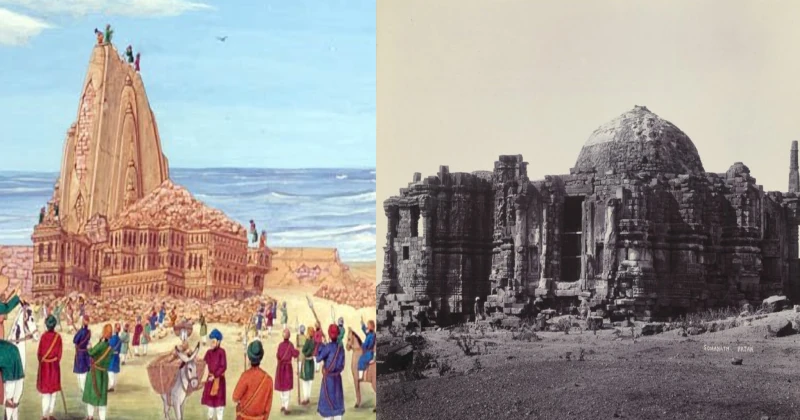
GUJARAT: As India approaches 2026, a millennium since the first recorded destruction of the Somnath Mandir, the ancient mandir on Gujarat’s western coast stands not merely as a place of worship, but as a powerful symbol of an unbroken civilisational will. Ravaged repeatedly by foreign invaders, converted into a mosque, plundered, desecrated and erased from the landscape again and again, Somnath’s survival tells a story that runs deeper than stone and mortar the story of Hindu resilience.

Exactly 1,000 years ago, in 1026 AD, during the reign of King Bhima I of the Chaulukya dynasty, the Turkic Muslim invader Mahmud of Ghazni launched a brutal raid on Somnath. Contemporary historical accounts record that Mahmud looted an estimated 2 million dinars from the Mandir treasury a staggering sum even by medieval standards.

Somnath temple stands as a testimony that Hindu civilisational spirit cannot be conquered, broken, or dominated. Every time it was destroyed by Muslim invaders, the temple was rebuilt by Hindus.

Exactly 1000 years back in 1026, during the reign of Bhima I, the Turkic Muslim… https://t.co/moHPp7rUbg pic.twitter.com/t0DrrV3dwK

— Monidipa Bose – Dey (মণিদীপা) (@monidipadey) January 5, 2026

The sanctum sanctorum was desecrated. The Jyotirlinga, among the holiest manifestations of Bhagwan Shiva, was shattered into four pieces. According to historical tradition, one fragment was buried beneath the Ghazni mosque, another under the gateway of Mahmud’s palace, while the remaining pieces were sent to Makkah and Madinah a deliberate act meant to humiliate and subjugate a civilisation.

Yet Somnath did not vanish. It was rebuilt. The centuries that followed saw Somnath become a recurring target of Islamic conquest:

  • 1299: The armies of Alauddin Khalji, led by Ulugh Khan, once again sacked the Mandir.
  • 1395: Zafar Khan, the last governor of Gujarat under the Delhi Sultanate, destroyed it for the third time.
  • 1669: Mughal emperor Aurangzeb issued a sweeping decree ordering the demolition of Hindu Mandirs and schools. Somnath was razed yet again and converted into a mosque.

Each attack was intended not only to destroy a religious structure but to crush the cultural and spiritual confidence of the Hindu people. Each time, the strategy failed.

After 1947, as India emerged from colonial rule, the question of rebuilding Somnath became a test of the nation’s civilisational self-respect. Sardar Vallabhbhai Patel championed the reconstruction, seeing it as a moral duty to restore what centuries of invasions had sought to erase.

However, the effort faced resistance from within the newly independent Indian leadership. Jawaharlal Nehru opposed the reconstruction, arguing that the state should not associate itself with religious revival. Despite this opposition, the will to rebuild prevailed.

On May 11 1951, the reconstructed Somnath Mandir was inaugurated in the presence of Dr Rajendra Prasad, India’s first President. His presence sent an unmistakable message: independent India would no longer be ashamed of reclaiming its civilisational heritage.

Earlier, Prime Minister Narendra Modi shared a message on X saying “Jai Somnath!”, underscoring the symbolic importance of the Mandir. Political leaders and commentators have highlighted Somnath as an enduring symbol of faith and continuity, noting that despite repeated destruction over centuries, the Mandir was rebuilt each time.

Jai Somnath!

2026 marks 1000 years since the first attack on Somnath took place. Despite repeated attacks subsequently, Somnath stands tall! This is because Somnath’s story is about the unbreakable courage of countless children of Bharat Mata who protected our culture and…

— Narendra Modi (@narendramodi) January 5, 2026

PM Modi has reflected on the enduring spiritual and civilisational significance of the Somnath Mandir in an article titled “Somnath Swabhiman Parv: 1,000 Years of Unbroken Faith.” In the piece, the Prime Minister described Somnath as a powerful symbol of India’s resilience, self-belief, and unwavering faith, noting that the Mandir has risen repeatedly over the last millennium despite facing repeated adversities.

Highlighting the Mandir’s place in India’s cultural consciousness, PM Modi wrote that Somnath embodies the timeless spirit of Bharat, rooted in heritage, guided by faith, and strengthened by collective resolve. He emphasised that beyond being a physical structure of stone and sanctum, Somnath represents India’s civilisational courage, enduring belief system, and commitment to dharma.

Also Read: “Somnath defined by unbreakable courage of children of Bharat Mata”: PM Modi on 1000 years of invasion of temple

The PM also pointed to the historical milestones associated with the Mandir, noting that while a thousand years have passed since its first destruction, Somnath continues to stand as a living symbol of continuity. He added that 2026 will mark 75 years since the Mandir’s restoration, a moment that honours the generations who worked to ensure that this symbol of faith and cultural identity remained alive.

BJP leader Amit Malviya took it to X, and referred to a blog by the Prime Minister that reflects on India’s civilisational strength and resilience. The writings emphasise that the first destruction of the Somnath Mandir took place in 1026 AD, and that over the centuries, while empires rose and fell and invaders came and went, India’s civilisational spirit endured.

 

Topics: Somnath at 1000Islamic InvasionGhazni mosqueChaulukya dynastyNarendra ModiPM ModiSomnath MandirSomnath
ShareTweetSendShareSend
✮ Subscribe Organiser YouTube Channel. ✮
✮ Join Organiser's WhatsApp channel for Nationalist views beyond the news. ✮
Previous News

J&K: Power Minister Khattar wants Pakal Dul, Kiru to start commercial production of 1,624 MW of power by December 2026

Next News

Chhattisgarh: Abujhmad villages set to be mapped for the first time, as government signed agreement with IIT-Roorkee

Related News

A representative image

Organic manure adoption surges 3.5 times in Kharif 2026 as India builds fertiliser buffer against global turmoil

Prime Minister Narendra Modi and French President Emmanuel Macron

India-France 114-Rafale Deal: How New Delhi is turning defence procurement into a Make-in-India aerospace revolution

PM Modi extended greetings to the people of West Bengal on the occasion of Paschimbanga Divas

“State that has profoundly shaped India’s history”: PM Modi greets West Bengal on Paschimbanga Divas

Prime Minister Narendra Modi with US President Donald Trump

A Handshake, Not a Hug: Why PM Modi must assert India’s strategic red lines in his crucial meeting with Trump

India’s first made-in-India C-295 aircraft marks a shift from state control to nation-building through public-private partnership

From Nationalisation to Nation Building: The difference between socialism and integral humanism

At the G7 Summit, PM Modi urged support for developing nations affected by the West Asia crisis

G7 Summit 2026: PM Modi seeks economic shield for global south from West Asia war fallout

Load More

Latest News

Yoga Day celebrations in Shanghai, China

International Yoga Day: Global celebrations echo the message of health, well-being and timeless ancient Indian wisdom

The Alchemy of Autarky: How India rewrote its economic destiny

Janjatiya Sanskriti Samagam at the Red Fort: A powerful celebration of India’s tribal heritage

Every rape victim of 2021 post-poll violence must come forward; govt is committed to deliver justice: Agnimitra Paul

FACT CHECK | Ajmer NEET Burqa Row: NTA permits religious attire; Student allowed post screening; Fake claims debunked

Rejuvenation of Yamuna is a cultural and national responsibility: Delhi CM Rekha Gupta

Yanung Jamoh Lego, popularly known as Queen of herbs was conferred with Padma Awards

From forest trails to Padma Shri: How Arunachal’s ‘Queen of Herbs’ is reviving India’s traditional herbal medicine

A representative image

India Defies Global Headwinds: Remittances and services exports power surprise current account surplus in Q4 FY26

EU lifts travel advisory for Assam

EU lifts travel advisory for Assam: CM Sarma says big boost for state’s tourism and development

Illegally constructed mosque in Japan

The Threat of Islamisation: A Japanese case study

Load More
  • Privacy
  • Terms
  • Cookie Policy
  • Refund and Cancellation
  • Delivery and Shipping

© Bharat Prakashan (Delhi) Limited.
Tech-enabled by Ananthapuri Technologies

  • Home
  • Search Organiser
  • Bharat
    • Assam
    • Bihar
    • Chhattisgarh
    • Jharkhand
    • Maharashtra
    • View All States
  • World
    • Asia
    • Africa
    • North America
    • South America
    • Europe
    • Australia
  • Editorial
  • Operation Sindoor
  • Opinion
  • Analysis
  • Defence
  • Culture
  • Sports
  • Business
  • RSS @ 100
  • Entertainment
  • More ..
    • Sci & Tech
    • Vocal4Local
    • Special Report
    • Education
    • Employment
    • Books
    • Interviews
    • Travel
    • Health
    • Politics
    • Law
    • Economy
    • Obituary
  • Subscribe Magazine
  • Read Ecopy
  • Advertise
  • Circulation
  • Careers
  • About Us
  • Contact Us
  • Policies & Terms
    • Privacy Policy
    • Cookie Policy
    • Refund and Cancellation
    • Terms of Use

© Bharat Prakashan (Delhi) Limited.
Tech-enabled by Ananthapuri Technologies