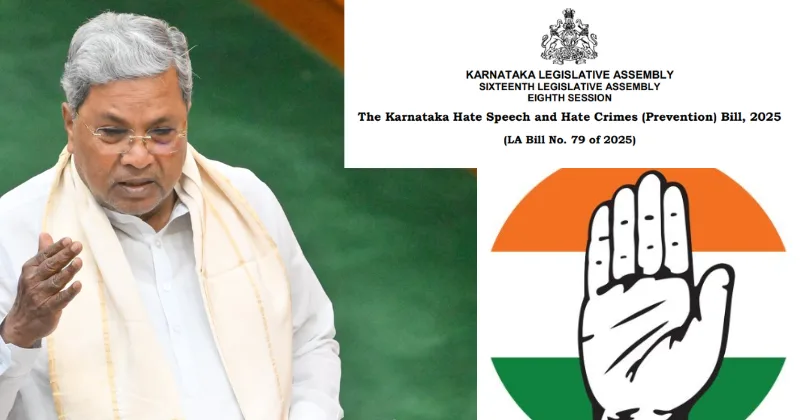
The Hate Speech Prohibition Bill, 2025, recently tabled inside the Karnataka Legislative Assembly, has triggered intense debate. While opposition parties have alleged that the Bill is politically motivated, the government has defended it by stating that the legislation is intended to curb elements that disturb social harmony, incite communal violence, and threaten law and order.
Irrespective of political accusations and counter-accusations, it is the responsibility of citizens to examine any proposed legislation within the constitutional framework.
The Congress ruled Karnataka State Government undoubtedly has the authority to introduce legislation citing maintenance of law and order. However, any Bill or law enacted by the government must strictly conform to constitutional provisions. More importantly, it must not violate the basic structure of the Constitution. If any legislation is found to be contrary to the basic structure, the judiciary has the power to declare it unconstitutional.
Therefore, the critical legal question is whether the proposed Bill violates the basic structure of the Constitution.
Constitutional Protection of Freedom of Expression
Article 19 of Part III of the Constitution guarantees the fundamental right to freedom of speech and expression. Under Article 19(1)(a), citizens are granted essential freedoms.
As per Article 19, Indian citizens have the constitutional right to freely express opinions, disseminate information, and engage in criticism. This is a fundamental right, and it cannot be curtailed arbitrarily.
Further, Articles 20 and 21 guarantee the right to life and personal liberty. These rights cannot be suspended even during the proclamation of an Emergency.
Basic Structure Doctrine and Judicial Authority
In 1971, through the 24th Constitutional Amendment, Parliament asserted its power to amend fundamental rights. However, in the landmark Kesavananda Bharati vs State of Kerala (1973) case, the Supreme Court ruled that Parliament does not have the authority to alter the basic structure of the Constitution.
During the constitutional amendments, Article 368 was amended to include Clause (5), borrowed from South African constitutional provisions, stating that no amendment made by Parliament could be challenged in court. This provision was subsequently struck down by the Supreme Court, which reaffirmed its authority to invalidate any law that violates the basic structure of the Constitution.
Dr B R Ambedkar had repeatedly emphasised that the chapter on Fundamental Rights is the heart and soul of the Constitution.
To safeguard fundamental rights, the Constitution itself provides remedies under Article 32 (Supreme Court) and Article 226 (High Courts), empowering courts to issue five types of rights.
Judicial Precedents on Freedom of Speech
Although the Karnataka Police Act, 1963 allows certain restrictions on fundamental rights in the interest of law and order, such restrictions must be justified by compelling, necessary, and extraordinary circumstances. Arbitrary curtailment of fundamental rights is impermissible.
The Supreme Court has consistently upheld freedom of expression in several landmark judgments:
Romesh Thappar vs State of Madras (1950) – The Court ruled that restrictions on freedom of expression were unconstitutional.
Brij Bhushan vs State of Delhi (1950) – Freedom of expression was strongly upheld.
Sakal Papers Ltd vs Union of India (1961) – The Court protected press freedom.
Indian Express Newspapers vs Union of India (1985) – The Supreme Court held that freedom of the press is an essential part of democracy.
Shreya Singhal vs Union of India (2015) – The Court clarified that only restrictions explicitly permitted under Article 19(2) are valid, and any excessive restriction would be struck down as unconstitutional.
The Court clearly stated that governments have no authority to impose restrictions beyond those specified in Article 19(2), and any such attempt would render the law invalid.
Therefore, any action that restricts fundamental rights, particularly freedom of expression, necessarily falls within the ambit of judicial review.
(LA Bill No. 79 of 2025)
Constitutional Limitations on State Power
State governments do not possess absolute sovereignty under the Constitution. Sovereignty rests solely with the Union of India. State governments do have constitutional authority to legislate on subjects listed in the State List for maintaining law and order. However, such laws must not conflict with Central legislation. Fundamental Rights occupy a highly protected and paramount position in the Constitution.
Article 19 falls within the ambit of the Basic Structure doctrine. Any provision forming part of the Basic Structure cannot be nullified or diluted.
Governor’s Discretion Over the Bill
Any Bill passed by the State Legislature becomes constitutionally valid only after receiving the Governor’s assent. The Governor has constitutional authority to withhold a Bill for a specified period or reserve it for further consideration. On 20 November 2025, in a case involving the Tamil Nadu Government and the Governor, the Supreme Court ruled that the Constitution does not prescribe any deadline for the President or Governors to grant assent to Bills.
Under Articles 160, 161, 163, 163(2), 163(3), 166, and 200, the Governor holds special discretionary powers in determining the fate of this Bill.
Societal Context and Potential Consequences
A review of historical instances in India, particularly in Karnataka, indicates that a majority of cases that could fall under the ambit of hate speech have originated from representatives of religions and sects expressing hostility towards Hindu society.
There appears to be a perception that denigration of Hindu beliefs will not face strong resistance, either due to the inherently tolerant nature of Hindus or the belief that such criticism will go unchallenged. Consequently, repeated attacks on Hindu religious ideals and traditions have continued unabated.
Importantly, Hindus traditionally do not respond to criticism of their religion in an unconstitutional or uncivilised manner.
In contrast, provocative speeches associated with religious proselytisation, particularly within Islam and Christianity, are more likely to fall within the scope of hate speech. Even routine sermons delivered by a cleric in a mosque could potentially be classified as constitutional offences under this law. Since Hindus, by their civilisational ethos, do not engage in practices that violate the Constitution or legal codes, enforcing such a law primarily for political considerations could lead to unintended and adverse consequences.
In conclusion, the Hate Speech Prohibition Bill must necessarily pass the test of ‘judicial review’ before it can attain the status of law.