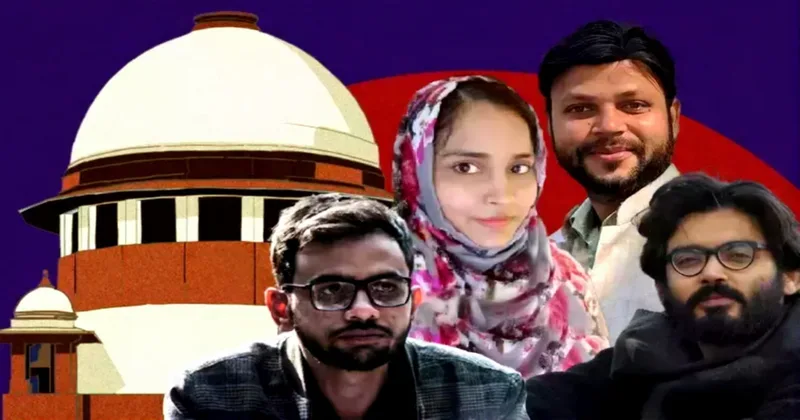
The Indian Constitution guarantees freedom of speech and expression under Article 19(1)(a). It is among the most cherished pillars of our democracy, empowering citizens to question authority, criticise governments and articulate dissent without fear. Yet, in the same constitutional breath, Article 19(2) places reasonable restrictions on this freedom. This dual framework reflects constitutional maturity: freedom is not anarchy and dissent is not disintegration.
The ongoing legal and political discourse surrounding the Umar Khalid case once again brings this delicate balance into sharp national focus. Is every utterance protected under the umbrella of free speech? Can slogans questioning the territorial integrity and unity of Bharat be defended as dissent? And where must the line be drawn between ideological opposition and separatist mobilisation?
The framers of the Constitution were acutely aware of India’s civilisational vulnerabilities. Emerging from the trauma of Partition, mass bloodshed and secessionist upheaval, they consciously rejected absolutist notions of free speech. Article 19(2) explicitly restricts expression in the interests of India’s sovereignty and integrity, public order and national security. This is neither unique nor authoritarian. No modern nation-state permits calls for its own dismemberment under the guise of free expression. Even the most liberal democracies draw firm red lines when speech mutates into incitement against the state.
This leads to the unavoidable constitutional and moral question: can one demand freedom of expression after raising slogans that call for the division of Bharat? The answer is unambiguous. Dissent against policies is democratic; dissent against the nation itself is destabilising. The Umar Khalid case is frequently reduced to a simplistic binary of individual liberty versus state power. Such framing deliberately ignores the broader ideological ecosystem in which the controversy is embedded. This is not merely about one individual. The slogans raised by them before the Delhi riot were not demands for policy reform or social justice; they allegedly questioned India’s sovereignty and echoed narratives historically exploited by forces hostile to the Indian state.
Jawaharlal Nehru University (JNU) has long been associated with intellectual debate and ideological contestation. Yet intellectualism cannot be used as a shield for ideological extremism. Very recent campus incidents reveal how slogans, symbols and selective outrage are deployed to deliberately blur the boundary between debate and provocation. It concerns the creeping normalisation of separatist rhetoric within elite academic spaces. Campus politics, when hijacked by radical ideologies, often masquerades under the banner of “academic freedom”. But academic freedom does not include the right to glorify separatism or normalise anti-national discourse. When publicly funded universities become platforms for legitimising such narratives, the state is not only empowered but duty-bound to intervene. Universities must remain spaces of debate, not laboratories of fragmentation. Freedom of speech within campuses must be accompanied by responsibility towardS the nation that sustains those institutions.
History repeatedly demonstrates that separatist movements often cloak themselves in the language of resistance and liberation. From Kashmir to Maoist corridors, such movements rarely deliver peace or prosperity. Instead, they generate cycles of violence, instability and prolonged suffering for ordinary citizens. Romanticising separatism from the safety of urban campuses reflects profound intellectual irresponsibility. Those who raise such slogans do not pay the price; soldiers, civilians and marginalised communities do. The Constitution does not protect speech that threatens national unity. To argue otherwise is to deliberately misread both its text and its spirit.
Freedom without restraint descends into chaos. Reasonable restrictions are not authoritarian inventions but constitutional necessities. They ensure that one person’s freedom does not become another’s insecurity. Critics often claim that invoking national security chills free speech. The greater danger, however, lies in selectively defending speech that undermines the nation while ignoring the rights of millions who depend on unity, stability and peace.
India’s democracy is resilient precisely because it accommodates dissent. But dissent must operate within constitutional boundaries. The freedom to speak does not extend to the freedom to call for the nation’s breakup. The Umar Khalid debate should not be trivialised into slogans about “intolerance” or “fascism”. Instead, it should force a more fundamental question: can a democracy survive if its foundational unity is treated as negotiable? The answer is clear. Freedom of speech is a right; loyalty to the nation is a duty. No right exists in isolation from that duty.
In recent years, a familiar pattern has emerged whenever India asserts its sovereignty, enforces its laws or confronts internal subversion. Western media outlets and left-leaning global institutions quickly manufacture narratives of “democratic backsliding” and “free speech suppression”. The Umar Khalid case exemplifies this broader ideological project; not merely to criticise India, but to delegitimize it from within. Accused under Indian law for his alleged role in the conspiracy behind the 2020 Delhi riots, Umar Khalid is routinely projected by Western media as a “student activist”, a “political prisoner”, or even a “prisoner of conscience”.
The actual charges—conspiracy, incitement and links to orchestrated violence are carefully minimised or omitted. This selective storytelling is not accidental; it is strategic. Western media and allied ideological organisations often weaponise free speech, not as a universal principle, but as a selective instrument. When riots erupt in European cities or national security laws are enforced in the West, such actions are framed as “necessary state measures”. When India applies its laws against individuals accused of orchestrating communal violence, the same actions are branded authoritarian.
By elevating figures like Umar Khalid into global symbols of resistance, three objectives are pursued. First, Indian institutions, the judiciary, police and legislature are portrayed as inherently illegitimate. Second, internal fault lines are amplified and internationalised. Third, external pressure is exerted through foreign lawmakers, NGOs and coordinated media campaigns, creating the illusion of global moral consensus against India. This strategy mirrors older colonial tactics where claims of moral superiority justified interference. Today’s vocabulary— “human rights”, “academic freedom”, “civil liberties” is softer, but the intent remains unchanged. What makes this narrative especially dangerous is its attempt to redefine violence as dissent and conspiracy as protest. The Delhi riots of 2020 resulted in deaths, destruction and enduring communal wounds. Reducing such events to mere “speech acts” is not only dishonest but morally indefensible. A democracy that cannot defend its unity cannot defend its freedoms either.
India’s Constitution enshrines free speech not as an absolute licence, but as a responsible right anchored in national unity. Dissent strengthens democracy only when it operates within constitutional boundaries. The attempt to portray separatist rhetoric as protected expression distorts both law and morality. A nation that tolerates calls for its own fragmentation undermines the very freedoms it seeks to defend. The Umar Khalid debate must therefore move beyond slogans and sentimentality to a constitutional reckoning. Liberty cannot survive without loyalty and rights lose meaning when detached from duty. Protecting India’s unity is not repression; it is democratic self-preservation.