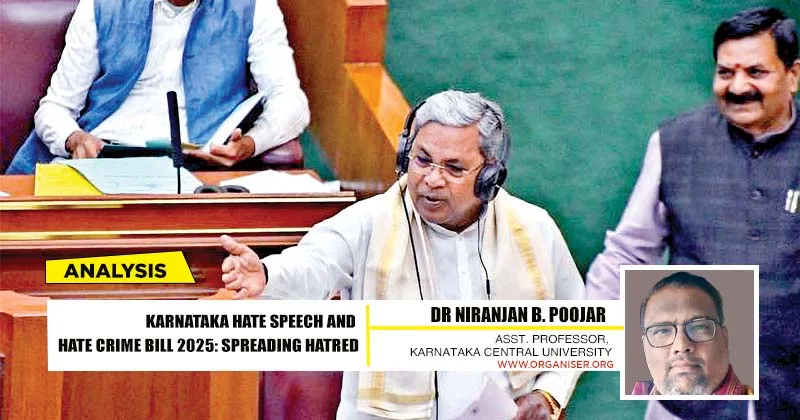
The Karnataka Hate Speech and Hate Crime Bill 2025, in the name of stopping hate, threatens free speech and constitutional rights, giving the State vague powers that can be misused to silence Hindu voices, dissent, criticism, and debate
The vitality of any democratic society rests squarely on the freedom of expression enjoyed by its citizens. Democracy is not merely the act of voting once every few years; it is a living, breathing system that survives through dissent, open debate, fearless questioning of authority, and the uninhibited exchange of ideas. History, however, repeatedly demonstrates a troubling pattern: laws introduced under the moral banners of “social harmony,” “communal peace,” and “public order” often become instruments for silencing inconvenient voices. The proposed Karnataka Hate Speech and Hate Crimes (Prevention) Bill, 2025, represents precisely such a moment of constitutional danger. Its vague language, excessive penal provisions, and ideological selectivity pose a grave and enduring threat to democratic life in Bharat.
At the heart of any just criminal law lies the principle of legal certainty; the citizen must clearly know what constitutes an offence. This Bill fails that fundamental test. Its definition of “hate speech” is dangerously broad and alarmingly ambiguous. Any spoken word, written expression, image, symbol, or digital communication that allegedly causes “discontent,” “disharmony,” or “offence” to an individual or group may be criminalised. These are not legal standards; they are emotional states. “Discontent” and “offence” vary across individuals, communities, and political moods. When such elastic and psychological terms are enshrined in law, they become potent weapons of state intimidation rather than instruments of justice.
A customised bill to target the opponents
• The Bill will erode the state’s intellectual vitality and normalise fear.
• Selective application of “hate” that can be defined by the State to initiate action against its target
• Re-entry of Congress’s Communal Violence Bill 2011 in a new format to brand Hindus as default aggressors
• Designed to target ideological and political opponents
• Under this law, protest slogans, speeches, or pamphlets could be reinterpreted as “hate speech” or “disturbance of public order”.
• The State can target academicians who research by revisiting historical narratives, sociological critiques of institutions, or philosophical debates on religion and society.
• This Bill overrides the existing Sections 153A, 295A, and 505 of the Indian Penal Code, along with relevant provisions of the Information Technology Act
• The proposed prison terms range from seven to ten years, coupled with non-bailable provisions against Article 21, which guarantees personal liberty
• The Bill will expand State control over speech, thought, and dissent, instead of truly curbing hatred.
• This Bill can target a cartoon, a satirical post, a tweet, a classroom lecture, or a critical article by labelling it “hate-inducing.”
• The Bill directly undermines Article 19(1)(a) of the Constitution.
This ambiguity directly undermines Article 19(1)(a) of the Constitution, which guarantees freedom of speech and expression. Reasonable restrictions are permitted under Article 19(2), but they must be precise, proportionate, and necessary. A law that criminalises subjective hurt rather than objective harm is neither reasonable nor constitutional; it is authoritarian in design.
This Bill prioritises perceived impact over actual intent. As a result, even truthful statements, historical facts, academic critiques, theological discussions, or sociological analyses may invite prosecution if someone claims emotional distress. Truth has always unsettled power. Reform movements, philosophical debates, and historical inquiry have invariably caused discomfort to entrenched interests. If discomfort becomes a crime, then intellectual life itself becomes illegal.
Such laws inevitably invite misuse, and the Bill grants dangerously broad discretionary powers to the police. A cartoon, a satirical post, a tweet, a classroom lecture, or a critical article could be interpreted as “hate-inducing” by a lower-level officer acting under ideological bias or political pressure. This produces a chilling effect far more damaging than overt censorship. Citizens begin to censor themselves. Journalists soften language. Scholars avoid controversial research. Artists abandon satire. When fear governs expression, democracy becomes a hollow ritual devoid of moral courage.
The severity of punishment prescribed under the Bill intensifies these concerns. Prison terms ranging from seven to ten years, coupled with non-bailable provisions, transform the law into an instrument of repression rather than justice. Article 21 guarantees personal liberty, yet denial of bail effectively punishes the accused before guilt is established. In politically motivated cases, individuals may languish in prison for years while trials drag on. The process itself becomes the punishment—an approach fundamentally alien to constitutional morality and natural justice.
What renders this Bill even more indefensible is the fact that Bharat already possesses sufficient legal mechanisms to address genuine cases of hate speech and incitement to violence. The insistence on introducing a new, harsher, and vaguer law raises a disturbing question: Is the objective truly to curb hatred or to expand state control over speech, thought, and dissent?
This question becomes sharper when viewed in the light of Congress’s historical pattern of communal legislation. Earlier attempts to introduce communal violence in 2011 and hate speech frameworks under Congress governments followed a similar template, projecting Hindus as the default aggressor and majority guilt as an assumed truth.
The Congress routinely presents itself as the self-appointed champion of democracy, liberalism, and freedom of expression. Yet when it comes to Hindu voices, be they religious, cultural, historical, or political, the same party displays a punitive impulse. Hindu festivals are labelled “provocations,” Hindu organisations are viewed with suspicion, and Hindu intellectual traditions are reduced to caricatures of oppression. In the process of minority appeasement, Hindus are expected to surrender not only political power but also cultural confidence and civilisational self-respect.
This selective application of “hate” is not accidental; it is ideological. Certain expressions are pre-labelled as “majoritarian,” “communal,” or “dangerous,” while others are shielded under the guise of victimhood. Such asymmetry corrodes the rule of law. Equality before the law cannot coexist with ideological bias. A law that punishes one community’s speech while excusing another’s excesses ceases to be secular; it becomes sectarian. The Karnataka Hate Speech and Hate Crimes (Prevention) Bill’s potential impact on opposition politics and social movements is equally alarming. Democratic protest is rarely polite. It is emotional, confrontational, and morally charged. Under this law, protest slogans, speeches, or pamphlets could be reinterpreted as “hate speech” or “disturbance of public order.” This weakens checks and balances and nudges the system toward authoritarian governance. A democracy without fearless opposition is democracy in name alone.
International human rights standards are also violated. Globally accepted frameworks insist that hate speech laws must consider intent, severity, likelihood of violence, and the influence of the speaker. The Karnataka Bill ignores these safeguards and instead empowers the State to act on subjective hurt and emotional offence. This places it in direct conflict with universal principles of freedom of expression and human rights.
The silence or selective approval of sections of the intellectual class is deeply troubling. Laws are never neutral. A statute celebrated today because it targets one’s ideological opponent can tomorrow be weaponised against oneself. History offers no shortage of such lessons. Selective outrage is not moral courage; it is intellectual opportunism. Freedom of expression is not a privilege granted by the State; it is a civilisational right earned through centuries of struggle.
Congress’ Persistent Assault on Hindu civilisational rights
The proposed Communal Violence Bill, 2011 triggered sustained opposition from the Rashtriya Swayamsevak Sangh (RSS) and large sections of civil society, who argued that the draft law threatened constitutional balance, social trust and democratic norms rather than promoting communal harmony.
RSS Sarsanghchalak Dr Mohan Bhagwat during his speech in Nagpur, warned that the Bill was part of a broader design by forces seeking to weaken Bharat. He stated that the draft was structured to “prove injustice as justice” and would cripple the administration. According to him, the legislation would not benefit even those it claimed to protect and would instead institutionalise permanent social conflict. He cautioned that the Bill would communalise the entire system, erode mutual trust and place individuals from the majority community under constant threat of legal action based on mere allegations.
Appealing to sants and civil society, Dr Bhagwat called for united resistance to ensure the Bill’s withdrawal and assured that the Sangh would support all democratic efforts opposing it. In line with this stand, the RSS conducted a nationwide awareness campaign from November 1 to 20, 2011.
Then RSS Sahsarkaryavaha Dattatreya Hosabale, speaking in Mangalore in January 2012, described the draft as communal in spirit rather than secular. He argued that it contradicted Bharat’s constitutional vision and civilisational ethos, and alleged that it was driven by minority appeasement aimed at electoral consolidation rather than genuine justice.
Seen in this backdrop, a clear line of continuity between the objections raised in 2011 and contemporary debates, including those surrounding the Karnataka Hate Speech Bill, 2025. The Congress party is known to frame with sweeping definitions, presumptions of guilt and discretionary powers revive earlier concerns flagged by the RSS and civil society—namely, the potential misuse of legislation to police thought, target select sections and widen social fault lines under the guise of harmony and justice. Rather than prioritising public welfare or national interests, the Congress party has repeatedly faced criticism for seeking to control people and institutions through legislation when in power. From Jawaharlal Nehru’s enactment of the Press (Objectionable Matter) Act, 1951, to the Emergency imposed by Indira Gandhi in 1975, the handling of the Shah Bano case in 1985 under Rajiv Gandhi, and the proposed Communal Violence Bill in 2011 during the Sonia Gandhi-led UPA, critics argue that these interventions were aimed at politically cornering opponents and curbing dissent.
There is no doubt that hatred harms society. But destroying freedom in the name of fighting hate is not a solution; it is a catastrophe. In a free society, hate must be countered with more speech, stronger arguments, education, and dialogue, not with draconian, non-bailable laws. If implemented in its present form, the Karnataka Hate Speech Bill, 2025, will erode the state’s intellectual vitality and normalise fear.