
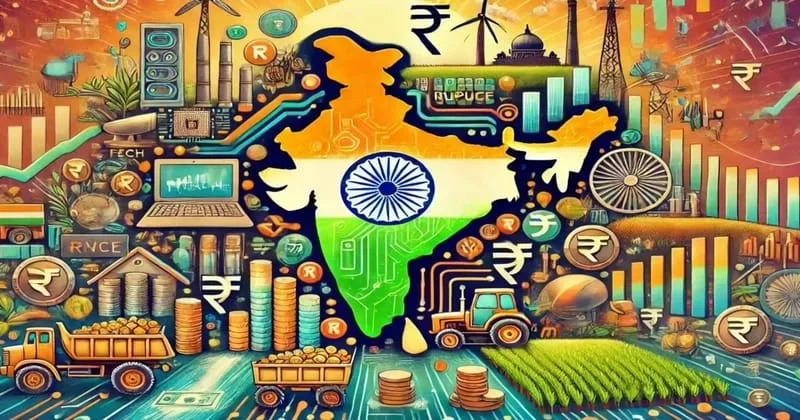
Bharat approaches 2026 with determination and clarity. The nation is constructing an energy basis that is cleaner. A more robust industrial environment. An enhanced pipeline of talent. A more inventive services industry. Opportunities arise from each of these changes. When taken as a whole, Bharat produces one of the most captivating tales of world development in recent memory. Today, foreign businesses have a strategic edge when they enter Bharat. The terrain is ever-changing. The possibilities are tangible. The growth is genuine.
What do international agencies report regarding Bharat’s GDP and economic growth?
Forecasts indicate that Bharat’s GDP would grow at the quickest rate in the world this year. According to the analytics firm Crisil, the Bharatiya economy is expected to grow by 6.5% in 2026, surpassing all major economies and advanced nations by a wide margin. According to economists, Bharat’s economy is still on track to surpass Germany’s as early as 2028 and become the third largest in the world. According to EY’s analysis, rapid growth might be supported by a number of structural advantages, such as a large, young population and a comparatively low debt burden.
In terms of nominal GDP, Bharat surpassed Japan last year to become the fourth-largest economy in the world. Going forward, it is anticipated that Bharat will increase its GDP by $1 trillion USD yearly. According to Markets & Markets’ most recent forecast, Bharat’s economy would reach $10 trillion by 2032. In a similar vein, the IMF’s World Economic Outlook projects that Bharat’s growth in FY2026 will be close to 6.6 per cent, stating that it will probably surpass other major countries and record the highest growth rate in the world in 2025–2026. Even the OECD called Bharat “one of the world’s fastest-growing economies” for the next two years, predicting “strong and broadly stable” growth of roughly 6.3 per cent in FY26.
What are the reasons and methods by which each sector will gain advantages?
The expansion is also supported by structural considerations. A sizable, youthful population with growing wealth and urbanisation creates a demographic tailwind, while continuous changes like digitisation, infrastructure development, and GST simplification are increasing productivity. Manufacturing and services are growing, according to analysts; S&P Global’s PMI data for fiscal 2026 indicates steady expansion in both sectors.
Domestic Demand: Bharat is set to emerge as the third-largest consumer market globally. Internal demand is maintained by a growing middle class and robust urban expenditure. Incomes in rural areas are also rising. This protects the economy from fluctuations around the world.
Sustained Investment: Bharat’s industry, renewable energy, and digital infrastructure are receiving investments from throughout the world. The markets are rich. Rules are more explicit. Investors are increasingly making strategic long-term bets on Bharat.
Services Export Boom: Ten years ago, services accounted for less than 30% of Bharat’s overall exports; today, they account for 46%. This trend is accelerated by Bharat’s leadership in business process management, technology services, and global capability centers (GCCs).
The way Bharatiyas study, work, interact, and prosper is already being transformed by advancements in AI, climate innovation, healthcare, and the workplace. All eyes will be on how these changes intensify in 2026 and how Bharat transforms its ambition, variety, and inventiveness into concepts that have an international influence.
Bharatiya Cinema
Something previously unthinkable will happen in Bharatiya cinema in 2026, the digital resuscitation of its most renowned screen legends. Filmmakers may soon “bring back” movie icons for public entertainment since AI can already accomplish jobs that formerly needed computer-generated imagery (CGI) with far less time, effort, and cost.
Healthcare and Education
The gender health gap may disappear more quickly than previously believed with creative care models and significant funding for research and development. By 2026, women’s health will no longer be viewed as a specialized problem but rather as a cornerstone of human advancement.
The future of higher education in Bharat is both globally local and global. Going overseas for a degree may soon become outdated if the coronavirus epidemic makes Zoom classrooms the norm, since international universities are packing their bags right now to come to Bharat. Additionally, this change is not exclusive to the metro area. Bharat’s education policy is very clear: to provide top-notch education outside of major cities. Universities are being encouraged to establish campuses in Special Education Zones—underprivileged areas that require access to high-quality education—under the National Education Policy 2020.
GEN – Zers and various sectors
With more than 380 million Gen Zers, Bharat’s demographics are predicted to have a significant impact on politics, innovation, culture, and purchasing habits. Future growth is expected to be significantly influenced by this generation’s entrepreneurial mindset and digital fluency. With growing Gen Z demand, the cultural economy—which includes everything from book publication to immersive entertainment and travel—is changing. Trends include an increase in wellness-driven consumer choices, lifestyle activities, and local music partnerships. The forecast for Bharat’s labor market in 2026 is still favorable, with employment growth anticipated in the fields of technology, healthcare, life sciences, and construction. Notably, in order to access qualified individuals in Tier-2 locales, companies are expanding their talent pools outside of large metropolitan areas.
Exports from Bharat
What are Bharat’s principal exports? Think of jewelry and stones, engineering services, and medicine. But in 2026, remote talent will take the lead. The MENA and Southeast Asian regions, in addition to South Africa and Australia, are rapidly embracing digital transformation, which is increasing the need for tech workers. And just in time for Bharat, everything is coming together! Data analytics and cybersecurity, cloud engineering, automation and cloud computing, AI specialists and developers, and machine learning are the most in-demand fields. In actuality, demand is soaring in a number of sectors, including healthcare and finance.
Green Energy
As of January 2026, capacity from non-fossil sources was five years ahead of the 2030 goal. However, the focus of investment in 2026 will be on transmission and storage rather than generation, rather than just creating solar parks. For the grid to function, significant changes are required. sporadic renewable energy Order inflows for businesses in the power transmission industry are similar to those in the defense industry. The next frontier is energy storage systems. It is crucial to store extra daytime energy for evening peak usage as solar capacity approaches 128 GW.
Defence sector
The military industry’s narrative has changed from “look at the order book” to “look at the delivery.” Businesses like Bharat Electronics Ltd. (BEL) and Hindustan Aeronautics Ltd. (HAL) have enormous order backlogs, with BEL having Rs 75,000 crore (October 2025) and HAL having over 1.89 lakh crore (March 2025). These orders will result in billing and cash flow in 2026.
Currency
Bharat already has bilateral currency exchange agreements with countries such as the United Arab Emirates, Japan, Sri Lanka, and the Maldives. Additionally, it lessens reliance on US dollars by facilitating rupee-based commercial transactions with 30 countries via Special Rupee Vostro Accounts (SRVAs). Bharat’s UPI is currently accepted by nine other countries.
Agriculture
Climate change-related weather events might lower crop yields in Bharat’s agriculture sector by up to 25 per cent, according to All India Farmer Associations. The solution to this problem might be found indoors. “Fresh produce free of pesticides and heavy metals will be available to urban populations through indoor farming.” Indoor farming grows crops in controlled environments with less space, thanks to vertical stacking, uses 95% less water than traditional methods, and directly infuses nutrients to accelerate growth.
GCC
Bharat is not holding out for improvements. On its own, it is gaining traction. Bharat’s GCCs are going to experience a significant transformation, shifting from cost-effectiveness to innovation leadership. By 2026, Bharat’s GCCs will be at the forefront of global digital transformation, AI use, and end-to-end product ownership. With its strong talent ecosystems, tech integration, and penetration into Tier-2 cities, Bharat is transforming the global GCC growth narrative. We are making progress in both the commodities and services value chains.
A structural change is taking place beneath the surface, despite the limited growth in headline IT services. Bharat’s Global Capability Centers (GCCs) are growing quickly. By 2026, it is anticipated that these centers will employ 2.4 million people. Large-scale Al deployment is anticipated in 2026, with global clients transitioning from “Pilot” to “Production” phases.
Bharat has a 55 per cent global share in the GCCs. Teams that oversee technology, data product development, and core business operations—rather than just back offices—for global organizations. So far, GCCs have created one crore jobs! As immigration laws get more strict, there will definitely be more GCCs coming to Bharat! With a 55 per cent global GCC share, Bharat is more than just the back office; it is the corporate brain of the world. It’s absurd that these aren’t call centers. Nike creates shoes, JP Morgan creates trading algorithms, and Google trains artificial intelligence from Bangalore and Hyderabad.
There are already one crore new jobs. Due to H1B crackdowns and rising US costs, this has increased over the past five years. Bharat’s real edge is no longer cheap labor. Expert talent is available for a third of what it costs in the United States. The labor force in Bharat is evolving quickly. Advanced digital skills are highly sought after AI and big data experts are among the quickly growing occupations, according to the World Economic Forum. Full-stack developers are among the most sought-after technical jobs in the Gulf Cooperation Council. IoT experts and cloud security experts, as GCCs increase connected devices and cybersecurity, jobs are in great demand. Data Scientists, Strong demand ahead, with 5 million data-related roles opening by 2026
However, technical proficiency is not the complete picture. These days, employers look for adaptability, curiosity, and resilience. The most prosperous professionals in Bharat combine high emotional intelligence with keen analytical skills. This shift reflects a fundamental truth: long-term success is driven by mentality, whereas industries are driven by skills.
The combination of clean energy and digital infrastructure is one of Bharat’s greatest advantages. It suggests a five-pronged strategy to boost growth: higher capital expenditures, improved ease of doing business, reduced business costs, a focus on labor-intensive manufacturing, and stronger integration into global value chains. It highlights how Bharat’s ascent has been fueled by proactive government reforms and a friendly investment environment, setting it apart from other nations that have seen slower growth. It also emphasizes the need to focus on key sectors like agriculture, fintech, semiconductor manufacturing, renewable energy, health, and insurance in order to sustain future growth. Business has a part to play, but government intervention is crucial. We must commit to skilling at scale, boost capacity, employ state-of-the-art technologies, and make confident investments. Decisions made by the corporation must be guided by transparency, and business strategy must prioritize sustainability. If the government leads boldly and clearly and Bharatiya industry responds with investment, innovation, and accountability, Bharat may turn its reform momentum into enduring national confidence. 2026 is anticipated to be a crucial year for Bharat, characterized by consolidation and acceleration. From economic milestones to technology leadership and demographic rewards, the nation is at a crossroads of opportunity and challenge. Whether these tendencies lead to inclusive growth and societal well-being will depend on how policies are implemented, how strong the private sector is, and how well nations work together.