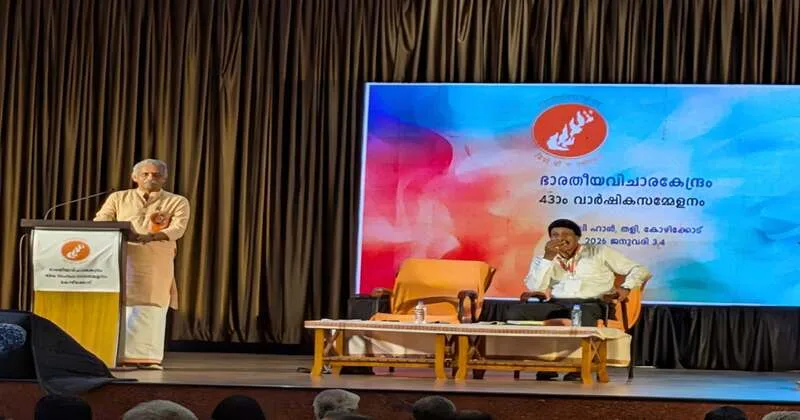
Kozhikode: If the sacred national mantra Vande Mataram had not been divided, Bharat itself would not have been divided, said J Nandakumar, Prajna Pravah National Coordinator and Akhil Bharatiya Karyakari Sadasya of the Rashtriya Swayamsevak Sangh. He was speaking while presenting the topic “Vande Mataram @ 150 – Bankim Chandra Chatterjee’s National Unity Mantra” at the 43rd annual conference of the Bharatheeya Vichara Kendram, held in Kozhikode district, Kerala.
Referring to the popular movement against the partition of Bengal, J Nandakumar said that it was a struggle that achieved complete success. At that time, there were no large political mobilisations or organised leadership to guide the masses. Instead, Vande Mataram itself became the driving force behind the people’s resistance. British imperialism was compelled to retreat before the strength of this national movement, he noted.
However, he argued that when the British moved to divide Bharat in 1947, there was no comparable nationwide resistance. This absence of a mass uprising, he said, demands serious reflection. According to J Nandakumar, the roots of this weakness lay in the developments that began with the deliberate dilution of Vande Mataram in 1936. He contended that the Congress leadership’s opposition to Vande Mataram, to Bharat’s civilisational uniqueness, and to its eternal values, all in the name of secularism, gradually drained the inner strength of the nation.
This ideological shift, he said, produced a leadership that had lost its heroic spirit, lacked the resolve to resist external pressures, and ultimately surrendered. The spiritual strength born out of sadhana was eroded. While people from every corner of Bharat rose against the partition of Bengal, the nation failed to muster sufficient strength to oppose the partition of Bharat itself. The reasons behind this contrast, J Nandakumar stressed, must be critically examined.
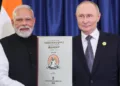
He further observed that Vande Mataram possesses the inherent power to awaken national consciousness and resist attempts to divide the Bharathiya mind. After Independence, efforts were made to sideline and avoid this mantra in an unscrupulous manner. Yet, in the 150th year of Vande Mataram, a renewed effort has begun to restore this national spirit at the heart of Bharat, he said. J Nandakumar pointed out that this renewed assertion of national identity was symbolised by the 150th anniversary celebrations of Vande Mataram, attended by Prime Minister Narendra Modi on November 7. Prof. K. P. Somaraj presided over the session.
43rd annual conference of Bharatheeya Vichara Kendram
The state conference was inaugurated by Justice N. Nagaresh of the High Court of Kerala at Jubilee Hall, Thali, at 10 am on January 3. Director of Bharatheeya Vichara Kendram R. Sanjayan presided over the inaugural meeting. R. Sanjayan observed that one could truly become an Indian only by embracing the Bharathiya worldview. He explained that this worldview rests on the understanding that man, nature, and God are essentially one. This vision, which has been part of Bharat’s knowledge tradition since the Vedic period, was eloquently articulated by Sree Narayana Guru through his ‘Daivadashakam’. He added that the belief that only the ‘Creator’ should be worshipped, while the universe, the earth, and living beings are excluded from reverence, runs contrary to the Guru’s philosophy. According to that philosophy, the Creator, creation, and the material of creation are one, and that unity itself is God.
A discussion titled “Awakening Bharat and the New World Order in the Geopolitical Perspective”, held at 11.30 am, was addressed by Dr. G. Gopakumar, former Vice-Chancellor of the Central University of Kerala. The session was presided over by Dr. S. Umadevi. The annual conference of the Bharatheeya Vichara Kendram, which focused on debates surrounding nationalism in a changing era, was held from January 2 to 4 at the Thali Jubilee Hall in Kozhikode district. As part of the state conference, the state committee met at the Dr. K. Madhavankutty Research Centre in Kesari Bhavan, Chalappuram. This was followed by the meeting of the state representative body.