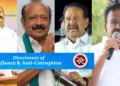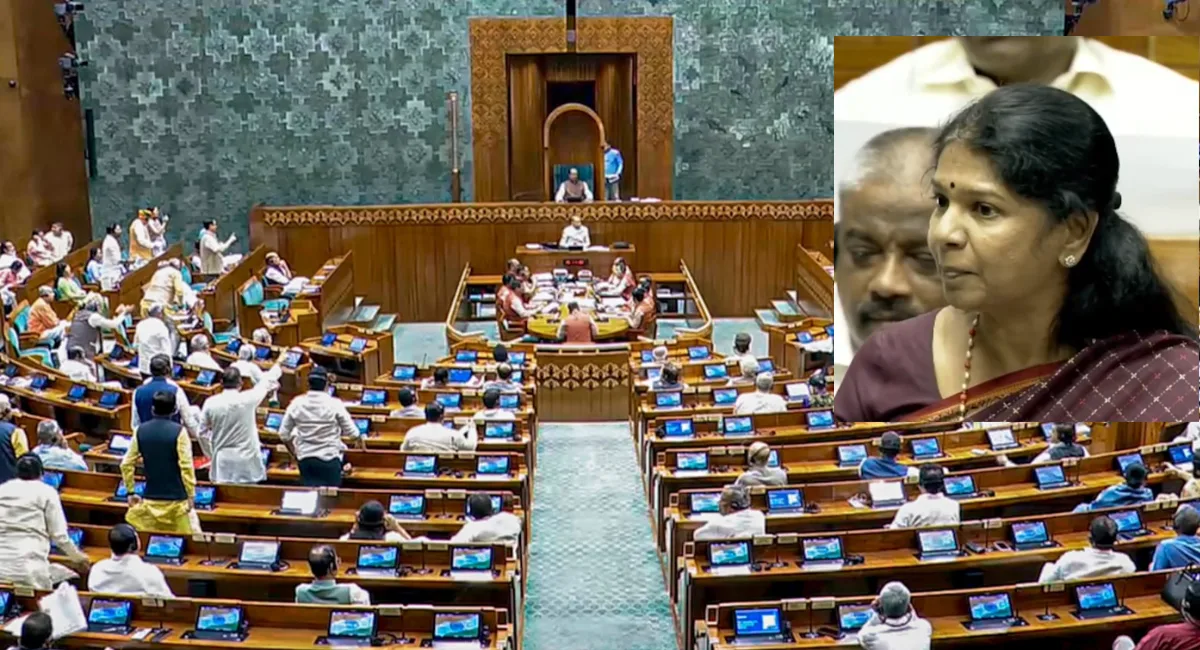
DMK Nilgiris Lok Sabha MP A Raja, a known rabid Hinduphobic, triggered a controversy by saying that rendering Vande Mataram compulsory would pave the way for the Partition of India, while CPI(M) MP Su Venkatesan distorted the Bill by claiming that “singing Tamil Thai Vazhthu before Vande Mataram could attract a three-year prison sentence”.
The DMK mounted an ideological defence against the Prevention of Insults to National Honour (Amendment) Bill, 2026. Raja argued that the historical enforcement of the song had once divided the country and warned that its criminalised imposition threatened to do so again. Opposing the Bill in the Lok Sabha, Raja outrightly rejected the legislation, describing its stated objectives as misleading and branding it “a joke, fraud, and foul play”. Hindu Munnani has condemned his remarks in Parliament.
வந்தே மாதரம் பாடினால், தேச பிரிவினை ஏற்படுமா?? | What uncle, it's very wrong Raja uncle |#VandeMataram #DMK #ARaja #Kanimozhi #HinduMunnani pic.twitter.com/3W6mbGSk0C
— Hindu Munnani (@hindumunnani_tn) July 31, 2026
Raja said, “Why did Partition happen? One person, Savarkar, and one song, Vande Mataram.” Though he sought time to present historical evidence to support his point, he was not allowed to elaborate further. Raja said he had moved an amendment seeking that only what was approved by the Constituent Assembly on January 24, 1950, be incorporated into the law.
The DMK MP accused the government of “committing fraud” by stating in the Bill that the Constituent Assembly had approved the full text of Bankim Chandra Chatterjee’s composition.
He said, “The Constituent Assembly accepted only two stanzas, in line with the decision taken earlier by the Congress Working Committee. The remaining stanzas were not accepted. If the Constituent Assembly approved only two stanzas, how can the government now go beyond that? It is unconstitutional.”
Thoothukudi DMK MP Kanimozhi targeted the Modi-led Central Government’s legislative decision, characterising the mandatory enforcement of all six stanzas of Bankim Chandra Chattopadhyay’s 1882 composition as an assault on federalism and secular guarantees. She said, “This is a Hindutva agenda which is being brought in masquerading as nationalism, which is against the people of this country and against federalism. You cannot impose nationalism by bringing a law.”
Arguing further, Kanimozhi said, “True nationalism cannot be mandated through penal laws,” and maintained that making all six stanzas of the song compulsory violates the nation’s secular foundations. “This song goes against the secularism of this country. The founding fathers had the wisdom to stop at only two stanzas. Today, you are trying to polarise this country by making it compulsory and making it a criminal offence if all six stanzas are not sung.”
She told reporters in the Parliament House complex, “The Vande Mataram Bill is against the secularism of our nation. Our founding fathers were very clear that only the first two stanzas should be sung. Now, the government is insisting that all the stanzas should be sung. It will hurt the sentiments of people of different faiths. Through this Bill, the government is trying to polarise and divide our country.”
CPI(M) Madurai Lok Sabha MP Su Venkatesan distorted the legislation by sharing a video on social media in which he claimed that singing Tamil Thai Vazhthu before Vande Mataram could attract a three-year prison sentence under the newly passed Bill. This is a false claim and is not supported by the text of the legislation.
In the video, Venkatesan attacked the amendment, saying, “The song ‘Vande Mataram’ has been incorporated into the Prevention of Insults to National Honour Act, 1971, through an amendment.
The Union BJP government pushed this through using a highly objectionable, underhanded method in the Rajya Sabha yesterday and the Lok Sabha today. The Constituent Assembly had previously decided that only two of the song’s six stanzas should be adopted.”
Su Venkatesan said, “Today, this has been enacted into law. A particularly adverse consequence of this affects states like Tamil Nadu, which have their own ‘Tamil Thai Vazhthu’. If the ‘Tamil Thai Vazhthu’ is sung before ‘Vande Mataram’, the penalty of three years’ imprisonment would apply to us as well. I must express that today is a deeply distressing day, as the Union BJP government has introduced a law that is discriminatory towards minorities, contrary to secular political principles, and fundamentally objectionable.”
A Raja made a similar statement while speaking during the Vande Mataram debate in the Lok Sabha on December 8, 2025.
On July 30, Parliament passed a Bill making any insult to the national song Vande Mataram a punishable offence, with the Lok Sabha clearing the legislation amid commotion. The government asserted that the Prevention of Insults to National Honour (Amendment) Bill, 2026, would grant Vande Mataram a status on par with the national anthem, Jana Gana Mana, making any insult to Vande Mataram a criminal offence.