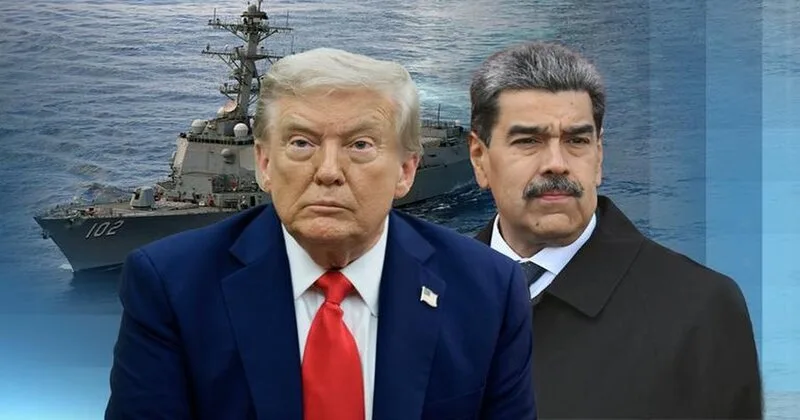
In the early hours of January 3, the United States launched an attack on Caracas after months of mounting pressure on Venezuela, citing drug trafficking, migration and narco-terrorism as its stated justifications. The self-proclaimed champion of democracy and political legitimacy declared the Maduro government to be illegitimate and authoritarian. By the evening of January 3, US forces had captured President Nicolás Maduro and his wife. Notably, the attack occurred just one day after Maduro had reportedly agreed to cooperate with the US government on issues related to drug trafficking and migration.
Accused reasons behind this attack
Trump has repeatedly associated Venezuela with the surge of migrants at the US-Mexico border. Since 2013, nearly eight million Venezuelans are believed to have fled the country due to economic collapse and political repression, with the majority resettling across Latin America. Trump has claimed (without providing evidence) that President Maduro deliberately released prisoners and patients from mental institutions and compelled them to migrate to the United States, an allegation strongly denied by the Venezuelan government.
A second justification advanced by Trump concerns narcotics trafficking. He has portrayed Venezuela as a key transit hub for cocaine and as a contributor to the United States’ fentanyl crisis. In this context, his administration designated two Venezuelan criminal networks the Tren de Aragua and the Cartel de los Soles as Foreign Terrorist Organisations (FTOs), alleging that the latter operates under Maduro’s leadership.
Caracas, however, maintains that Washington is instrumentalising the “war on drugs” as a pretext to advance a policy of regime change in Venezuela.
The hypocrisy
The United States is frequently labelling its opponents with the term “narco-terrorist” which really shows how distorted the picture is when compared to the historical narrative in which U.S. agencies such as the Central Intelligence Agency (CIA) have been the ones who, more or less, facilitated the selling of drugs worldwide or just didn’t care about it when the opium producing countries happened to be in the U.S.’s good books. In Afghanistan, the UN Office on Drugs and Crime (UNODC) has data that shows after the 2001 U.S.-led intervention the country became the place where around 70-90 per cent of the world’s opium was illegally produced. Although extensive U.S. counter-narcotics programs were in place, cultivation and production grew significantly during this period (UNODC, 2004-2021).
Further the U.S. intelligence community cooperated with the warlords who were very much a part of the opium trade and even offered them some political protection, thus locating their interests in the region through counter insurgency and stability and their opposing drug use strategy, mirroring earlier operational patterns during the Cold War (McCoy, 2003). In Latin America, the U.S. was tacitly tolerating the drug trafficking that was going on when it formally acknowledged this in a government-sponsored report.
The Senate Foreign Relations Committee investigation (the Kerry Committee) concluded in its 1989 report that CIA-supported Contra groups were involved in cocaine trafficking and that U.S. agencies had prior knowledge of these activities but chose not to intervene because the reason for such actions was already covered with strategic concern (U.S. Senate, 1989). The agency’s own Inspector General later validated the findings when he testified that the Agency maintained connections with those involved in drug trafficking and did not automatically report them to law enforcement (CIA Inspector General, 1998). The series of investigative journalism, particularly known as Gary Webb’s Dark Alliance, also backed up the claim of the U.S. government being cognizant of the drug trade and even involved in some way through its supported groups.
The myth of rule-based world order
When Russia attacked Ukraine, forty-five countries, along with the United States and the European Union, imposed sanctions on Moscow and twenty-nine countries directly or indirectly armed Ukrainian forces. However, no state is likely to impose sanctions on the United States following its illegal attack on Venezuela. This asymmetry clearly demonstrates that power, rather than principle, dictates the functioning of the contemporary world order, while weaker states are compelled to comply.
This contradiction is further evident in the response of European leaders. The Vice President of the European Commission, Kaja Kallas, publicly delegitimised the Maduro government and stated that “the principles of international law and the UN Charter must be respected”, while simultaneously calling for restraint. Yet, at its 1883rd plenary meeting on October 24, 1970, the United Nations General Assembly adopted a resolution affirming that “every state has an inalienable right to choose its political, economic, social and cultural system, without interference in any form by another state”.
What next
The United States has managed to gain strategic leverage over Venezuela and indirectly, over the world’s largest proven oil reserves. This development carries long-term consequences for geopolitics. The shadow of American hegemony is likely to extend towards Iran, where an already weakened clerical (mullah) regime is witnessing the largest anti-government protests in the country’s history.
Control over Venezuelan oil reserves would substantially reduce U.S. vulnerability to energy disruptions in the Persian Gulf, while simultaneously insulating Washington from supply shocks arising from a potential confrontation with Iran. Reliable access to heavy crude influence would allow the United States to absorb, offset or compensate for the destruction or temporary shutdown of critical Gulf energy infrastructure during wartime. As a result, the economic costs of escalation would be lower, making sustained military pressure against Iran more politically feasible and economically sustainable.
China, meanwhile, has repeatedly stated that it does not intend to behave as a global superpower in the manner of the United States, preferring instead to remain a dominant regional power in Asia. However, the unresolved Taiwan question remains central. A U.S. attack on Venezuela could provide Beijing with moral and strategic justification to move against Taiwan, particularly given the widely held assessment that the United States may be unable to militarily defend Taiwan in a full-scale conflict.
World politics will remain fundamentally anarchic and survival ultimately depends on military preparedness. Nuclear weapons and hard power continue to be the only credible guarantors of security; all other assurances are largely illusory. In an era of hyper-interdependence, any major disruption anywhere in the world inevitably affects all states. The coming period, therefore, is anything but peaceful.