NEW DELHI: Although the Trump administration appears to be focusing on Venezuelan President Nicolas Maduro, the deeper target of US strategy is China. The developments in Venezuela represent the latest chapter in an intensifying US–China Cold War. In recent years, China has posed two major challenges to the United States. The first relates to Taiwan, which Beijing has long sought to bring under its control. China has openly clashed with Japan over Taiwan, conducted massive military exercises around the island, and strongly criticised new arms deals between the United States and Taiwan. From Beijing’s perspective, Taiwan is an inseparable part of China.
However, America’s concern is not just about borders or political claims. It is about technology. History offers an important lesson here. After World War II, Communist Russia forcibly took German scientists, engineers, and their families through ‘Operation Osoaviakhim’. At that time, Germany was the world’s centre of scientific innovation. Russia took not only people but also knowledge, books, research records, and technical expertise. This stolen knowledge played a major role in building Soviet power during the Cold War. The United States carried out a similar effort through ‘Operation Paperclip’, but by then much of the most valuable expertise had already been taken by Russia.
Today, Taiwan represents a similar turning point. The world’s most advanced semiconductors, such as 2-nanometre chips used in artificial intelligence and modern smartphones, are produced by Taiwan Semiconductor Manufacturing Company (TSMC). In fact, nearly half of the world’s semiconductors are made in Taiwan.
The United States fears that if China invades Taiwan, it would gain control over these technologies and the scientists behind them. If China starts producing advanced chips on a massive scale, America’s technological and economic dominance could decline sharply. That is a scenario Washington wants to avoid at all costs.
This fear explains why chip companies are slowly shifting production away from Taiwan to countries like Japan and South Korea. It would not be surprising if Taiwan eventually finds itself in a situation similar to Ukraine, caught between competing global powers.
Rare Earth Minerals: China’s weaponised economic coercion tool
The second major threat concerns rare-earth minerals. China produces approximately 60-70 per cent of the world’s rare earth minerals and processes about 90 per cent of the global supply. The United States, by contrast, produces only about 10 per cent. These minerals are critical to modern life. They are used to make magnets for electric vehicles and wind turbines, as well as LED screens, smartphones, lasers, MRI machines, and advanced military equipment. American companies dominate many of these industries, making the US heavily dependent on China for raw materials.
Currently, the United States imports about 70 per cent of its rare earth needs from China. When the US imposed tariffs on Chinese goods, China responded by restricting exports of rare earths. Although the issue was temporarily resolved through talks between Donald Trump and Xi Jinping, the threat never disappeared. China’s control over rare earth minerals remains a powerful pressure point against the American economy.
Why Venezuela Matters So Much
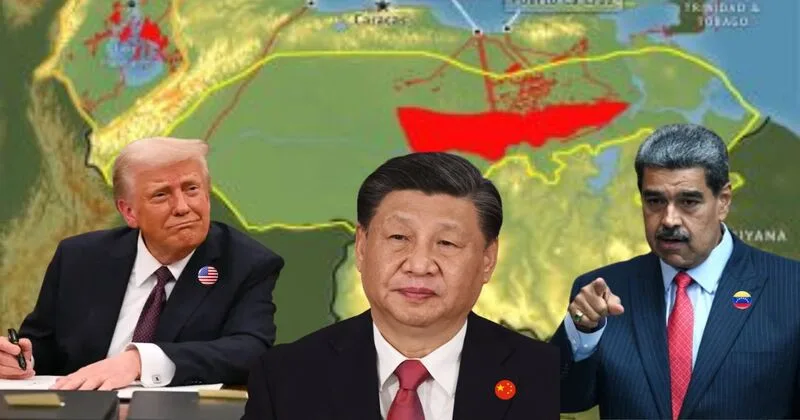
Faced with these two challenges, the Trump administration adopted two strategies: contain China and reduce dependence on Chinese resources. This is where Venezuela becomes crucial.
China is the world’s largest importer of crude oil. Venezuela is one of the world’s biggest oil producers and holds the largest proven oil reserves, about 303 billion barrels. Despite US sanctions, China currently buys around 75 to 80 per cent of Venezuela’s oil, roughly six million barrels per day. This makes up about seven per cent of China’s total oil imports. China has also invested around 60 billion US dollars in Venezuela’s oil sector. These investments secure long-term access to energy in Beijing. If a US-backed government were to take power in Venezuela, the United States would gain influence over Venezuelan oil. In that case, if China invades Taiwan or restricts rare earth supplies, Washington could respond by limiting China’s access to Venezuelan oil. There is also a strong possibility that a new Venezuelan government would ban Chinese oil companies altogether.
Beyond Venezuela: Iran and the wider strategy
The American push for regime change does not stop with Venezuela. This must also be seen alongside the anti-government protests currently unfolding in Iran. The United States is seeking to weaken and ultimately overthrow the Islamic regime in Iran, led by Ayatollah Khomeini, with objectives similar to those pursued in Venezuela. China purchases nearly 85–90 per cent of Iran’s oil exports, despite US sanctions, accounting for roughly 15–23 per cent of China’s total oil imports. The ongoing protests in Iran are taking place with open US support. President Trump has warned that the United States could intervene militarily if the Iranian authorities attempt to suppress these protests by force. Washington frames its position by accusing both Venezuela’s communist government and Iran’s religious regime of serious human rights violations. Against this backdrop, a regime change in Iran appears increasingly possible.
Beyond Iran, the United States and Europe are also closely watching developments in Iraq. Around 12–13 per cent of China’s oil imports come from Iraq. With Russian oil supplies largely cut off, Europe’s strategic attention has shifted sharply toward West Asia. At the same time, Pakistan has been increasingly isolated by the United States from China. Islamabad has stepped back from active engagement in the China–Pakistan Economic Corridor through Jammu and Kashmir, a move Washington has projected as evidence of the vulnerabilities in China’s plans to transport West Asian energy through Pakistan.
Saudi Arabia is another critical piece in this strategic puzzle, supplying an estimated 14–21 percent of China’s total oil imports. There are indications that Trump may have pressed Saudi Arabia to limit China’s access to oil in return for advanced military hardware, including F-35 fighter jets. Moreover, the world’s largest oil producer, Aramco, operates as a joint venture with deep US–Saudi ties, further strengthening Washington’s leverage. In South Asia, pro-China governments in countries such as Bangladesh, Nepal, and Sri Lanka have been weakened or removed, further shrinking Beijing’s strategic space. In essence, if China were to move against Taiwan or restrict exports of rare earth minerals, the United States would still be positioned to control a significant share of China’s oil supply routes.
Alongside energy, the United States is also working to reduce its dependence on China for rare earth mineral imports. To achieve this, Washington has turned its attention to multiple countries rich in these resources. Recently, the US military carried out a swift strike on Islamic terrorist centres in Nigeria, officially citing attacks on Christian communities. In reality, the operation also served as a warning to the Nigerian government, which has been hesitant to grant access to its oil and rare mineral reserves. Nigeria is believed to hold more than 100,000 tonnes of rare mineral deposits and is a major oil producer, accounting for about 2.5 percent of global oil reserves.
The United States has also made strategic moves toward Greenland, a territory under Danish control, where approximately 1.5 million tonnes of rare mineral deposits have been discovered, an estimated 10–20 per cent of global reserves. At the same time, Washington’s strategic gaze extends across much of Latin America, including Mexico. Taken together, these developments suggest that the world may witness many more interventions and upheavals reminiscent of Cold War–era coups, similar to what has unfolded in Venezuela.