The Ministry of Defence has formally described 2025 as the year of reforms for India’s defence sector, marking a decisive phase in the country’s long journey towards self-reliance and global competitiveness. Under the Atmanirbhar Bharat (Self-Reliant India) initiative, India has made significant strides in defence manufacturing, technology development, and exports. Indigenous weapons systems, advanced drones, defence industrial corridors, and record-breaking export deals have collectively strengthened India’s standing in the global defence market.
Speaking at a recent event, Defence Minister Rajnath Singh noted that India’s defence exports have increased nearly 35 times over the past decade, an achievement that reflects both policy consistency and growing international confidence in Indian-made military hardware. Building on this momentum, India is targeting defence exports worth Rs 30,000 crore by March 2026, with a longer-term ambition of reaching Rs 50,000 crore by 2029.
Rising export volumes and global reach
India’s defence exports stood at around Rs 24,000 crore in 2024–25, a sharp increase compared to figures from the previous decade. Today, Indian defence products are exported to more than 100 countries across multiple regions. Key destinations include the United States, France, Armenia, and the Philippines, reflecting the growing diversity of India’s defence partnerships.
Between 2015 and 2025, India’s cumulative defence exports amounted to Rs 1,09,997 crore. This growth has placed India among the top 25 defence exporters globally in terms of the range and volume of products supplied. Analysts note that with further progress in advanced technologies and expanded production capacity, India has the potential to significantly improve its global ranking in the coming years.
According to the Stockholm International Peace Research Institute (SIPRI), the United States remains the world’s largest defence exporter, followed by France, Russia, China, Germany, Italy, the United Kingdom, Israel, Spain, and South Korea. The top five exporting nations together control about 72 per cent of global arms exports. The United States alone accounts for roughly 21 per cent, with exports estimated at around $238 billion.
While India’s current share remains modest in comparison, its rapid growth trajectory distinguishes it from many traditional exporters. Experts argue that sustained reforms, innovation, and competitive pricing could enable India to capture a larger share of the international defence market over the next decade.
The backdrop of Operation Sindoor, which showcased India’s military readiness and strategic capabilities, has further enhanced global interest in Indian defence equipment. The operation demonstrated not only operational effectiveness but also the reliability of indigenous platforms under real-world conditions. As a result, several countries are reportedly reassessing procurement options in favour of Indian systems.
Against this backdrop, defence analysts anticipate a potential increase of over 25 per cent in India’s defence budget in the 2026–27 financial year. Such an expansion would provide additional resources for research and development, modernisation, and capacity expansion across the defence ecosystem.
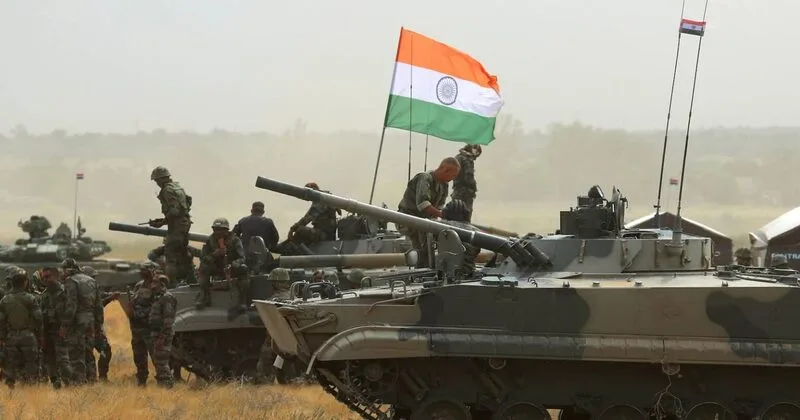
India’s defence equipment production reached a record Rs 1.54 lakh crore in 2025, underscoring the scale of domestic manufacturing achieved under Atmanirbhar Bharat. Defence exports grew by approximately 12 per cent to Rs 24,000 crore during the same period. Notably, more than 65 per cent of India’s defence equipment is now produced domestically, significantly reducing dependence on imports.
This shift has been enabled by policy reforms that prioritise indigenous procurement, encourage private sector participation, and foster competition. As a result, India has emerged as a serious force in defence manufacturing, capable of supplying both its own armed forces and international customers.
To sustain and accelerate this growth, defence infrastructure is being expanded across the country. Defence industrial corridors are under development in Uttar Pradesh and Tamil Nadu, with a combined investment exceeding Rs 91,450 crore. These corridors are expected to generate employment for more than 50,000 people and attract substantial domestic and foreign investment.
In addition, India’s first autonomous shipyard is currently under construction, signalling a major step forward in naval manufacturing capabilities. Such infrastructure projects are designed to integrate supply chains, reduce production costs, and enhance export competitiveness.
India’s defence exports span a wide range of products, including missiles, radar systems, naval platforms, and ammunition. Prominent missile systems exported include the Akash surface-to-air missile, the BrahMos supersonic cruise missile, and the Pinaka multi-barrel rocket launcher. Other major exports include the Advanced Artillery Gun System, the Swati Weapon Locating Radar, components of the Tejas light combat aircraft, the Dhruv advanced light helicopter, and Dornier-228 aircraft.
For naval customers, India exports fast attack craft, offshore patrol vessels, and other maritime platforms. The United States, in particular, imports aircraft and helicopter components from India, reflecting the integration of Indian firms into global defence supply chains.
Despite the strong push for self-reliance, India continues to import defence equipment to address immediate operational requirements. In the last financial year, defence imports were estimated at $20–25 billion. However, this figure is expected to decline gradually as domestic manufacturing capabilities expand. India currently sources major systems from Russia, France, the United States, Israel, Germany, and South Korea. Key imports include advanced air defence systems, fighter aircraft, submarines, and helicopters. Over time, the government aims to replace many of these imports with indigenous alternatives.
The year 2025 stands out as a milestone for India’s defence sector. Amid evolving global security challenges, India has demonstrated both military strength and industrial capability. The Atmanirbhar Bharat initiative has not only enhanced self-reliance but also elevated India’s profile as a credible defence exporter.
According to the Asia Power Index published by the Australia-based Lowy Institute, India is now the world’s third-largest defence power, behind the United States and China, with Russia ranking fourth. This position reflects not only manpower and operational readiness but also the rapid development of advanced defence systems and the surge in exports.