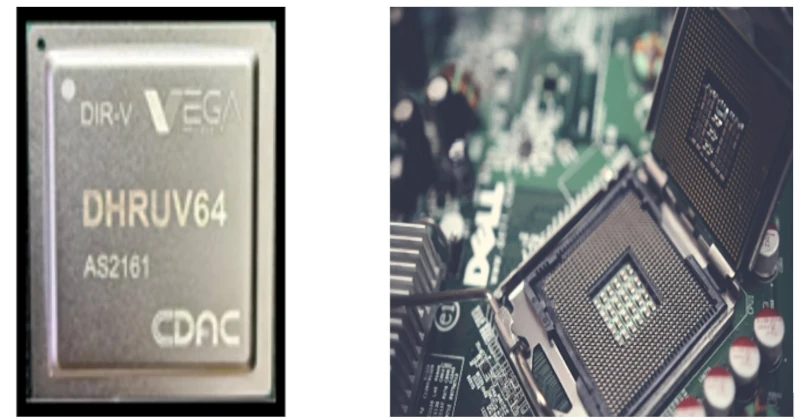
India is slowly marching towards a journey of technological self-reliance in terms of manufacturing capacity, digital platforms and strategic autonomy. One of the most critical layers of modern sovereignty lies deeper inside the microprocessors, a power that controls from mobile phones, automobiles to defence systems and satellites. The launch of DHRUV64, which is India’s first fully indigenous 1.0 GHz, 64-bit dual-core microprocessor, represents a decisive step in asserting control over this foundational layer of the digital economy.
Developed by the Centre for Development of Advanced Computing (C-DAC) under the Microprocessor Development Programme (MDP), DHRUV64 is a technical achievement for India. It is a strategic tool meant to lessen the long-standing import dependency on imported processor technologies by being focused to the domestic design and innovation strength of the country.
Why Microprocessors are Important to National Power
Microprocessors are referred as the brain of an electronic device, but from a strategic point of view, they can also be seen as a control instrument. India is a nation that is a consumer of around 20 percent of the world’s microprocessors. High level of dependency on foreign microprocessors not only poses economic threats but also security threats to India.
DHRUV64 has countered this challenge by offering a trusted, indigenous processor technology to India that is able to support strategic as well as business sectors. Its architecture enables the integration of various sectors like telecommunication, automotive systems, industrial automation, consumer electronics, 5G infrastructure and Internet of Things (IoT). This will ensure that indigenous computing remains not only in the laboratory environment but also embedded in practical systems.
DHRUV64 Contemporary Requirements
In terms of technical details, it could be seen that DHRUV64 is a product of modern CPU design. Its architecture is a dual-core, 64-bit design, making it beneficial in multitasking, efficiency and system reliability. With this the developers can create complex applications without sacrificing performance and system integrity. It is also crucial to note that it is designed to run well on a variety of hardware.
The chip fabrication process employed by the processor utilizes innovative technologies found in high-performance chips, making it relevant in a rapidly changing digital world. The aim of the DHRUV64 architecture appears to be more in line with mass use, application and sustainability rather than being an alternate or research-oriented project.
Developing the Indigenous Processor by India
DHRUV64 does not appear singly. It is a stepping stone in a long progression of indigenous processors in India, which have been developing over the course of a decade. A series of initiatives contributed significantly toward this end.
Processors like SHAKTI developed at IIT Madras and AJIT developed at IIT Bombay showed the country’s prowess in designing processors for defense, space, robotics and industrial applications. VIKRAM developed for space missions by ISRO and Semiconductor Laboratory (SCL) satisfied the very high reliability requirements for interstellar space. THEJAS64 developed at C-DAC served industrial automation applications.
DHRUV64 carries forward this tradition by providing a more general-purpose and scalable computing platform that has the capabilities of serving research and commercial applications alike. These processor architectures constitute the foundation of an emerging processor community in India rather than remaining purely technological prototypes.
One of the biggest values that DHRUV64 brings to the table is the impact that it makes in the Indian innovation context. The fact that it provides an IP free processor platform allows new age Indian startups, universities and industry players to innovate and build solutions using Indian IP and architectures. This autonomy lowers entry barriers for innovation. Prototype development becomes more affordable, iteration cycles shorten and experimentation expands. For a country that already accounts for around 20 per cent of the world’s chip design engineers, such platforms are critical for converting talent into tangible technological output.
The success of DHRUV64 also accelerates the development roadmap for the upcoming Dhanush and Dhanush+ processors, which are currently under development. This continuity ensures that indigenous processor innovation remains a sustained effort rather than a one time achievement.
RISC-V Advantage and the DIR-V Vision
A defining feature of DHRUV64 is its foundation on the RISC-V open architecture. Unlike proprietary instruction sets that require costly licensing and restrict customization, RISC-V offers a licence-free framework that encourages shared innovation. For India, this choice aligns closely with the goals of Aatmanirbhar Bharat and long-term digital sovereignty.
Under the Digital India RISC-V (DIR-V) Programme, the Government of India aims to develop a complete portfolio of indigenous processors spanning strategic, industrial and consumer applications. DHRUV64 is the third chip fabricated under DIR-V, following THEJAS32, produced at Malaysia’s Silterra facility and THEJAS64, manufactured domestically at SCL Mohali.
By eliminating licence costs and encouraging standardised development tools, RISC-V enables collaboration across research organisations, startups and industry. This shared ecosystem approach is essential for scaling indigenous chip design beyond isolated success stories.
The coming up of DHRUV64 is an indication not only of the availability of the necessary technical know-how but even more importantly, an official warp with the support of the MeitY through schemes like Microprocessor Development Programme, DIR-V, Chips to Startup (C2S) or the India Semiconductor Mission (ISM)
The role of C-DAC is that of the design anchor for this eco-system, undertaking the development of processor IP, system on chip and development boards, among others. The furtherance of next-generation processor designs, such as Dhanush and Dhanush+ by C-DAC speaks to a look to the future rather than a status quo approach to innovation.
National Programmes Strengthening the Ecosystem
The DHRUV64 is placed in the policy spectrum to enhance capacities in the semiconductor ecosystem as a whole. The India Semiconductor Mission was launched in 2021 and has sanctioned ten projects across six states that altogether commit an investment of Rs 1.60 lakh crore to make India an attractive destination for semiconductor manufacturing and design
To complement this is the Chips to Startup (C2S) Programme, which involves 113 institutions and seeks to produce 85,000 industry-ready personnel over five years. In terms of expenditure of Rs 250 crore, this initiative seeks to establish a robust fabless design ecosystem that involves academia, start-ups, as well as MSME.
There are other programs involving Design Linked Incentive (DLI) Scheme, INUP-i2i Program, which offer financial assistance, infrastructure facilities and direct handling training. In combined approach they make sure processors like DHRUV64, have adequate human resources, research facilities and industry links.
Towards a Self-Reliant Computing Future
The DHRUV64 marks a quiet but significant change in the technological pathway for India. The success not only indicates that developing processors for India is a pipe dream for the future but has been made possible.
The progression from THEJAS32 to DHRUV64, outlines a confident national pathway. One that prioritises sovereignty, innovation and long-term capability over short-term dependence. As digital systems become ever more central to economic growth and national security such foundational technologies will increasingly define a nation’s strategic autonomy. DHRUV64 is not just a microprocessor. It is a statement of intent quietly asserting India’s future digital infrastructure.