Bangladesh Violence: Propoganda over proof
July 11, 2026
  • Read Ecopy
  • Circulation
  • Advertise
  • Careers
  • About Us
  • Contact Us
Android AppiPhone AppArattai
Organiser
  • ‌
  • Bharat
    • Assam
    • Bihar
    • Chhattisgarh
    • Jharkhand
    • Maharashtra
    • View All States
  • World
    • Asia
    • Europe
    • North America
    • South America
    • Africa
    • Australia
  • Editorial
  • International
  • Opinion
  • RSS @ 100
  • More
    • Op Sindoor
    • Analysis
    • Sports
    • Defence
    • Politics
    • Business
    • Economy
    • Culture
    • Special Report
    • Sci & Tech
    • Entertainment
    • G20
    • Azadi Ka Amrit Mahotsav
    • Vocal4Local
    • Web Stories
    • Education
    • Employment
    • Books
    • Interviews
    • Travel
    • Law
    • Health
    • Obituary
  • Subscribe
    • Subscribe Print Edition
    • Subscribe Ecopy
    • Read Ecopy
  • ‌
  • Bharat
    • Assam
    • Bihar
    • Chhattisgarh
    • Jharkhand
    • Maharashtra
    • View All States
  • World
    • Asia
    • Europe
    • North America
    • South America
    • Africa
    • Australia
  • Editorial
  • International
  • Opinion
  • RSS @ 100
  • More
    • Op Sindoor
    • Analysis
    • Sports
    • Defence
    • Politics
    • Business
    • Economy
    • Culture
    • Special Report
    • Sci & Tech
    • Entertainment
    • G20
    • Azadi Ka Amrit Mahotsav
    • Vocal4Local
    • Web Stories
    • Education
    • Employment
    • Books
    • Interviews
    • Travel
    • Law
    • Health
    • Obituary
  • Subscribe
    • Subscribe Print Edition
    • Subscribe Ecopy
    • Read Ecopy
Organiser
  • Home
  • Bharat
  • World
  • Operation Sindoor
  • Editorial
  • Analysis
  • Opinion
  • Culture
  • Defence
  • International Edition
  • RSS @ 100
  • Magazine
  • Read Ecopy
Home Bharat

Bangladesh Violence: Propoganda over proof

The recent anti-Hindu violence in Bangladesh has been followed by a wave of propaganda from Pakistan’s media and political circles. Instead of waiting for facts, they are blaming India and spreading rumours to convert a domestic crisis into a wider regional confrontation

MA HossainMA Hossain
Dec 30, 2025, 08:20 pm IST
in Bharat, Analysis
Follow on Google News
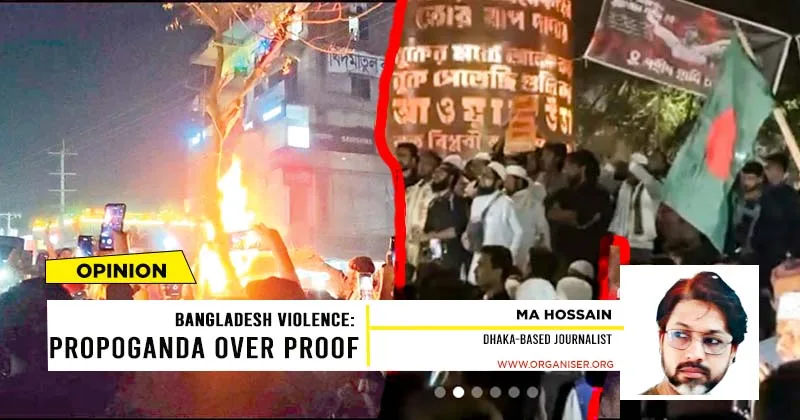
Chhayanaut, a Bengali cultural organisation founded in the 1960s survived the carnage of 1971. Even Pakistani occupiers failed to destroy it. But this time Islamists vandalised it completely. The mob was raising religious slogans, including Naraye Takbir. Chhayanaut is considered as Bangladesh’s most prominent institutions, widely known for promoting Bengali music, heritage and traditions

Chhayanaut, a Bengali cultural organisation founded in the 1960s survived the carnage of 1971. Even Pakistani occupiers failed to destroy it. But this time Islamists vandalised it completely. The mob was raising religious slogans, including Naraye Takbir. Chhayanaut is considered as Bangladesh’s most prominent institutions, widely known for promoting Bengali music, heritage and traditions

FacebookTwitterWhatsAppTelegramEmail
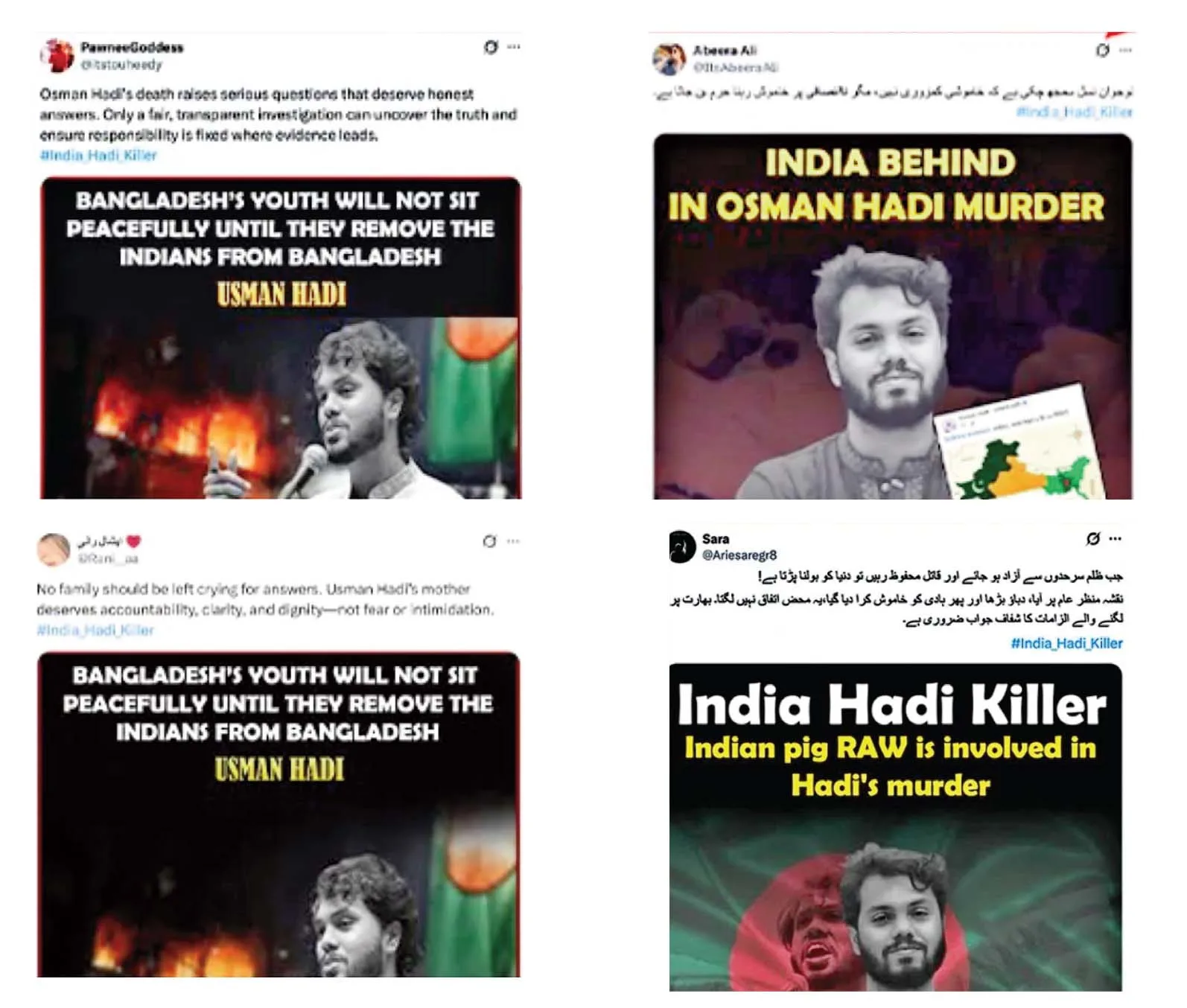
Pakistan pushed an anti-India narrative amid the chaos in Bangladesh, running a propaganda campaign on social media that claimed India was behind the killing of Osman Hadi. Many of these posters were later amplified by Pakistani journalists and government officials

In South Asia, truth is often the first casualty of geopolitical rivalry. The second is restraint. The two narratives now circulating around the tragic killing of Sharif Osman Hadi—one pushed by Pakistan’s Times of Islamabad on December 22, 2025, the other amplified through a fiery video message by Kamran Sayeed Usmani of Pakistan’s ruling PML-N—belong squarely in that tradition. They are less about justice for a murdered Bangladeshi youth leader and more about opportunistic politics, ideological projection, and a familiar attempt to pin regional instability in India.

Let us begin with the Times of Islamabad article, which declares—without judicial findings or verified intelligence—that India’s Research and Analysis Wing (RAW) “role [is] confirmed” in Hadi’s assassination. That headline alone should set off alarm bells. Confirmed by whom? On what legal authority? Through which evidentiary process? None is offered. Instead, the article relies on insinuation: suspects allegedly fleeing “towards India,” protests erupting in Dhaka, and Hadi’s past criticism of Indian influence. In serious investigative journalism, correlation is not causation. In propaganda, it often suffices.

Bangladeshi authorities themselves, as the article grudgingly admits, have not produced “concrete evidence yet confirming foreign agency involvement.” Human rights organisations and the United Nations have called for impartial investigations—not for geopolitical finger-pointing. And yet, the article races ahead, constructing a narrative of Indian culpability that rests more on public anger than on proof. This is not analysis; it is advocacy masquerading as reporting. There is a deeper irony here. India, whatever one thinks of its regional posture, has consistently emphasised stability in Bangladesh—politically, economically, and strategically. A violent assassination that triggers riots, diplomatic crises, and election uncertainty in Dhaka would directly undermine Indian interests.
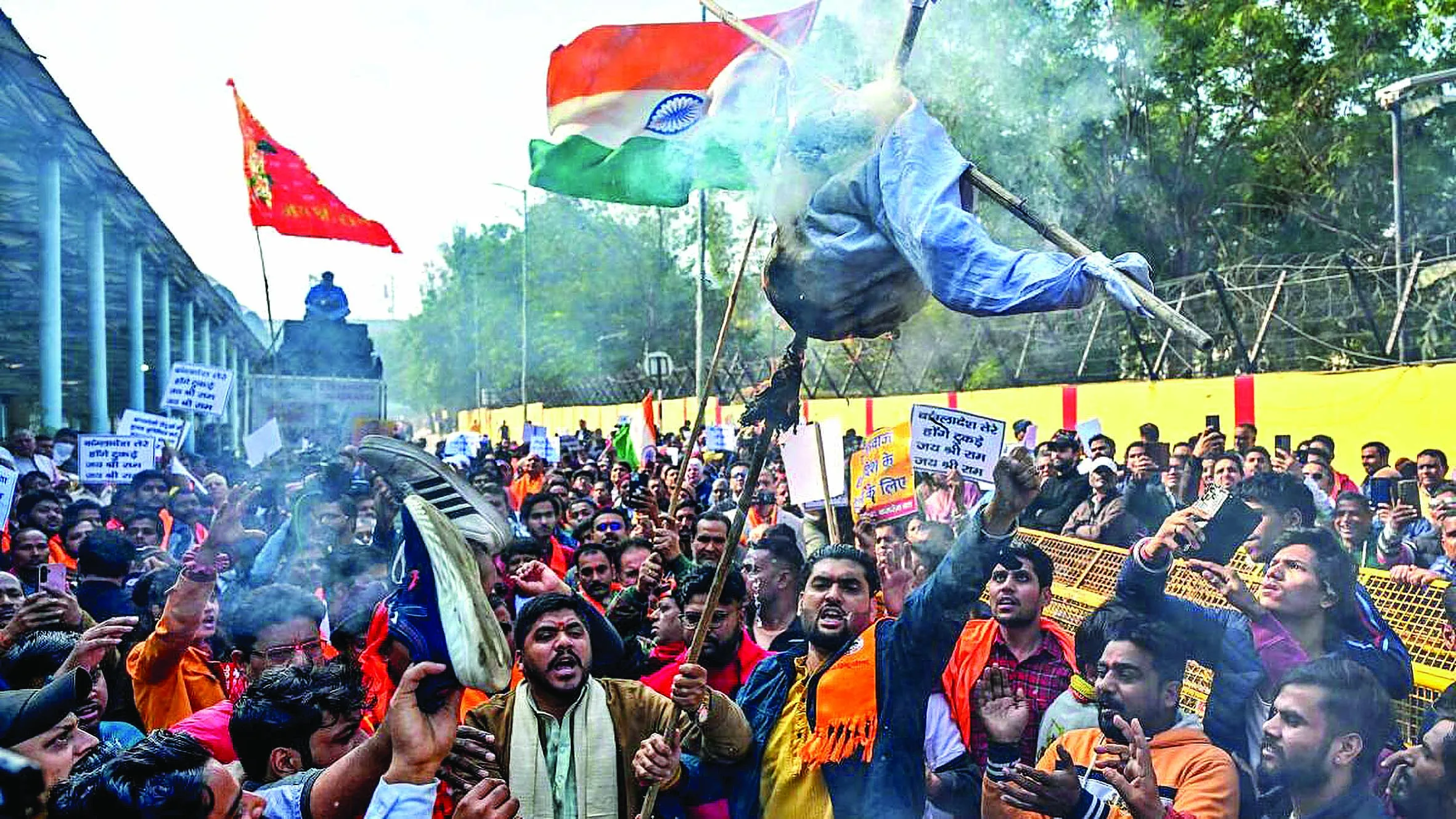
Hindu organisations stage a protest against attack on Hindus in Bangladesh, near Bangladesh High Commission in
New Delhi on December 23, 2025

What the Times of Islamabad piece does accomplish is something else entirely: it internationalises Bangladesh’s internal trauma in a way that conveniently aligns with Pakistan’s long-standing rivalry with India. It reframes a domestic criminal investigation into a proxy battle of South Asian intelligence agencies. That move may sell papers or satisfy nationalist appetites. Still, it does nothing to help Bangladesh heal—or to uncover who actually financed and organised the killing, including the suspicious Tk127 crore trail mentioned in the report.
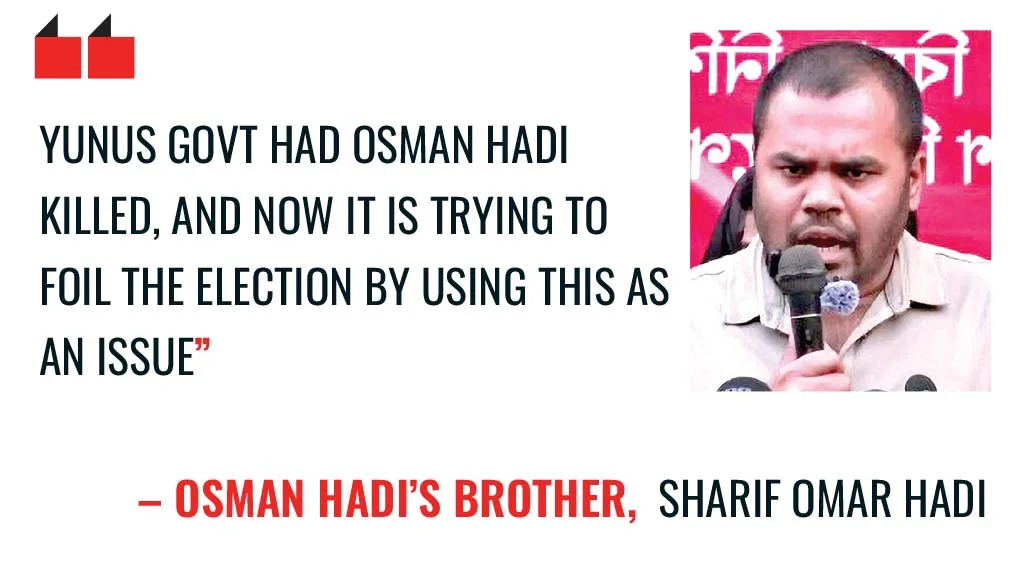
If the article’s tone is insinuating, Kamran Sayeed Usmani’s video is incendiary. Draped in religious rhetoric and historical grievance, Usmani openly threatens India with missile retaliation, invokes past military confrontations, and casts Pakistan as the armed guardian of Bangladesh’s sovereignty. This is not solidarity; it is incitement. And it is deeply irresponsible for a leader of the youth wing of a ruling party in a nuclear-armed state.

Usmani’s speech collapses complex political realities into a crude binary: Muslim resistance versus a so-called “Brahmin empire.” This is a sectarian language designed to inflame, not enlighten. Bangladesh’s founding history rejects precisely this framing. The country was born in 1971, not as an extension of pan-Islamic ideology, but as a rebellion against Pakistan’s own military and political dominance. To hear a Pakistani politician now invoke 1947 “principles” while glossing over 1971 is not just selective memory; it is historical revisionism.

Even more troubling is the casual invocation of missiles and military operations—“Operation Markah-e-Haq”—as if war were a rhetorical flourish rather than a catastrophe. Pakistan’s record of using militant rhetoric to compensate for strategic weakness is well documented. From Kargil to countless cross-border crises, bluster has often been substituted for sustainable policy. To drag Bangladesh into this pattern is to disrespect its sovereignty, not defend it.

India, by contrast, has responded to these developments with notable restraint. It rejected the allegations as baseless, summoned Bangladesh’s envoy to address concerns over attacks on its missions, and emphasized cooperation in apprehending suspects. This is what responsible regional power behaviour looks like: engagement through diplomacy, not megaphone threats. India understands that South Asia’s future depends less on ideological theatrics and more on economic integration, political stability, and crisis management.

The pro-Pakistan narrative also misreads Bangladesh itself. Bangladeshi politics is not a blank canvas onto which Islamabad can project its rivalries with New Delhi. The violent protests described in the Times of Islamabad article—including attacks on media houses and cultural institutions—were condemned by Bangladesh’s interim leadership. The interim government framed the assassination as an attempt to derail elections, not as a civilisational struggle against India. That distinction matters. It reflects Dhaka’s insistence on agency, something Pakistan’s rhetoric conspicuously denies.

There is, finally, a moral hazard in turning Hadi into a geopolitical symbol. Declaring him a “martyr” in a struggle against Indian “hegemony,” as both narratives do, risks obscuring the real questions: Who paid for the assassination? Who benefited politically from the ensuing chaos? And why are certain actors so eager to answer those questions with slogans instead of evidence?
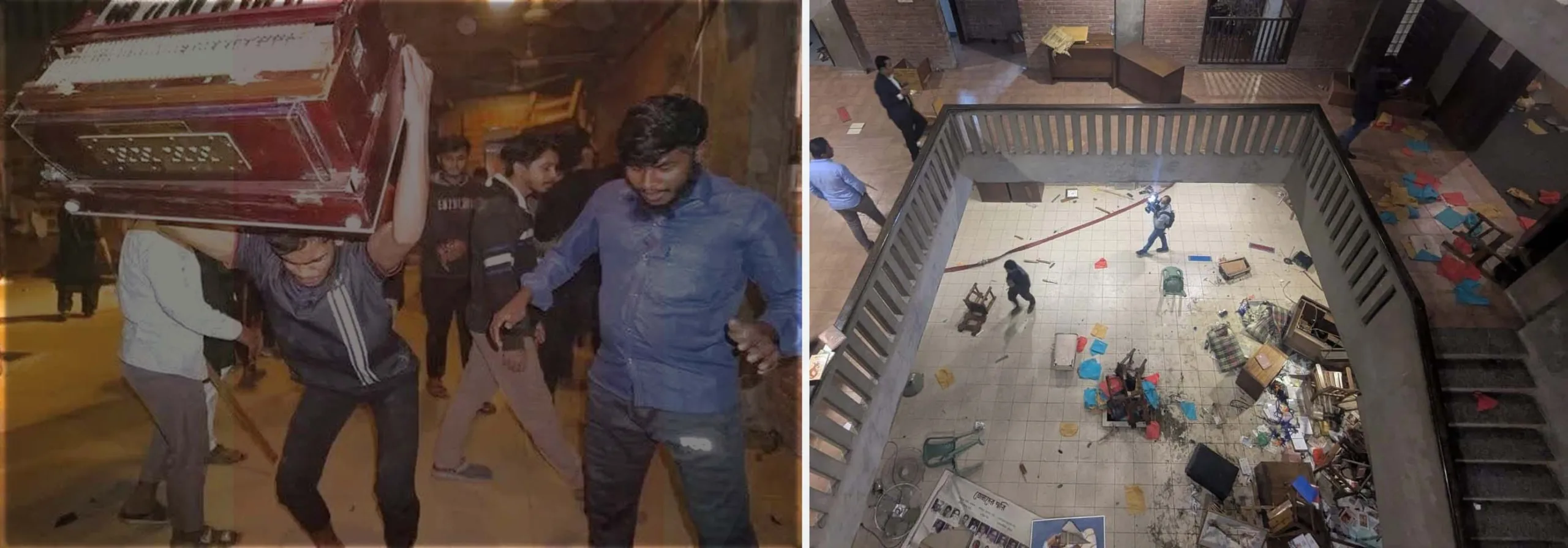
Chhayanaut, a Bengali cultural organisation founded in the 1960s survived the carnage of 1971. Even Pakistani occupiers failed to destroy it. But this time Islamists vandalised it completely. The mob was raising religious slogans, including Naraye Takbir. Chhayanaut is considered as Bangladesh’s most prominent institutions, widely known for promoting Bengali music, heritage and traditions

Pakistan’s media and political class would do well to reflect on their own credibility. When threats replace diplomacy, and conjecture replaces proof, the result is not regional leadership but strategic self-isolation. India’s rise—economically, technologically, diplomatically—cannot be reversed by shouting louder or invoking missiles. It can only be engaged through realism, accountability, and a willingness to confront uncomfortable truths at home.

Bangladesh deserves justice, not narrative warfare. South Asia deserves stability, not recycled rivalries. And the memory of Sharif Osman Hadi deserves better than to be weaponised in a contest where facts are optional, and threats are cheap. In this contest of stories, India’s restraint and insistence on evidence stand in sharper contrast than its critics might like to admit.


Topics: Bangladesh violenceBangladesh deserves justicePakistan’s mediapro-Pakistan narrativeOperation Markah-e-HaqUsmani’s speechTimes of Islamabad
MA Hossain
MA Hossain
Dhaka-Based Journalist [Read more]
ShareTweetSendShareSend
✮ Subscribe Organiser YouTube Channel. ✮
✮ Join Organiser's WhatsApp channel for Nationalist views beyond the news. ✮
Previous News

Hindu Hate Watch-A Weekly Tracker: 92 cases of reported abuse, threats and violence against Hindus in Bharat and abroad

Next News

Bangladesh’s descent into Pakistanised Jihad

Related News

Madhu Chandra Shil killed over land dispute (Image via X/DDNewslive)

Bangladesh: Hindu man Madhu killed by Muslim neighbour over land dispute, minority safety concerns grow

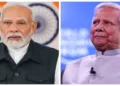
Prime Minister Narendra Modi (Left) and Bangladesh interim government chief advisor Muhammad Yunus (Right)

India signals security concerns ahead of Bangladesh elections, withdraws diplomats’ families amid mounting threats

Violence against Hindus in Bangladesh

Hunted for their faith: Why the world is ignoring the bloodbath of Hindus in Bangladesh

40-year-old Hindu widow in Bangladesh was gang-raped, tortured, and publicly humiliated by two men

Brutality in Bangladesh: Hindu widow gang-raped, tortured & publicly humiliated by Shahin and Hasan in Jhenaidah

Representative Image

Rising Islamic radicalism and plight of minorities in Bangladesh

Spirit of Bangladesh under siege

Load More

Latest News

Tamil Nadu: Ramaswamy Naicker statue on ancient Shiva temple land without HR&CE approval; Hindu activist seeks removal

From 2016 to 2026, attacks on Sikhs and Gurdwaras have raised concerns over the safety of Sikh communities worldwide

Islamist Extremism and the Targeting of Sikhs: Major incidents of violence from 2016–2026

Keralam: PDP claims Assembly Secretary expunged remarks against Madani, raises questions on procedure and privilege

Manipur: Fresh violence erupts as Kuki miscreants torch Meitei houses in Kanto Sabal; Security forces avert big clash

India and Indonesia Strengthen South-South Cooperation (This image is AI generated)

India-Indonesia Partnership – Ultimate fulcrum for global south framework

NSUI and ABVP supporters clash in Kota college over the damaged statue of Swami Vivekananda

ABVP seeks immediate installation of new statue of Swami Vivekananda in Kota College

Defence Minister Rajnath Singh

Rajnath Singh lauds Indian Navy’s role during West Asia Conflict; Reiterates naval power as key to economic prosperity

India-Pakistan Track 2 Dialogue: A propaganda playbook pushed by Islamabad & fuelled by Western think tanks

Chhattisgarh HC upholds Saraswati Vandana, Gayatri Mantra in government schools

Chhattisgarh HC upholds Saraswati Vandana, Gayatri Mantra in govt schools, says moral education is constitutional

Detained Bangladeshi infiltrators

Four Bangladeshi held in Tripura, 11 more detained in Guwahati; Police crackdown on cross-border infiltration

Load More
  • Privacy
  • Terms
  • Cookie Policy
  • Refund and Cancellation
  • Delivery and Shipping

© Bharat Prakashan (Delhi) Limited.
Tech-enabled by Ananthapuri Technologies

  • Home
  • Search Organiser
  • Bharat
    • Assam
    • Bihar
    • Chhattisgarh
    • Jharkhand
    • Maharashtra
    • View All States
  • World
    • Asia
    • Africa
    • North America
    • South America
    • Europe
    • Australia
  • Editorial
  • Operation Sindoor
  • Opinion
  • Analysis
  • Defence
  • Culture
  • Sports
  • Business
  • RSS @ 100
  • Entertainment
  • More ..
    • Sci & Tech
    • Vocal4Local
    • Special Report
    • Education
    • Employment
    • Books
    • Interviews
    • Travel
    • Health
    • Politics
    • Law
    • Economy
    • Obituary
  • Subscribe Magazine
  • Read Ecopy
  • Advertise
  • Circulation
  • Careers
  • About Us
  • Contact Us
  • Policies & Terms
    • Privacy Policy
    • Cookie Policy
    • Refund and Cancellation
    • Terms of Use

© Bharat Prakashan (Delhi) Limited.
Tech-enabled by Ananthapuri Technologies