
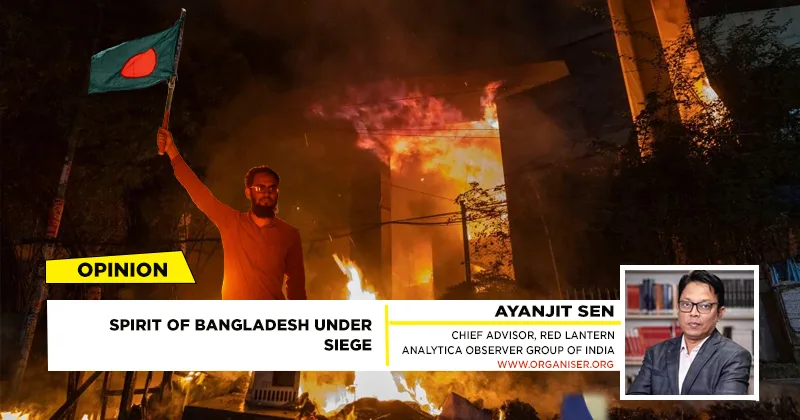
Bangladesh is today at a watershed moment in history, a period of tension that is a product of and determined by the weight of not only the current pressures of politics that have defined its history but also the weight of its history. To put one’s finger on what is shaping up in the country—tension, deep dissent, and inchoate questions of democratic space—we need to go back to the core of the country, the origins of national spirit and to the enduring longings that have been transposed through the generations.
The founding of Bangladesh in 1971 was an act of defiance. Bangladesh emerged from the Bangladesh Liberation War, which was characterised by linguistic nationalism, economic discrimination, and an oppressive military state crackdown at the hands of the Pakistani state. With a strong emphasis on a “national ethos”, the war fostered a vision of secularism, social justice and cultural identity — values popularised by Sheikh Mujibur Rahman, the man who has long been a cornerstone of the country’s political imagination.
In the past, Bangladesh has also learned that deep-state exclusion usually leads to dissent spilling onto the streets. Change has rarely come through institutional reform, but rather through the Language Movement of 1952 and the mass uprisings of 1969 and 1990, as it has repeatedly occurred through popular mobilisation. The current unrest, then, is situated within a familiar historical pattern: when formal political channels close, informal resistance expands.
Since the Bangladesh Nationalist Party (BNP) acting chairman, Tarique Rahman, returned to Dhaka after self-imposing exile for more than 17 years, the political scene has been interpreted as reflecting changes in Bangladesh. During his speech in Dhaka on December 25, 2026, he declared the country’s national identity to be that of all people, regardless of faith. This statement, in which he also addressed tolerance and inclusivity, departs from the interim administration’s on-the-ground practices.
Mymensingh’s garment factory worker, Dipu Chandra Das, was brutally lynched recently by a mob over charges of blasphemy — never mind that he was never found to have uttered any such allegations. This celebration by the participants as his body was set on fire is a clear demonstration of how far the radical Islamists can go to destroy the word — minorities — from their land. Hundreds of Hindus have been killed, raped and tortured in the past year; most of these acts have never been revealed in the public eye. That lynching has resulted in multiple arrests, and the case has triggered nationwide and foreign scrutiny. This incident, which again clearly further fuels the anti-Hindu sentiment, facilitated in its acts by the Islamists of Bangladesh, has also received tacit approval from the Yunus administration, although they attempted to repair the damage when the incident sparked international criticism and was condemned by so many countries.
These anti-India and anti-Hindu sentiments nourished by Islamists in Bangladesh and tutored by the current administration were part of Pakistan’s ‘meticulous planning’.
ISI heads the coordination between Bangladeshi terrorist groups. Two terrorist groups from Pakistan arrived in Bangladesh in November 2025 and have established their small bases there. These terrorist groups are green signalled by the Yunus-led government to build up their own forces, arms and ammunition, to operate against India
The same anti-India was propelled initially following the killing of Sharif Usman Hadi, one of the key July protestors, by the same Islamists. India had no part in the attack on Hadi. Hadi, who was murdered by rivals in the current Bangladeshi political apparatus, himself also told a public function earlier that as elections loom a few months ahead, there are prospects for a few July protestors to be killed.
As things stand, the terrorist groups in Bangladesh, including Hizb-ut-Tahrir, Ansarullah Bangla Team, Neo-JMB (ISIS inspired), Ansar-ul -Islam, establishing on the ground bases in different parts of Bangladesh for indoctrination and arms training, gradually the country is advancing towards a terrorist state in the current state.
The Inter-Services Intelligence (ISI) of Pakistan heads the coordination between these Bangladeshi terrorist groups. Two terrorist groups from Pakistan – Lashkar-e-Toyeba and Jaish-e-Mohammed – arrived in Bangladesh in November 2025 and have established their small bases there. They train Bangladeshi terrorist units and plot strikes on Indian soil from the eastern border. These terrorist groups are green signalled by the Yunus-led government to build up their own forces, arms and ammunition, to operate against India. Although the dossier, given to Bangladesh’s National Security Advisor, Dr Khalilur Rahman, by the Indian government, has been in place since then, Dhaka’s job has moved at a snail’s pace.
Additionally, the spread of anti-India narratives has been propagated by the Pakistani army officers stationed at Rawalpindi, as part of information warfare, with some Bangladeshi political parties, including the newly established NCP, and in the digital space on social media. A notable example is the recent protests held around the Indian High Commission in Bangladesh.
A source within the Pakistan High Commission in Dhaka confirmed that a blueprint was prepared in the Pakistan High Commission, in meetings attended by the Foreign Affairs Advisor Touhid Hasan, NCP leader Hasnat Abdulla and Pakistani High Commissioner to Bangladesh Imran Haider.
When the Indian High Commission was met with protests in a few cities in Bangladesh, Haider — and three ISI operatives — were streaming live from his house.
For decades, India–Bangladesh relations were one of South Asia’s quiet diplomatic triumphs, rooted in a shared history, strategic cooperation, and a pragmatic Dhaka government. That equilibrium, however, fell apart in the chaotic political turmoil that followed the fall of Sheikh Hasina’s regime. At the centre of that subsequent pandemonium, at the core of the chaos, is Muhammed Yunus, a Nobel laureate originally hailed as the moral compass of Bangladesh, now seen as a destabilising political force whose ascent coincided with an irreparable blowback for the bilateral relationship. India invested heavily in the country during Sheikh Hasina’s rule, which maintained close security cooperation with India, curbed anti-India insurgent movements, and deepened economic integration. Yunus’s rise transformed this trajectory quite abruptly. The momentousness of the political future for Bangladesh without Sheikh Hasina is not only in Dhaka but also in New Delhi.
Over the past decade, India-Bangladesh relations have been dominated by Hasina’s deeply personal diplomacy, grounded in history, security cooperation, and regional pragmatism. The relationship hasn’t been destroyed by her political decline—or the end of her authority—but, in no small way, the character, priorities, and vulnerabilities of the relationship have visibly changed. India is wary of political chaos, which could create space for radical, anti-India actors, including groups that have long been wary of and resistant to the presence of the New Delhi government.
Meanwhile, post-Hasina Bangladesh’s diplomacy has become more overtly multifaceted. Engagement with China, the Gulf states, and Western partners is no longer delicately balanced by Indian sensitivities. According to Dhaka, diversification serves as a hedge against overdependence; for New Delhi, the former entails strategic competition in a space once deemed secure. History has an instructive parallel. The relationship between India and Bangladesh has waxed and waned, from the fraught relations between the two in 1971 and the late 1970s and 1980s to a cautiously repaired relationship in the 1990s. Each phase reflected who ruled in Dhaka and the reception of nationalism.
As Bangladesh enters this new chapter, the central question is not just who rules but how. Ultimately, whether the spirit of 1971 will linger as a living example or only as a ritualised memory remains to be seen. History still speaks in a country born of resistance.