
The West Pakistanis characterised the Bengalis as an inferior race who have closer intellectual and cultural links with their Hindu brethren in West Bengal, India. Moreover, since the East Pakistani Awami league was known to have socialist sympathies and deep intellectual links with the Communist Party of India, there was an underlying assumption in West Pakistan that the Bengalis are reflecting the political and strategic interests of India. This caricature of East Pakistan had a far-reaching effect since it allowed the West Pakistan.– “Kill 3 Million and the Rest Will Eat of Our Hands”: Genocide, Rape, and the Bangladeshi War of Liberation, by Anwar Ouassini and Nabil Ouassini, in the book Genocide and Mass Violence in Asia, by Frank Jacob (ed.), De Gruyter, Berlin/Boston, 2019, p. 45
In December 1971, more than fifty-four years ago, Bangladesh liberated itself, defying the idea of Pakistan based on religious fundamentalism and exclusion, which unfortunately is a forgotten chapter in the national consciousness of Bangladesh. The takeover of Bangladesh by radical jihadists in the name of democracy and protest should be contextualised in the spirit of the liberation war, rather than the interests of various actors that are functioning from outside.
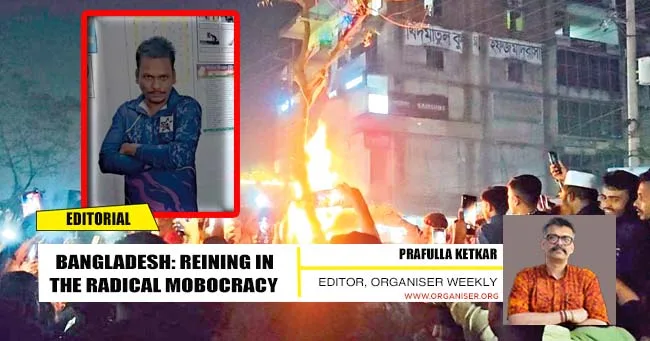
The events unfolding the killing of Sharif Osman Hadi, the spokesperson of Inquilab Moncho, an organisation born out of the 2024 protest ousting the democratically elected Prime Minister Sheikh Hasina, on December 12, is another blow to the idea of Bangladesh. Hadi was shot at close range under the nose of the Yunus government in Dhaka triggering violent protests, with radical mobs targeting the offices of prominent media houses. Even though the brother of the slain leader accused the unelected government of Yunus of conspiring to derail the elections that are scheduled to take place in February, Bangladesh witnessed another round of radicalised mobocracy. A Hindu village was burnt, and a Dalit Hindu, Dipu Chandra Das, who was a poor garment factory worker, was lynched to death. Later, his body tied to a tree and was set on fire in the name of blasphemy, with security forces remaining mute spectators. Accusing Bharat and targeting Hindus for everything happening within the country has become a common practice for resorting to violence and arson by the radical Islamist forces in Bangladesh. Instead of getting carried away with the fake narratives, now is the time is for the people of Bangladesh introspect and take corrective measures to save the country.
Bangladeshi people fought the liberation war and refused to be identified as ‘East Pakistan’ as they resisted the religious and racial supremacist policies of the then ‘West Pakistan’. Although the majority of both West and East Pakistan were Muslim, the ideational factors, namely linguistic nationality and Bengali culture, differentiated them from the Punjabi, Urdu-dominating regions. According to the records, during the nine-month-long liberation war, more than three million Bengalis were killed, and half a million Bengali women were raped. The main culprits were the Pakistan Military Forces, Jamat-i-Islami, Islami Chatra Shibir, Muslim League, Nezam-i-Islami Party, Razakars, Al-Shams, Al-Badr, Peace Committee, and Muzahid Bahini. The same forces are now trying to take control of Bangladesh by adopting different names and by instigating anti-Bharat and anti-Hindu sentiments.
Bharat was involved in the process because the international actors were mute spectators of the Pakistani atrocities, as they are now looking the other way when minorities are being burnt to death. As a neighbouring country, Bharat had to remain vigilant about refugee influx across the border, as it is now. Both Bharat and Bangladesh cannot forget that they share a common ancestry and culture rooted in the coexistence of religious faiths, before the colonial project of partition. That is precisely why Tagore’s songs inspired Bengalis, regardless of their religious diversity. Western actors would always like to continue the colonial policies of intervention and manipulation for their strategic interests. The people of Bharat and Bangladesh should decide together whether to fall prey to such predatory strategies and get caught in binaries or celebrate our common heritage despite being sovereign states.
Bharat must put pressure on human rights agencies to guarantee the protection of minorities in Bangladesh. The people of Bangladesh have the right to get a democratic government as early as possible through free and fair elections, and the onus lies on the international community. The united forum of minorities, along with other patriotic groups, should work together to rein in the tyranny of radicalised mobs in the name of protest.