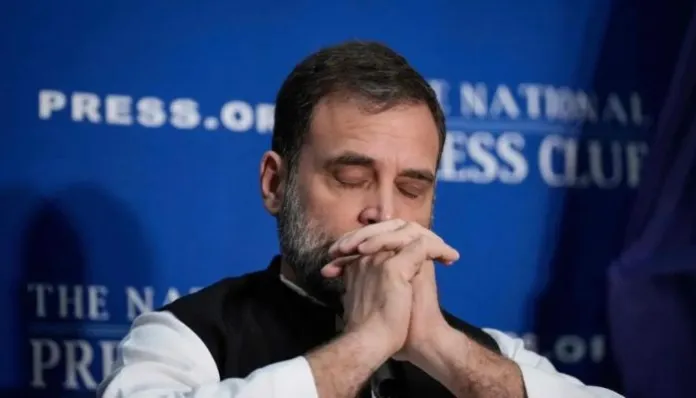
On December 26, 2025, Sam Pitroda, a long-time adviser and ideological anchor of the Gandhi ecosystem, publicly acknowledged what many had already inferred. Rahul Gandhi did not miss Parliament due to unavoidable circumstances. He skipped it deliberately to attend a meeting of the Progressive Alliance in Germany. This disclosure, made in an interview with India Today, was meant to normalise the absence. Instead, it amplified criticism.
The winter session of Parliament ran from December 1 to December 19, 2025. The Progressive Alliance Presidium meeting in Berlin took place on December 19, the final day of the session. Rahul Gandhi, an elected Member of Parliament and the Leader of Opposition of the principal opposition party, chose to be absent during crucial legislative deliberations. The justification offered was that the international conference had been scheduled months in advance and that the Indian National Congress is a member of the Progressive Alliance.
What Pitroda framed as a matter of organisational obligation, many see as a telling political choice. When faced with a conflict between parliamentary responsibility and ideological networking abroad, Rahul Gandhi chose the latter. This was not a one-off scheduling clash. It fits a broader pattern where domestic accountability takes a back seat to international ideological positioning.
The progressive alliance and Rahul Gandhi’s elevated role
The Progressive Alliance is not a benign discussion forum. Founded on May 22, 2013, in Leipzig, Germany, it is an international network of progressive, social-democratic, socialist, and labour parties. Headquartered in Berlin, it was formed as an alternative to the Socialist International, largely because several major parties felt the latter had become too tolerant of undemocratic regimes.
Today, the Progressive Alliance claims 119 political parties from 97 countries as members, along with 30 left-liberal organisations. From India, the Indian National Congress and the Samajwadi Party are members. Rahul Gandhi is not a peripheral participant. According to the organisation’s website, he is a member of the Presidium, representing the Asian region.
The Presidium is the Alliance’s highest decision-making body, with representation divided across continents. Rahul Gandhi is one of only two Asian representatives. Yet, curiously, while photographs of all other Presidium members are displayed on the official website, Rahul Gandhi’s image is absent. His name appears, but without visual prominence. This anomaly has raised eyebrows, though it has not been explained by either the Congress party or the Alliance.
Beyond Rahul Gandhi, two Congress leaders hold positions on the Alliance’s board, Sam Pitroda himself and Jothimani Sennimalai. This level of institutional embedding suggests not a casual association, but deep ideological alignment.
A pattern of global activism
The Berlin visit was not an isolated international engagement. In October 2024, Rahul Gandhi attended another Progressive Alliance event in Santiago, Chile. That meeting brought together international political leaders to “cooperate in the fight against democratic backsliding and rising global uncertainties.” The language used by the Alliance is revealing. Democratic backsliding is often defined by these networks through a distinctly ideological lens, frequently targeting governments that prioritise nationalism, cultural sovereignty, or strong executive leadership.
In April 2025, the Congress party went a step further by co-hosting an international Progressive Alliance conference in Hyderabad. Senior Congress leaders attended the two-day event, signalling that the party was not merely participating in the Alliance but actively promoting its agenda on Indian soil.
Taken together, these events indicate a sustained engagement with a global ideological ecosystem that positions itself explicitly against nationalist governments. Rahul Gandhi’s repeated presence at these forums, even at the cost of parliamentary participation, underscores where his political energies are increasingly invested.
The Progressive Alliance makes no secret of its ideological mission. Its guiding principles state that it takes political arms against what it calls “dangerous new authoritarianism and increasing right-wing populism.” It accuses right-wing politics of pursuing division, fuelling hate and fear, and promoting marginalisation and isolation.
This framing is not neutral. It mirrors a broader global narrative that equates nationalism with authoritarianism and cultural assertion with democratic decay. In this worldview, governments that emphasise national identity, border security, or civilisational continuity are cast as threats to pluralism.
Rahul Gandhi’s alignment with this framework is not merely coincidence. It increasingly reflects in his domestic political messaging, where India is often portrayed as sliding into authoritarianism, democratic institutions are described as hollowed out, and electoral victories of his opponents are questioned in legitimacy rather than contested politically.
On the same ideological page as George Soros
One of the most controversial aspects of the Progressive Alliance is how closely its ideological posture aligns with that of billionaire financier George Soros and his Open Society Foundation. Soros has consistently framed nationalism and populism as existential threats to democracy. He has openly criticised governments led by Narendra Modi in India, Viktor Orban in Hungary, and Donald Trump in the United States.
In a 2020 speech at the World Economic Forum in Davos, Soros described India under Modi as the “biggest and most frightening setback” to open societies, citing Kashmir and citizenship policies. In 2023, ahead of the Munich Security Conference, he went further, linking the Adani Group’s market troubles, triggered by allegations later widely questioned, to potential political consequences for Modi. He suggested that these events could weaken the prime minister and lead to a “democratic revival.”
Sam Pitroda, while confirming Rahul Gandhi’s presence at the Berlin event, casually dismissed concerns about Rahul Gandhi meeting Cornelia Woll, a figure linked to Soros-associated networks. His statement that he did not care about such links only reinforced perceptions that the Congress leadership sees no issue in engaging with global actors openly hostile to India’s elected government.
The Progressive Alliance’s ideological hostility towards nationalist governments aligns seamlessly with Soros’s worldview. That alignment raises a fundamental question: when Rahul Gandhi participates in these forums, is he representing Indian democratic opposition or endorsing a global campaign to delegitimise India’s political choices?
Shaping policy positions
Supporters of Rahul Gandhi often argue that international engagement is a hallmark of global leadership. However, the issue is not engagement but influence. The Progressive Alliance is not a powerless debating club. Its membership includes some of the most electorally powerful parties in the world, including the Democratic Party of the United States, the UK Labour Party, Germany’s Social Democratic Party, France’s Socialist Party, and Spain’s Socialist Workers’ Party.
These parties have governed, or continue to govern, major economies. The Alliance maintains close relationships with trade unions, NGOs, and policy institutions. When its member parties assume power, policies often reflect shared ideological commitments on climate, economic redistribution, identity politics, and governance.
In India, several Congress party positions post-2013 coincide strikingly with its association with the Progressive Alliance. The Congress became a member the same year the Alliance was founded. Subsequently, the party emerged as a vocal critic of Electronic Voting Machines, despite having introduced and used EVMs extensively during its own tenure in government.
Similarly, the Congress’s renewed tilt towards aggressive socialism, expanded state control, and scepticism towards economic liberalisation mirrors the ideological preferences of the Alliance. These shifts are presented domestically as organic policy evolution, but their timing suggests external ideological reinforcement.
Leader of Propaganda, not parliamentary opposition
Rahul Gandhi has become the Leader of Propaganda, a politician who appears more comfortable addressing international audiences critical of India than engaging constructively within its democratic institutions.
Skipping Parliament to attend ideological conclaves abroad feeds this narrative. Parliament is where opposition leaders test the government through debate, scrutiny, and legislative challenge. By absenting himself, Rahul Gandhi weakens the institutional opposition while amplifying his voice in global forums that often echo a one-sided portrayal of India.
This approach may earn applause in Berlin or Santiago, but it raises serious concerns about democratic responsibility. An opposition leader’s primary accountability is to the electorate and the legislature, not to transnational ideological networks.
At its core, the controversy is not about the Progressive Alliance alone. It is about political priorities. Rahul Gandhi had a choice on December 19, 2025. He could have been in Parliament, representing his constituents and his party during a crucial session. Or he could attend an international meeting that aligns ideologically with his worldview but has no direct democratic mandate from Indian voters.
He chose Berlin.
For many, that choice symbolises a deeper problem. Rahul Gandhi increasingly appears invested in shaping narratives about India for global consumption, often critical, often alarmist, while disengaging from the hard, unglamorous work of parliamentary politics. This strategy may suit an activist or an international campaigner. It sits uneasily with the role of a national opposition leader.
As India approaches another decisive electoral cycle, voters will likely judge not just speeches or slogans, but actions. Skipping Parliament for ideological networking abroad sends a message. Whether that message resonates as leadership or propaganda remains for the electorate to decide.