

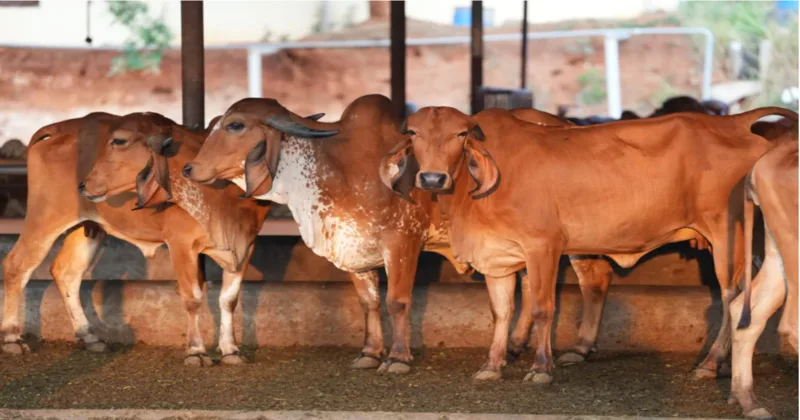
Desi Cows are mentioned several times in the Vedas, the oldest and most revered texts in Hindu Dharma. Cows are referred to as “Aghnya,” which means “not to be killed,” in the Rigveda, one of the four Vedas. This emphasises how sacred cows were and how much ancient Hindus revered them. Desi Cows are praised in the Rigveda for their milk, which is utilised in Dharmic rites and given to the gods as “ghee,” utilised in Dharmic rites like “yajnas”, which are thought to guarantee society’s well-being. The cow is also mentioned as a symbol of wealth in the Atharvaveda. This Veda asserts that the prosperity of a home or society is intimately correlated with the health and quantity of Desi cows. As a result, individuals were urged to care for cows, as it was believed that doing so would bring prosperity, health, and happiness to the family.
Desi Cow is a divine gift bestowed by Mother Nature
For ages, Desi Gau Mata has worked for human well-being. A while back, the Allahabad High Court’s Justice issued a significant ruling stating that cows play a significant role in Bharatiya culture. Bharatiya writings, including the Puranas, emphasise the value of cows in great detail. Bharatiya leaders and kings from various regions have long discussed the protection of cows. The Bharatiya Constitution’s Article 48 also addresses the protection of the cow breed and the prohibition of cow slaughter. Many Bharatiya states forbid the killing of cows.
The majority of breeds produce very little milk. Over the ages, most were designed specifically for labour-intensive tasks on farms. Only four or five breeds provide a healthy amount of milk. We are to blame if we accuse other dairy breeds of producing less milk. Historically, milk was not a commercially viable product. It wasn’t even required. Each farmer owned between 10 and 20 animals. His family could drink even a sufficient amount of milk from five or six of the herd’s cows. For centuries, people from all over the world have been drawn to Bharat because of its incredible range of Desi cow breeds. Bharatiya varieties such as Ongole and Gir account for 98 per cent of Brazil’s cattle population. To develop resistance to foot-and-mouth disease, Britain has utilised genes from the Bharatiya breed Hallikar. To survive in Bharat’s vibrant landscapes, lush beaches, and desert plateaus, Desi cows have adapted over generations to the nation’s climate. Their genetic makeup enables them to endure high temperatures, resist local diseases, and thrive on native foods. Unlike imported breeds such as Jersey and Holstein, Desi breeds have naturally robust immune systems and require fewer medical interventions.
People were misled into believing that milk from foreign-bred cows was more nutrient-dense and of higher quality than that from Bharatiya cows, as globalisation and commercialisation rose. As a result, the number of people purchasing and consuming milk from Desi cow farms sharply decreased. Unfortunately, this resulted in the extinction of more than 120 Indigenous cattle breeds, leaving only 30. Because of this, it is even more crucial that we safeguard our Indigenous Bharatiya cows, also known as “Desi cows.”
The quality of milk produced by our native cows is one of the most important aspects of their protection. Compared with mixed-breed cows from other countries, nutritionists and medical professionals believe that native Bharatiya breeds, such as the Hallikar and Gir, produce higher-quality milk. This is due to the A2 protein found in native cow’s milk, which helps prevent heart disease and mitigates lactose intolerance.
The majority of homes drink milk from cows raised abroad. Both A1 and A2 proteins are present in this milk. The main cause of lactose intolerance and dyspepsia in many foreign-bred cows is the presence of A1 protein. A2 milk from Bharatiya cows, on the other hand, is suitable for everyone because it does not differ in composition. Therefore, switching to A2 milk from authentic Desi cow farms is advised.
Hindu Dharma has religious beliefs about cows. whereby the Gau Mata is revered. In addition to Dharmic convictions, it is a highly significant organism from a scientific perspective. When seen from the side, a variety of qualities that aid in the battle against various illnesses have been discovered in everything from cow manure to its milk. In Hindu Dharma, the sacred cow is equally significant.
The opinions of scientists worldwide regarding Bharatiya Gau Mata
Unquestionably, cows have never been viewed as animals in Bharat; instead, they are regarded as the mother of both the universe and humanity. She has been valued for spiritual, cultural, social, economic, religious, and therapeutic purposes since the Vedic era. Strengthening the economic value of indigenous cattle is a major challenge at present. Scientific studies have demonstrated that the three primary doshas (Vata, Pitta, and Kapha) in humans are eliminated by the five principal compounds derived from cows, known as Panchagavya: milk, curd, ghee, urine, and cow dung.
The Cow is the only ruminant with a large intestine that is 180 feet long. Its speciality is that the meal it eats causes the milk to contain the pigment carotene. When it enters the human body, it prepares vitamin A, which is necessary for eyesight. The National Cancer Institute of America estimates that consuming milk from Jersey breed cows increases the risk of cancer by thirty per cent. In contrast, the Desi cow does not pose this risk. According to German scientist Rudolf Steiner, the horn of the Desi Gaumata gets cosmic power. Dr Kafod Hamilton of the UK claims that the usage of cow urine can cure heart disease. After a few days of drinking cow urine, the arterial blood pressure returns to normal. The best remedy for long-term skin conditions is cow urine. Dr Julius, a German agricultural scientist, stated that only the Desi cow is such a holy creature in the world that releases oxygen in its breath, according to the book’s research. Ronald Gow Wright of Cornell University claims that the component found in cow’s milk aids in brain development and memory. The MDGI protein prevents cancer from penetrating blood cells.
Which culture ought to be embraced in order to save Desi cows?
Kenneth R. Valpey’s latest book, “Cow Care in Hindu Animal Ethics,” which is part of the Palgrave Macmillan animal ethics series, examines the development of Indian cow culture and its implications for modern Bharatiya and global society. Three Hindu paradigms—dharma, yoga, and bhakti—are the foundation of Valpey’s animal ethics model. Although the Hindu faith offers instruction on proper animal care, Valpey acknowledges—as Gandhi did—that this guidance is not exclusive to Hindus or particularly associated with particular castes in Bharat. Similar to the deontic and consequentialist normative ethics promoted by Western thinkers, dharma contributes a duty towards all living beings. Bhakti imposes a duty on human beings that stems from respect for the heavenly Krishna, the unassuming cowherd who devotedly and carefully cared for animals, especially his cattle. Yoga is the unifying practice that promotes self-cultivation toward spiritual freedom and affirms the equality of all beings.
The importance of skilled cow caretakers has been recognised since the writing of the Bhagavad Gita. This prevents cows from being betrayed by their caregivers and, ultimately, from becoming commodities, according to Valpey. Increasing people’s understanding of ethically sensitive subjects improves their ability to recognise animal emotions and show empathy. Schools and universities recognise the importance of training, particularly for farmers, much as Gandhi did. The training must acknowledge the need to significantly alter human-environment interactions and be based on organic farming practices. It will help create a culture of reverence for Desi cows, which will discourage illegal activities that breach this respect, such as the common habit of transporting cattle from India to other countries for slaughter. Followers of the cow care concept should be characterised by a culture of regard for all living things and a modest knowledge that all life is tied to a divine being—represented by Krishna, the playful cow caretaker.