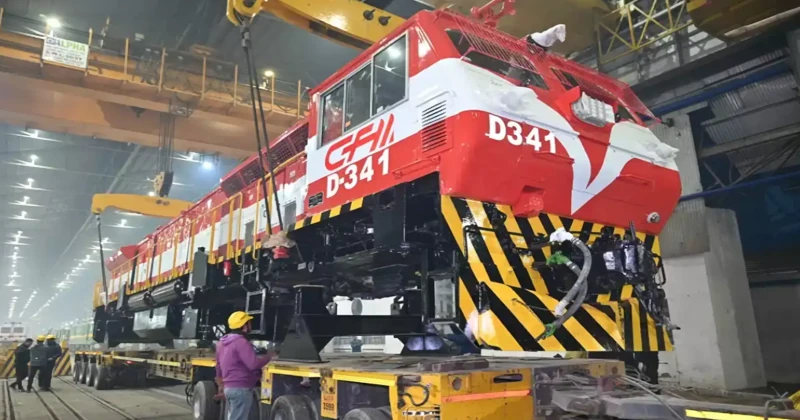
NEW DELHI: The dispatch of the sixth 3300 Horse Power AC–AC diesel electric locomotive from BLW to Mozambique on December 15, 2025, was a part of an ongoing export contract. BLW is supplying ten locomotives to Mozambique under an agreement executed through RITES, six have been delivered between June and December 2025. This timely delivery of engine schedule reflects the commitment towards contractual timelines and production planning within an existing manufacturing framework.
BLW (Banaras Locomotive Works), earlier known as Diesel Locomotive Works, functions as a production unit of Indian Railways. For several decade,s its primary responsibility was to meet domestic locomotive requirements. Afters 2014, BLW role gradually expanded to international orders by executing alongside domestic production. This change did not involve structural reorganisation but across sector framework.
Official records indicate that after 2014, BLW supplied locomotives to countries including Sri Lanka, Myanmar and Mozambique. These exports were routed through RITES, the public-sector agency for overseas railway projects. The Mozambique contract follows this established mechanism and reflects continuity in India’s approach to railway exports rather than a change in direction
🔹 Banaras Locomotive Works (BLW) Dispatches 6th Indigenously Manufactured 3300 HP Locomotive to #Mozambique
🔹 BLW’s 3300 HP Locomotives with International-Standard, Driver-Friendly Features Operate at Speed Up to 100 kmph
🔹 Since 2014, BLW has exported locomotives to… pic.twitter.com/Zc57XflCAs
— PIB India (@PIB_India) December 16, 2025
The current export locomotives are designed for Cape Gauge (1067 mm) tracks, specification not used on Indian Railways. This indicates BLW’s capacity to manufacture locomotives compatible with international standards and non-domestic operating conditions. The design adaptation does not involve changes in the locomotive’s fundamental traction class or power rating but aligns with the requirements specified by the importing country.
Manufacturing Framework and Export of the Locomotives
The locomotives being supplied to Mozambique are 3300 HP units with AC–AC traction and a maximum operating speed of 100 kmph. These parameters are consistent across all units supplied under the contract. The locomotives include basic crew-oriented facilities such as a refrigerator and hot plate, features incorporated as part of the export configuration
These features do not represent a shift in locomotive performance standards but reflect operational requirements communicated by the buyer. Their inclusion indicates BLW’s ability to integrate customer-specific inputs within standard production processes.
The export of locomotives has been manufactured within existing production facilities. There is no indication of a separate export-exclusive production line or outsourced assembly. This suggests that international orders are being accommodated within BLW regular production planning alongside the requirements of Indian Railways.
The institutional capacity of BLW to handle such a parallel commitment is its long-time experience in locomotive manufacturing. The Mozambique order has been executed over several months, showing the phased production rather than batch diversion from domestic supply.
Swadeshi Manufacturing in Practice
The locomotives exported from BLW are designed, assembled and tested in India. All core manufacturing processes are carried out domestically. The localisation percentages, BLW’s classification as a fully integrated production unit of Indian Railways implies dependence on domestic manufacturing systems and vendor networks.
Swadeshi manufacturing is reflected through execution rather than scale claims. The export programme does not involve relocation of production abroad, but rely on imported with fully built units. Export earnings therefore accrue directly within the Indian railway manufacturing ecosystem.
Role of RITES in Export Execution
RITES acts as the contracting and project-execution agency for BLW’s international locomotive exports. This institutional arrangement has been used consistently after 2014 and provides a structured interface between Indian production units and overseas buyers.
Through RITES the export contracts include financing, logistics and compliance mechanisms without requiring BLW to be distracted from its manufacturing functions. Deliveries for Mozambique follow this model, underlining the function of public-sector coordination in Indian railway export strategy.
Strategic context of railway export
Locomotives are long-life assets, commonly serving for many years if not decades. Such exports, means a long-term technical involvement between the supplier and the operator.
From an Indian perspective, BLW’s exports after 2014 demonstrate how public-sector manufacturing units can participate in international markets without diluting their domestic responsibilities. The Mozambique contract was executed in phases, which suggests that export activity has been balanced with existing production commitments.
The post-2014 export activity of BLW represents consolidation rather than rapid expansion. The unit has continued to supply locomotives to select countries through established institutional channels. The Mozambique order fits into this pattern as a continuation of earlier engagements rather than a departure from them.
In the absence of sudden capacity building or product design changes, it appears that export readiness of BLW has been developed over time in a gradual manner. This reduces operational risk and sustain stability of production.
This order to supply 3,300 HP diesel-electric locomotives to Mozambique is a part of the continuous involvement of BLW in international railway manufacturing since 2014. The contract was awarded through and executed in phases by RITES, thus establishing production consistency, design adaptability and institutional continuity. Without invoking any new claims or expanded metrics, BLW’s export record encapsulates steady capability consolidation within Indian public-sector manufacturing framework. Swadeshi manufacturing is reflected not through documentation but through controlled execution, domestic production and adherence to documented commitments.